


| Newspaper Articles |

|
Newspaper Articles |
 |
 |
15th November 1941, Page: 149, Column: 1
Mining Geology
[Contributed.]
Correlation of Coal Seams.
The methods by which coal seams may be identified, and their occurrence in different parts of a coalfield correlated with each other, have not until recently been characterised by precision in the results obtained by their use. The uncertainty that arises in the use of the earlier methods is due mainly to the fact that in any coalfield a cross-section of a considerable part of it will show that the thickness of the seams varies from one proving to another, that seams split and reunite, that they are separated by varying thicknesses of rock, and that faults occur in different parts of the coalfield. The earlier methods of correlating seams were based on the thickness and depth of the seams together with the order of succession of the beds of other rocks associated with them, and accurate correlations were made in that way, only when the exposures of the seams were not far apart.
Having found a seam of a certain thickness in a new boring, or shaft, at a certain depth, it was always possible to obtain information regarding seams being exploited in collieries near to the new exposure. It was only necessary to determine the respective levels of the tops of the shafts, or borings, the depths to the seams, the dip of the measures in the direction of the line joining the exposures, to correlate the newly-discovered seam to one of the seams already being worked. The thickness of the newly-discovered seam would obviously be an important item in the considerations leading to identification, but that would of course become of little value in the event of the splitting, or cessation, of the seams being worked. In that connection it must always be remembered that seams do split and washouts occur. Nevertheless, it is a fact that, as between one colliery and another not very far away from it, correlation of seams was not really difficult, and was therefore reasonably accurate. It was only when the exposures of seams were far apart in a faulted field that real difficulty was experienced in the identification of newly proved seams, and on coming to any conclusion regarding the identity of a seam due consideration was always given to the rocks found in association with it.
Lithological Evidence.
The character of a rock expressed in terms of its mineral composition, its structure, the grain-size and the arrangement of its component parts, admits of the rock being used as a horizon from which measurements may be made with the view of verifying the accuracy with which a seam may be identified on other grounds. These factors define the lithological character of rocks, sometimes with such distinction that little, if any, doubt remains as to the position of a coal seam in the coal measures, notwithstanding the fact that prominent beds are seldom continuous over large areas in a coalfield.
In the Wigan coalfield, for example, the middle coal measures have come to be regarded as consisting of the Ince, Pemberton, and Wigan mines, together with others occurring below the last-named mines, and these are separated from each other by rocks whose lithological characters enable them to be identified without difficulty. The Ince mines are separated from the Pemberton mines by the Pemberton rock, the Pemberton mines from the Wigan mines by Ravenhead rock, the Wigan 6-feet seam is overlain by the Trencherbone rock, and the last-named seam is separated from the next lower one (the King Mine) by the Cannel rock. The Pemberton and Ravenhead rocks occupy the positions of considerable barren zones in the coal measures, and being readily identified serve to enable the positions of the Ince, Pemberton, and Wigan groups of seams to be located, in spite of the fact that these barren rocks are not continuous over the whole coalfield, and where they exist are not of uniform thickness.
When a borehole has been put down to prove a coalfield, or when a shaft has been sunk to enable seams of coal to be worked, it offers an opportunity to the mining engineer to plot a section of the strata passed through to such a scale that the section can be mounted on rollers, and extended when it is desired to make a comparison of the succession of strata with a partial succession which has been obtained at a new exposure of a coal seam. If the several beds of sandstone, shale, limestone, ironstone, coal, and fireclay, are drawn to scale and distinctively coloured, the partial section including the seam to be identified can be placed against the shaft, or borehole, section and adjusted to the position in which the closest lithological resemblance is obtained. Such partial exposures are found in driving tunnels between seams and in boring for coal from a seam already being worked, or from a drift driven through a fault in search of proof. Prominent limestone beds are sometimes used for the purpose of correlating coal seams.
Use of Fossils.
The lithological succession exhibited in borings and sinkings is important as a means of identifying coal seams, especially when sections are plotted in a conventional manner to mark the individuality of the beds, but correlation is enormously strengthened when the marine bands and mussel beds are fitted into the succession. The marine band of the Lower Coal Measures in Lancashire, taken in conjunction with the Carbonicola bed a few yards lower in the series, is useful as an index from which the position of other beds in the lower measures can be determined, and on occasion it may also be used as a horizon to which the lower beds of the Middle Coal Measures may be related. The correlation of the middle measures is now firmly established on the basis of the fresh-water fauna contained in them. As might have been expected, the original zonal scheme initiated by Davis and Trueman in South Wales Was found to need modification when applied to the Lancashire coalfield from which one of the zones (Similis) is missing. As applied to Lancashire the scheme becomes :—
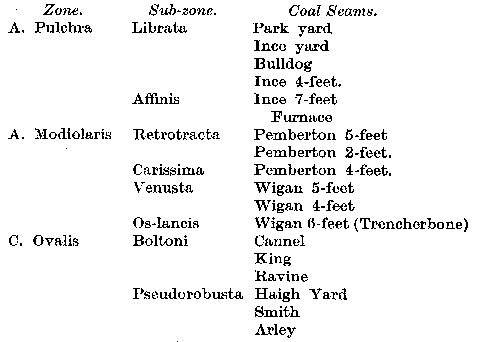
Marine bands where they occur serve as additional means of correlating coal seams, especially when they occur in the coal measures. Green's marine band and Skipsey's marine band are distinctive enough, but they occur too high in the carboniferous series to be of much use in correlation. On the other hand the Bullion bed of the Lower Coal Measures in Lancashire and the Burdiehouse, or Queensferry, Limestone in the Lothians, can be of use since they occur near the bases Of the series to which they belong.
Evidence of Spore Content.
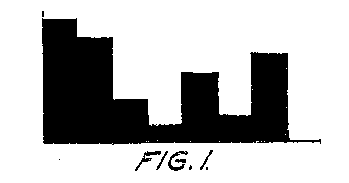
Examination of coal in thin sections under the microscope shows that much of the coal substance consists of the spores of the plants from which the coal had its origin. A spore which gives rise to a male reproductive cell is called a microspore and one that gives rise to a female cell is called a megaspore. In general it is correct to say that these bodies were spherical, but as they now appear in coal a vertical section shows them to be elongated bodies, whereas a horizontal section shows them to approach the circular form. They doubtless differed in size and shape, and were distinguished by the spines, tubercles, and irregular outgrowths which gave them characteristic appearances. The outer wall, or exine, of these bodies may be isolated from the coal and those of certain types may be counted in the field of view of the microscope, and if a representative sample of the coal in a seam be taken and ground fine enough to enable the exines to be isolated, the numbers of typical exines may be counted on a spore diagram drawn. The heights of the various sections of the diagram (see Figure 1) are in proportion to the numbers of spores identified as belonging to seven recognisable types.
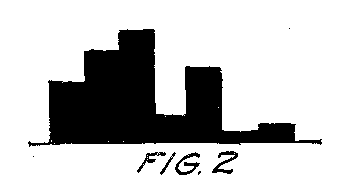
If one diagram representing the coal from a mine already working is placed beside the diagram of a newly discovered seam, and they appear alike when the exines are taken in the same order, it may be assumed that the diagrams belong to the same seam of coal, but if the diagram (Figure 2) differs greatly from that of the known seam it may be assumed that they belong to different seams. As Dr. North has written : "The use of spores in correlation lies not so much in the identification of the particular kinds that are present, as in determining their distribution throughout the thickness of a seam."
 |
 |
| Names mentioned in this article | |
 |
 |
| Name | Age | Occupation | Notes |
|---|---|---|---|
| Davis, — | |||
| North, —, Dr. | |||
| Trueman, — |
 |
 |
| Related Articles | |
|
|
| Pub. Date | Article (Newspaper) |
|---|---|
| 12 Jul 1941 | Mining Geology (The Science and Art of Mining) |
| 26 Jul 1941 | Mining Geology (The Science and Art of Mining) |
| 09 Aug 1941 | Mining Geology (The Science and Art of Mining) |
| 23 Aug 1941 | Mining Geology (The Science and Art of Mining) |
| 06 Sep 1941 | Mining Geology (The Science and Art of Mining) |
| 20 Sep 1941 | Mining Geology (The Science and Art of Mining) |
| 04 Oct 1941 | Mining Geology (The Science and Art of Mining) |
| 18 Oct 1941 | Mining Geology (The Science and Art of Mining) |
| 15 Nov 1941 | Mining Geology (The Science and Art of Mining) |
| 29 Nov 1941 | Mining Geology (The Science and Art of Mining) |
| 13 Dec 1941 | Mining Geology (The Science and Art of Mining) |
| 27 Dec 1941 | Mining Geology (The Science and Art of Mining) |



 Contains public sector information licensed under the

