


| Newspaper Articles |

|
Newspaper Articles |
 |
 |
1st November 1941, Page: 136, Column: 2
Mining Geology
[Contributed.]
Organic Remains of the Carboniferous Pariod.
Minute examination of the rocks of the earth's crust shows that at the time of deposition of the various beds living organisms inhabited the waters on the earth, birds flew through the air, and plants grew on the surface of the earth. Organic remains are found in all the systems into which the rocks of the earth's crust are divided, and they belong to the two great kingdoms of plants and animals.
The vegetable kingdom which flourished so luxuriantly during Carboniferous times is divided into two sub-kingdoms: (1) Cryptogams, comprising the Cellular and Vascular species ; (2) Phanerogams, comprising Gymnosperms and Angiosperms. Sea-weeds, lichens, fungi belong to the cellular species ; ferns, mosses, and horse-tails to the vascular species ; conifers and cycads to the gymnosperms ; and grasses, palms, lilies (monocotyledons), oak and poplar (dicotyledons) to the angiosperms.
The animal kingdom is conveniently divided into the following sub-kingdoms and species :—
I. Protozoa : comprising Foraminiferae and Radiolaria.
II. Coelenterata : comprising sponges, corals, graptolites.
III. Echinodorms : comprising star-fishes, encrinites, sea urchins.
IV. Annulosa : Serpula.
V. Articulata : Crustacea, including trilobites, crabs, lobsters, etc.
VI. Mollusca: Polyzoa, Brachiopoda, Lamellibranchiata, Cephalopoda (belemnites and ammonites), etc.
VII. Vertebrata : including fishes, amphibians, reptiles, birds and mammals.
Each system of rocks in the earth's crust contains the remains of some species of plant or animal, and whilst it may be found that some members of the species are to be found in each subdivision of a system it is quite likely that a concentration of a particular form may be found to predominate in, and be typical of, a certain sub-division or zone.
Palaeontology, the study of fossils, is important to mining engineers concerned with the identification of the zones into which the Carboniferous system has been divided, and more particularly when they are concerned with the identification of particular seams of coal. That the methods by which particular seams are identified have not been completely established is suggested in a paper on "A new interpretation of the Pollington Boring," by W. Edwards, J. J. Walker, and A. M. Wandless. In this paper it is suggested that the correlation of seams arrived at on completion of the boring is now capable of another interpretation based on the evidence of a recent development of geological science in which the spore content of coals is an important factor, taken together with geological and chemical evidence.
Substantial and far-reaching contributions have in recent years been made to the knowledge of Carboniferous Palaeontology by Prof. Trueman, Mr. J. H. Davies, Miss E. Dix, and others.
Marine Bands.
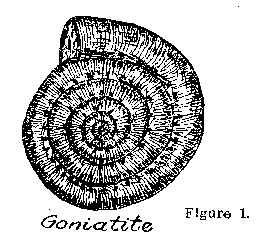
At different periods in the deposition of the Coal Measures the sea made incursions into the Carboniferous swamp and interrupted the normal sedimentation in the Coal Measure basins. Proof of these incursions is found in the occurrence, in the Coal Measures and in the underlying Millstone Grit, of marine bands. As zonal indices the Goniatitos of the marine bands possess the great advantage of distinctive form, which leads to the identification of the horizons on which they occur, especially when their relationship to the enveloping measures has been established. "The Scarcity of the bands in the Coal Measures is perhaps their chief virtue, for they are separated by such thicknesses of strata that they are extremely useful as index-horizons not likely to be confused with each other. Had they been more closely crowded they would have been a source of much confusion." (Edwards in Coalfield Geology). Although certain goniatites are indistinguishable from each other in tho different marine bands, the other marine fossils with which they are associated are so peculiarly distinctive that error in fixing horizons is unlikely. Figure 1 indicates the form of the goniatites found in marine bands.
Non-marine Fossils.
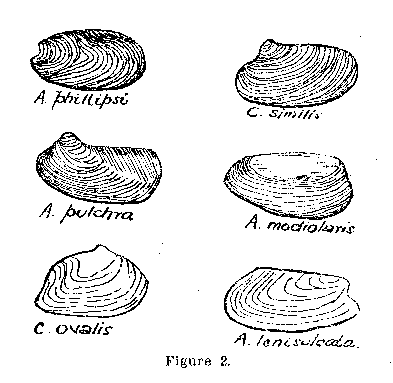
The usefulness of marine fossils is greatly enhanced by their association with the non-marine, or freshwater, mussel bands which occur in the Coal Measures. The mussel shells are familiar to students of coal-measures geology because of the abundance of specimens found in the shalss overlying coal seams. The shells are believed to have lived in fresh or brackish water where they found such a suitable environment that they persisted with modifications of form throughout the greater portion of the Coal Measures strata. The slight changes in form and dimensions that were developed did not prove at first to admit of the beds in which they occurred being distinguished by them, but a special technique has now been developed to enable the variants of the species to be measured, classified, and tabulated. By using ratios of height, length and thickness, frequency diagrams have been constructed with the object of showing that each species has its characteristic diagram. On that basis the Coal Measures have been divided into a number of zones based on characteristic fresh-water shells, as follows in descending order :—
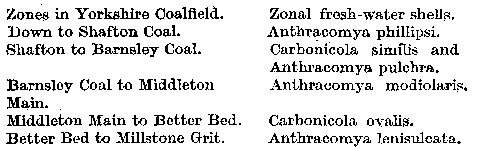
Figure 2 shows a few forms of these shells.
Plant Remains.
Plants have been used in the correlation of seams but they are only really useful in broad grouping. On the basis of plant fossils the Coal Measures are grouped into the Radstockian, Staffordian, Yorkian, and Lanarkian series.
The upper coal measures of South Wales represent part of the Radstockian group, but unlike South Wales the Midlands and North Wales have no seams in that group. The Staffordian comprises the Pennant Series of South Wales and the Southern Coalfields, with coal seams, together with part of the lower coal series. The Yorkian group comprises part of the lower coal series of South Wales with steam coal seams, and it includes the bulk of the coal seams in North Wales and the Midlands. The Lanarkian is well developed in Scotland and certain workable seams of coal.
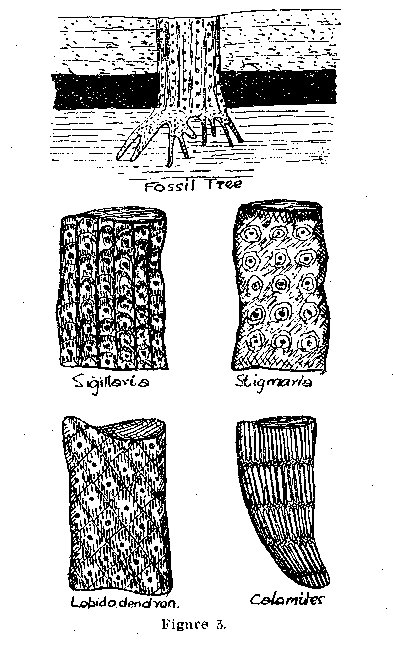
Figure 3 shows but a few of the fossil plants found in the Coal Measures, and the first of these is a fossil tree, which is seen to have its roots in the clay immediately under a seam of coal, the trunk passing up through the coal seam into the rocks above.
The remains of sigillaria are often found in coal and impressions of the bark are fairly common in associated shale. The plants sometimes grew to a height of 50 feet, and a diameter of 4 feet. They are easily recognised by the symmetrically scarred impressions of the bark. Stems of the plant are occasionally found rising up through coal seams into the shales above, and then it is seen that the thin film of coal formed by the bark forms a line of weakness, as a result of which parts of the stem, called pot bottoms, are liable to fall out without warning. In lifting the fireclay floor of a coal seam it is not uncommon to come across stigmarian roots in great abundance, many being well formed and distinctively marked.
Lepidodendron is another ancient representative of the present-day club mosses which is of common occurrence in the coal measures. The scars are well marked. Seed cones are often found well preserved in the overlying shales. The figure shows the characteristic marking of L. Obovatum.
Calamites flourished during carboniferous times and their jointed and striated stems are found in abundance in many of the coal measure shales. These plants are closely related to the horse-tails of our time.
Ferns are found in great profusion in the shales of the coal measures, and among them Neuropteris, Pecopteris, and Sphenopteris are common. Although their graceful forms are very pleasing to the eye they are really of little use as indices of geological horizons.
 |
 |
| Names mentioned in this article | |
 |
 |
| Name | Age | Occupation | Notes |
|---|---|---|---|
| Davies, J. H. | |||
| Dix, E., Miss | |||
| Edwards, W. | |||
| Trueman, —, Prof. | |||
| Walker, J. J. | |||
| Wandless, A. M. |




 Contains public sector information licensed under the

