


| Newspaper Articles |

|
Newspaper Articles |
 |
 |
4th October 1941, Page: 102, Column: 1
Limits Of Inflammability
A critical review of the question of Limits of Inflammability of Gases and Vapours* is presented in Bulletin 279 of the U.S. Bureau of Mines, prepared by H. F. Coward and G. W. Jones. The text approximates 150 pages and the illustrations number 44. Extracts are appended.
Definitions.
An inflammable mixture of gases, such as methane and air, may be diluted with one of its constituents or with other gases until it is no longer inflammable. The dilution limit of inflammability, or simply the limit of inflammability, is the border-line composition; a slight change in one direction produces an inflammable mixture, in the other direction a non-inflammable mixture.
There are clearly two limits of inflammability, a lower and a higher, for each pair of so-called combustible gases and supporters of combustion. The lower limit corresponds to the minimum amount of combustible gas and the higher or upper limit to the maximum amount of combustible gas capable of conferring inflammability on the mixture. For example, for methane-air mixtures these limits under normal conditions are approximately 5 and 14 per cent. methane, respectively. Mixtures within these limits liberate enough energy on combustion of any one layer to ignite the neighbouring layer of unburned gas and are therefore capable of self-propagation of flame ; others are not. Mixtures richer than 14 per cent. methane, however, may burn on contact with external air, as mixtures that contain less than 14 per cent. methane are formed in the zone where the gases mingle.
Source of Ignition.
When a source of heat of sufficient size and intensity is introduced into a weak mixture, some combustion occurs even when the mixture is incapable of self-propagation of flame. This is often visible as a "cap" of flame which may be large if the source of heat is ample. The flame cap may be fixed in relative position to the source of ignition, as in a miner's flame lamp burning in a gassy atmosphere, or may become detached from the source and float for a limited distance in a moving atmosphere, or may travel away 2 or 3 feet from an initiating spark or flame in a still atmosphere. Such flames are not self-propagating, as they are extinguished when the influence of the source of ignition is lost.
When a weak source of ignition is employed, some inflammable mixtures, especially those near the limits, may not inflame. The source of ignition is not strong enough to be satisfactory for the test.
As the test concerns the capability of the mixture to propagate flame, not the capacity of the source of energy to initiate flame, it is axiomatic that the limits are unaffected by variations in the nature and strength of the source of ignition. When statements are made that limits vary according to the means of ignition it is clear that the observers used such strong sources of ignition that the caps of flame gave the appearance of general inflammation or such weak sources that flame was not started in mixtures which were, in fact, inflammable. Under these conditions they were determining the limits of ignitability by the particular sources of ignition they used, not the limits of inflammability of the mixture itself.
Direction of Flame Propagation.
When a source of ignition, such as an electric spark or a flame, is introduced into an inflammable mixture, flame tends to travel away from the source in all directions. In a very large volume of mixture the form of the zone of combustion would be a spherical shell of increasing radius were it not that the hot, expanded products of combustion tend to rise and hence to introduce convection currents. Flame cannot travel downward when the upward movement of the gases, due to convection, is faster than the speed of flame in a still mixture, as happens in weak mixtures near the limits of inflammability. Hence, near each limit there is a range of mixtures that will propagate flame upward but not downward. These may correctly be termed "inflammable mixtures," as it is only necessary to ignite them near their lower confines to observe self-propagating flame travelling to the higher confines. The gentle convection current set up by the flame increases the apparent speed of flame but, as far as is known, does not enable flame to travel when in the absence of convection effects it would not be propagated. It seems correct, therefore, to observe upward propagating flames when defining the limits of inflammability of gas mixtures ; but for some purposes it is desirable to know the limits of inflammability for propagation of flame in other directions.
For safety in industrial operations it is generally wisest to consider the limits for upward propagation as the danger line, since these limits are wider than those for horizontal or downward propagation of flame.
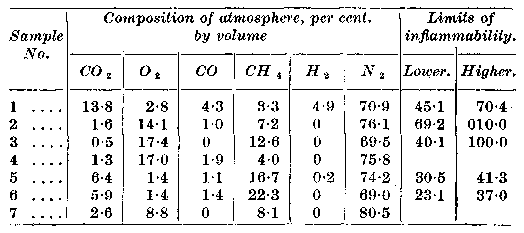
A table is presented of typical samples of mine-fire atmospheres in coal mines, samples 4 and 7 being non-inflammable, as follows:—
* Superintendent of Documents; Washington, D.C. Price 20 cents net.
 |
 |
| Names mentioned in this article | |
 |
 |
| Name | Age | Occupation | Notes |
|---|---|---|---|
| Coward, H. F. | U.S. Bureau of Mines | ||
| Jones, G. W. | U.S. Bureau of Mines |




 Contains public sector information licensed under the

