


| Newspaper Articles |

|
Newspaper Articles |
 |
 |
4th October 1941, Page: 98, Column: 1
Examination Results
Mine Surveyors' Certificates
The Central Examiner's Report on the examination for certificates of qualification as surveyors of mines, held in July, 1941, has been issued. The candidates in attendance numbered 89, and in the written examination 27 qualified Whilst in the practical examination 24 qualified, as follows :—
Glasgow Centre : James Allan, Walter Darling, George Henshilwood, Alexander John Russell, Charles Emslie Walker.
Newcastle Centre : Frederick Alfred Milsom, Charles Curwen Morris.
Doncaster Centre : Harold Wynn Bithell, Noel Marlow Carter, Arthur William Clarke, Eric Cownley, Douglas John Hartell, George Harold Jackson, Clifford Henry Johnson, Ivan Frederick Kirk, Colin Lister, Joseph Moss, Denis Turrell.
Stoke Centre : Henry Hindley.
Cardiff Centre : Joseph James Douglas Bowen, Robert Edward Chambers, William Downie, Thomas John Dyfrig Hughes, Vincent Jones Pickens.
Central Examiner's Report.
The written examination of candidates for mine surveyors' certificates was held at the various centres on 3rd July, 1941, and the oral and practical examination of candidates who obtained qualifying marks thereat was carried out during the week commencing 18th August, 1941.
The undernoted table shows the number of candidates who came forward for examination at each centre, and the number who eventually qualified for a certificate :—
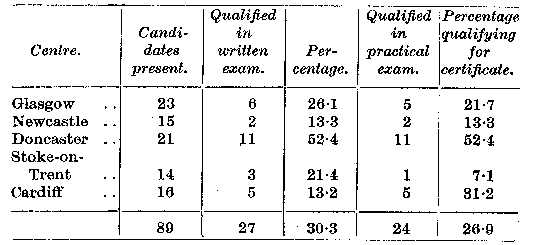
The number of candidates who presented themselves for examination was somewhat larger than it has been for several years.
The percentage of candidates who qualified for a certificate shows an increase on the corresponding figure for last year's examination, but it is rather less than for several of the examinations immediately prior thereto.
The work done in the written part of the examination can be summed up by stating that it contained a fair proportion of reasonably satisfactory answers, and a greater proportion than usual of exceedingly mediocre ones. The percentage of the former would have been considerably higher had the work done at Newcastle and Stoke-on-Trent centres been only up to the average, but, generally, candidates at these centres made a poor show.
Actually, of candidates who failed to qualify in the written examination, the average marks earned amounted to no more than 35 — a disappointing total for 6½ hours' Work.
By far the most noteworthy feature of the examination was the work done by candidates at Doncaster Centre. The large percentage of candidates who obtained qualifying marks there followed up their good work by a hundred per cent. pass in the subsequent oral and practical tests — an achievement entirely unique In the history of the examination.
The work done by candidates at Cardiff Centre — both Written and practical — was also on this occasion exceedingly good.
Oral and Practical Examination.
Reports from the examiners who conducted the oral and practical part of the examination indicate that as a general rule the work performed with the theodolite, both underground and on the surface, was satisfactory, although in some instances manipulation and reading was very slow.
There is, however, in quite a number of instances adverse criticism of the methods adopted by candidates in measuring distances.
The work done in the levelling test was also, as a rule, not unsatisfactory, criticism being confined to a lack of care in the equalisation of sights and the choice of change points. Lack of instructions to ensure verticality of the staff when readings were being taken is also another item of adverse comment.
In the office test, plotting and draughtsmanship, with one or two exceptions, was satisfactory.
Several examiners comment on the unsatisfactory answers given to questions in the oral examination on the subject of ordnance and geological maps. In one instance these answers are described as "distinctly weak."
General.
This was the first examination to be held under the new conditions recently approved by the Board whereby a candidate who receives 65 per cent. of the maximum marks in the written part of the examination and at least 50 per cent. in the subsequent oral and practical part, is entitled to go forward to the next succeeding oral and practical examination without undergoing a further written examination. A scrutiny of the marks sheets shows that on this occasion no candidate profited by this concession.
 |
 |
| Names mentioned in this article | |
 |
 |
| Name | Age | Occupation | Notes |
|---|---|---|---|
| Allan, James | Glasgow | ||
| Bithell, Harold Wynn | Doncaster | ||
| Bowen, Joseph James Douglas | Cardiff | ||
| Carter, Noel Marlow | Doncaster | ||
| Chambers, Robert Edward | Cardiff | ||
| Clarke, Arthur William | Doncaster | ||
| Cownley, Eric | Doncaster | ||
| Darling, Walter | Glasgow | ||
| Downie, William | Cardiff | ||
| Hartell, Douglas John | Doncaster | ||
| Henshilwood, George | Glasgow | ||
| Hindley, Henry | Stoke | ||
| Hughes, Thomas John Dyfrig | Cardiff | ||
| Jackson, George Harold | Doncaster | ||
| Johnson, Clifford Henry | Doncaster | ||
| Kirk, Ivan Frederick | Doncaster | ||
| Lister, Colin | Doncaster | ||
| Milsom, Frederick Alfred | Newcastle | ||
| Morris, Charles Curwen | Newcastle | ||
| Moss, Joseph | Doncaster | ||
| Pickens, Vincent Jones | Cardiff | ||
| Russell, Alexander John | Glasgow | ||
| Turrell, Denis | Doncaster | ||
| Walker, Charles Emslie | Glasgow |
 |
 |
| Related Articles | |
|
|
| Pub. Date | Article (Newspaper) |
|---|---|
| 08 Mar 1941 | Mining Examinations (The Science and Art of Mining) |
| 22 Mar 1941 | Mine Surveyors' Examinations (The Science and Art of Mining) |
| 05 Apr 1941 | Examinations For Certificates (The Science and Art of Mining) |
| 04 Oct 1941 | Examination Results, Mine Surveyors' Certificates (The Science and Art of Mining) |
| 15 Nov 1941 | Notes On Surveyors' Examination, Questions and Examiner's Comments (The Science and Art of Mining) |
| 13 Dec 1941 | Examination Results (The Science and Art of Mining) |
| 21 Feb 1942 | Notes On Managers' Examinations — I, Report of Central Examiners (The Science and Art of Mining) |
| 07 Mar 1942 | Notes On Managers' Examinations — II, Report of Central Examiners (The Science and Art of Mining) |
| 21 Mar 1942 | Notes On Managers' Examinations — III, Report of Central Examiners (The Science and Art of Mining) |
| 04 Apr 1942 | Notes On Managers' Examinations — IV (The Science and Art of Mining) |
| 18 Apr 1942 | Notes On Managers' Examinations — V, Report of Central Examiners (The Science and Art of Mining) |



 Contains public sector information licensed under the

