


| Newspaper Articles |

|
Newspaper Articles |
 |
 |
20th September 1941, Page: 81, Column: 1
Mining Geology
[Contributed.]
Coal and its Origin.
The word coal originally implied any substance which could be made use of as a fuel, and in its earliest use was added to another word as a suffix to indicate the source of the coal. Charcoal was largely used as a fuel in pre-mining times, but that term gave place to "pit cole" or "earth cole" in order to signify that the substance had been dug from pits in the earth. "Sea cole" was a term which merely denoted that the coal raised from pits or holes in the earth had been conveyed by sea from Newcastle to London. Coal is a purely popular term which includes a variety of earthy substances differing in geological age and dissimilar in their chemical and physical properties. It is often spoken of as one of the most important items of our mineral wealth, but really coal is not a mineral but a rock. It is a sedimentary rock in the sense that it was either deposited in water or was carried into the position in which it is now found by the agency of water.
In-situ and Drift Theories.
There are two theories regarding the mode of accumulation of the masses of vegetable matter which have gone to form the coal seams, and each has been held so tenaciously as to exclude all possibility of the other being the mode.
On the one hand supporters of the in-situ theory believed in the original luxurious growth of a mass of vegetation in a swamp like the Great Dismal Swamp of North America. When the vegetation had grown to immense proportions the land subsided under the waters of an inland sea, in which fresh-water forms of life were to be found, or under the waters of the sea, in which distinct marine forms of life prevailed. The wind scattered the fruits and seeds of the trees in all directions and these together with the accumulation of rotting vegetable matter became buried under the deposits of sandstone and shales which were afterwards formed from the detritus of the rivers which flowed into the subsided area. Such is the older view of the method by which the mother substance accumulated and was buried under the rocks we now find superimposed upon the coal seams.
One of the strongest arguments in favour of the "in-situ" theory of the origin of coal seams is that they can generally be seen to rest on a bed of clay, the earth in which the vegetable matter had its roots, and to be covered over by alternating beds of sandstones and shales. That evidence is accepted as conclusive proof of the growth-in-place of the vegetation, and it is supported by the fact that in whatever geological age, or in whatever part of the world, it may occur, coal is remarkably pure. Coal is generally free from such an admixture of sand or mud as would be found in vegetable matter which had been transported by the agency of water over great distances.
The "drift" theory is based on the idea that the vegetable matter which has gone to form coal was transported from the original site upon which it grew to some other place where it was deposited and buried under the deposits of sand and mud that have gone to form the roof strata. Since the laws of sedimentation would operate in the case of drifting vegetable matter it is likely that the vegetation would become mixed with sand and mud, thus leading to the accumulation of vegetable matter mixed with earthy matter. But if there should be a cessation in the supply of earthy matter there is still a possibility that the heavier mineral matter would be sorted out to leave the mass of vegetable matter comparatively free from earthy sediment, therefore pure.
The greater the thought that is given to the problem the more likely is it to be found that the theories of accumulation are complementary rather than antagonistic. During the subsidences which occurred in Carboniferous times it is conceivable that some part of the mother substance might be transported from the position in which it grew to be deposited elsewhere upon vegetable matter which had grown there and been decimated by bacterial action. The occurrence in the coal measures of current-bedded sandstones points to the possibility of existence of rivers capable of transporting vegetable matter from place to place.
Classes of Coal.
The chief constituent of coal is carbon, which is always greatly in excess of all the other constituents. The purest forms of coal are those in which elements other than carbon, hydrogen, oxygen and nitrogen, are present only in small proportions. One of the commonest impurities is sulphur, which is usually present in the volatile matter and in the ash, and is derived chiefly from the bi-sulphide of iron called iron pyrites. Coals containing a high percentage of sulphur are generally unsuitable for commercial and metallurgical purposes, and are liable to spontaneous combustion in the mine and in storage. Phosphorus and arsenic occur in some coals, and when these elements occur in considerable proportions the coals are rendered unsuitable for metallurgical purposes. The ash of coal contains alumina, silica, lime, magnesia, together with small proportions of other oxides, and the proportions of the constituents determine the melting point of it, an important feature of coal used for generating steam in boilers.
Coal may be regarded as consisting of carbon, ash, combustible volatile matter, and moisture, and these constituents are usually reported in a proximate analysis, but for a proper classification of coals it is generally necessary that the proportions of carbon hydrogen, oxygen and nitrogen, should be known.
It is customary to regard anthracite as the purest form of coal, because of the high percentage of carbon in it. Bituminous coals are less pure, but they nevertheless constitute an important class of coals having a great variety of uses. Lignite and brown coals are not of high quality, and have compositions which place them but slightly above the rank of peat in the scale of carbonisation or metamorphosis of the original vegetable matter.
The following is a simple general classification of coals according to the increasing percentage of carbon :—
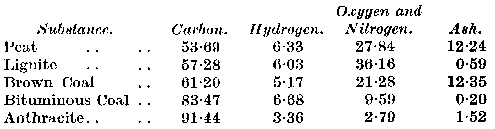
It is seen that the ratio of C to H increases from 8.48, 9.53, 11.85, 12.50, to 27.2, and that may be taken to mean that not only does the percentage of carbon increase from peat to anthracite, but the calorific value of the fuel also increases as the metamorphosis of the mother substance becomes more complete. The bases of classification of coal by rank are the carbon content and the calorific value, therefore the above table may be regarded as one in which the various classes of coal are arranged according to increasing rank.
The more deeply buried coals would be subject to higher pressures and temperatures and consequently they would be expected to be more completely metamorphosed than those nearer the surface, at least that was the result obtained from the researches of Hilt into the coals of the Pas-de-Calais coalfield. "In a vertical succession of coal seams the rank increases with depth" is commonly regarded as Hilt's law, and experience and research show that it is substantially true, notwithstanding the exceptions found in South Wales by Strahan and Pollard.
 |
 |
| Names mentioned in this article | |
 |
 |
| Name | Age | Occupation | Notes |
|---|---|---|---|
| Hilt, — | |||
| Pollard, — | |||
| Strahan, — |
 |
 |
| Related Articles | |
|
|
| Pub. Date | Article (Newspaper) |
|---|---|
| 12 Jul 1941 | Mining Geology (The Science and Art of Mining) |
| 26 Jul 1941 | Mining Geology (The Science and Art of Mining) |
| 09 Aug 1941 | Mining Geology (The Science and Art of Mining) |
| 23 Aug 1941 | Mining Geology (The Science and Art of Mining) |
| 06 Sep 1941 | Mining Geology (The Science and Art of Mining) |
| 20 Sep 1941 | Mining Geology (The Science and Art of Mining) |
| 04 Oct 1941 | Mining Geology (The Science and Art of Mining) |
| 18 Oct 1941 | Mining Geology (The Science and Art of Mining) |
| 15 Nov 1941 | Mining Geology (The Science and Art of Mining) |
| 29 Nov 1941 | Mining Geology (The Science and Art of Mining) |
| 13 Dec 1941 | Mining Geology (The Science and Art of Mining) |
| 27 Dec 1941 | Mining Geology (The Science and Art of Mining) |



 Contains public sector information licensed under the

