


| Newspaper Articles |

|
Newspaper Articles |
 |
 |
6th September 1941, Page: 75, Column: 1
Results Of Shot-Firing Experiments
One of the papers prepared for the 5th International Conference of Directors of Mine Safety Research was "An Experimental Study of the Ignition of Firedamp-Air Mixtures by Explosives." It was handed in by Etienne Audibert, Director of the Station d'Essais, Comite Central des Houilleres, Senlis, Prance. Conditions led to the postponement of the Conference, but in view of the general interest in the subject the U.S. Bureau of Mines has published the paper as Report of Investigations 3518. The author says that no satisfactory theory has yet been advanced to explain what takes place when an explosive is fired in a mixture of firedamp and air. The only means of measuring the danger is to fire the explosive into the gas mixture and note the effect, but the conditions of firing must be chosen carefully.
Experiments designed to show the effect of the principal factors involved in the conditions of firing are discussed by M. Audibert, the diameter of the cartridge being 30 mm. and that of the shot-hole 35 mm., these being the sizes generally used in France. The results of firing stemmed shots when direct initiation was substituted for inverse initiation were examined.
The conclusions drawn from the experimental results are reproduced from the Circular as under :—
(1) It has been accepted up to the present time that, all other things being equal, the use of stemming always decreases the risk of inflammation of gaseous mixtures by explosives. This was true in the author's experiments only for explosives whose speed of decomposition was high. When the speed is not so high (as when the explosives in the tests contained less than 20 per cent. of nitro-glycerine), a stemmed shot may be more dangerous than an unstemmed one.
(2) Moreover, it has been accepted generally that the risk of inflammation of gaseous mixtures by explosives is an increasing function of the weight of the charge. It has even been thought possible to characterise the danger of an explosive by its "charge limit," that is, by the weight of the strongest charge that can be fired, under given conditions, without causing inflammation. The present researches show that the exact significance of the studies from which this idea was obtained has not been realised. If the risk of ignition increases with the charge when the mortar is of constant length, it is because, under these conditions, cooling of the gaseous products of detonation by the mortar decreases when the charge increases . . . . The idea of a "charge limit" has no experimental support.
(3) It is often stated that in practice direct initiation presents less risk of inflammation than inverse initiation; as a matter of fact this is not true. Where the stemming has slowed expansion far enough for the explosive to decompose completely (and it is only when this condition is realised that an explosive is used to its best effect), there is no difference in the effect on gaseous mixtures of firing shots with direct or inverse initiation.
(4) To determine the danger from an explosive fired into gaseous mixtures it is necessary to fire small charges of the explosive in mortars of the same length as the charge and with inverse initiation. With explosives whose speed of decomposition is high it is adequate to fire these shots without stemming. Explosives with average or slow speeds of decomposition, such as many ammonium-nitrate explosives, should be fired in mortars closed by devices that slow the speed of expansion of the gaseous products of detonation.
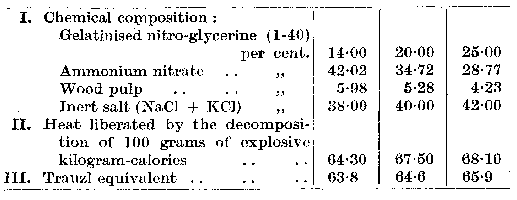
(5) Application of this method to balanced mixtures of gelatinised nitro-glycerine, ammonium nitrate, wood pulp, and inert salt (NaCl + KCl) has brought about the discovery of explosives which, when fired in a shothole, have no effect on gaseous mixtures and are still strong enough to be practical. For example, the following table shows the characteristics of explosives that contain 14, 20, or 25 per cent. of gelatinised nitro-glycerine and the exact proportion of inert salt necessary to insure their safety in practice :—
 |
 |
| Names mentioned in this article | |
 |
 |
| Name | Age | Occupation | Notes |
|---|---|---|---|
| Audibert, Etienne | Director |




 Contains public sector information licensed under the

