


| Newspaper Articles |

|
Newspaper Articles |
 |
 |
26th July 1941, Page: 21, Column: 1
Dust Hazards In Mechanical Mining
U.S. Bureau Viewpoints
There is a growing realisation in the United States that control of dust in mechanical mining is one of the outstanding problems of the industry to-day. Tests hare shown that not only is the explosibility greater than formerly indicated but also that the explosibility is greatly increased when the explosion is initiated by gas. Most of the low-volatile coals now being mined require more than 60 per cent. incombustible matter to be present to render them inert to explosion. In fact, it is these data that have caused the Bureau of Mines to advocate that all coal mines except anthracite mines apply enough rock dust to maintain an incombustible content of at least 65 per cent. in the mine dust.
According to Mr. C. W. Owings in the Bureau's Information Circular 7151 on "Some Preliminary Data on Methods for Controlling the Dust Hazards in Mechanical Mining," the West Virginia Department of Mines has found that by using a methane indicator in holes drilled into the coal in many so-called non-gassy mines an explosive mixture of gas has been detected, following which fire-boss examinations have found explosive mixtures of gas in the air-currents. Samples collected by the Bureau under similar conditions have contained as much as 19 per cent. methane in spite of the fact that the management believed its mine to be non-gassy. This condition presents an explosion hazard in hand-loading mines, but in mechanised mines where the rate of advance is rapid the danger is greatly increased. The sources of ignition also are many times greater. As a result of the changed conditions the liberation of gas is more rapid and the ignition sources are more numerous in mechanical mining, greatly increasing the probable explosibility of the dust. Added to this potential hazard is the large amount of dust found in most mechanised systems.
Methods of Controlling Dust.
Modern methods of controlling dust are in reality an application of old principles. Widespread rock-dusting is essential to prevent propagation of an explosion, but tests have been made to prove that allaying the dust at the source greatly reduces its retrogression. This statement has become virtually axiomatic. Brief extracts from the Circular regarding this point are appended.
Systems of applying water to allay dust in coal mines have been in effect for many years and have been satisfactory under some conditions, but little experimenting has been done to improve these systems.
One of the most successful methods of applying water on the cutter bar of undercutting machines has been to place a water pipe through the centre of the bar, terminating at or near the end of the bar. Unqualified approval of this method cannot be given because, unless the pressure is high enough and the quantity of water is great enough, dust raised during cutting may, under some specific conditions, be greater than during dry cutting.
An arrangement of water outlets on cutter bars of mining machines consists of a series of holes placed on the outcoming bit side, so that the dust will be wetted as it travels out of the kerf.
Dust can be abated somewhat by directing a stream of water into the channel of the bar on the intaking bits, but the results are not always satisfactory.
Top-cutting is generally a dustier operation than under-cutting. Tests in a mine where both methods are employed showed :—
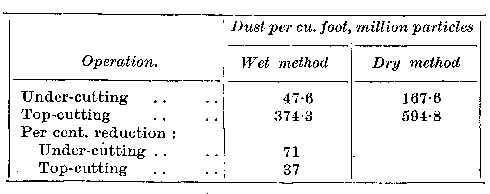
One of the reasons for the greater dustiness of top-cutting is that the dust issues from the kerf at or near the top of the coal bed and has a greater distance to fall, which permits greater dispersion of the dust. Initiation of the sumping operation is also very dusty, as the bits tend to throw the dust off the face into suspension in the air.
In hand-drilling of coal an average of a large number of tests indicates that about 35 million particles of dust per cubic foot of air is representative of this operation. Electric drilling of coal (based upon tests in about a dozen mines) will produce about 105 million particles of dust per cubic foot of air. The time of drilling ranges from about 5 minutes for hand to about 1 minute for electric drilling, therefore the amount of dust thrown into the air is not relatively great. Virtually all the dust could be kept out of the air if a stream of water were directed into the collar of the hole during drilling.
One of the greatest hazards in mechanical loading lies in the fact that in some systems of loading by hand on to conveyors or loading by mobile loaders on to cars, large piles of fine coal are left in rooms, either from spillage or thrown back because of high sulphur or high ash in some of the coal or in the machine cuttings. The recommended method for overcoming this condition is to load out the dust and fine coal. The coal pile should be kept wet during loading on to the conveyors, and near the end of each shift dust and loose coal that have accumulated along the belt or pans should be cleaned up and the area rock-dusted. The walkway beside the conveyors should be kept rock-dusted or sprinkled, whichever method is best suited to local conditions.
Bureau of Mines recommendations for use of water during haulage are repeated for emphasis :—
1. Water sprays should be provided at each gathering sidetrack, and the tops of all cars should be wetted thoroughly before loaded trips leave for the shaft bottom or the outside.
2. Coal should be wetted as the cars are dumped.
3. The empty cars should be wetted before they are taken underground to prevent dry dust from being taken back into the mine.
4. Haulage roads may also be wetted whenever necessary to reduce the amount of dust raised during passage of trips, provided that the haulage entries are adequately rock-dusted on ribs, roof, and timbers.
Summary of Methods Discussed.
In his summary appended to the Circular Mr. Owings says :—
The problem of controlling dust in mechanical mining requires further research to determine the best places for jets and nozzles and the proper placing and types of nozzles. Water should be applied near the head of the cutter bars on mining machines or on the ingoing cutting chain and bits, supplemented with spray nozzles so placed that they will trap dust escaping from the kerf.
Directing a stream of water into the collar of the hole during drilling of coal probably will eliminate most of the dust, but drilling rock with pneumatic hammer drills should be done wet, water being forced through the hollow centre of the drills.
Coal piles should be wetted thoroughly after blasting and, if feasible, during loading with mobile loaders. Spray nozzles should be installed on the loading head near the top of the conveyor guide, supplemented by sprays placed on the front of a crossbar at the coal face. Where rubber-tyred buggies are used the loose coal and dust should be cleaned up after each cut of coal has been loaded out, coal bottom should be removed, loose coal spilled along the road travelled by the buggies should be cleaned up at the end of each shift; and buggies should not be overloaded. Gates should be placed on the discharge end of the buggies to reduce spillage of fine coal. Spray nozzles should be placed at each end of the conveyor or inside tipples.
The objection to the use of excessive quantities of water may be overcome by employing wetting agents. However, care must be exercised to obtain agents suitable for the work to be done. Wetting agents give promise of reducing the quantity of water necessary as well as of removing more dust from the air than can be done with water alone.
 |
 |
| Names mentioned in this article | |
 |
 |
| Name | Age | Occupation | Notes |
|---|---|---|---|
| Owings, C. W. | U.S. Bureau of Mines |




 Contains public sector information licensed under the

