


| Newspaper Articles |

|
Newspaper Articles |
 |
 |
12th July 1941, Page: 1, Column: 1
Mining Geology
[Contributed.]
Geology is a subject of industrial importance, and in so far as its study is related to the needs of miners it is called Mining Geology. The operations of mining are sharply divisible into two classes, viz. : metal mining and coal mining, and it is with the latter aspect of the subject that we wish to deal in the present instance.
It was once written that "In mining, ignorance of some of the common facts of geology has led to serious mistakes. For example, on the top of the rocks in which our English coal is found there lies a series of red sandstones and marls, some three or four thousand feet in thickness. Where the lower of these are at the surface, a shaft sunk down will reach coal at a workable distance, but if sunk in the uppermost of the series it would be hopeless. Yet there are cases where this has been done at an expense of thousands of pounds. Below the coals there are other red rocks much older, and in some cases these also have been vainly penetrated by shafts, although a very little knowledge of fossils would have made the mistake evident."
Although it is almost half a century since these words were first written and were followed by an expression of the opinion that few mistakes of such a kind occur at the present day, it falls to be remarked that a correlation of coal seams made a decade or more ago has just recently been proved by the method of spore content to be incorrect. The subject must therefore be regarded as one which should be included in a mining student's curriculum, not only because the matter is of industrial importance, but because of the pleasure derived from contemplation of the wonders of creation. As a guide to the study of coal none is of greater value than "Coal, and the Coalfields in Wales" by F. J. North, D.Sc., F.G.S., of the National Museum of Wales. Candidates for colliery managers' certificates are expected to be able to provide answers to questions in mining geology, and because of that there follows a discussion of the points raised in such questions as have been set in recent years.
The Earth's Crust.
In the beginning, the earth was without form, and void. Contemplation of this sentence leads to the thought that at first the earth consisted of a mass of minerals which had cooled from the molten state and was without any crust. But in process of time rains descended on the earth, alternations of heat and cold took place, winds swept the surface of the nucleus, rivers were formed, and sediment was formed which was then transported from the land to the sea where it was deposited in layers according to the size and density of the particles. Beds of stratified rocks were formed. Life originated on the surface of the earth and organic remains were buried in these earliest of stratified rocks. The fossils contained in the Cambrian rocks are often contorted, thus showing that there must have been earth movements subsequent to the burial of the organic remains. The central core of the earth consisted of the fundamental igneous rocks upon which the Cambrian rocks were laid down by deposition out of water, and although the thickness of the earth's crust may exceed 100,000 feet it is now found that wall-like masses of igneous rocks have risen up from the interior and intersected the coal seams, thus showing that the injection of molten rock into the crust has extended into other rocks of later origin than the Cambrian. The occurrence of igneous rocks cutting across the planes of stratification in the sedimentary rocks hinders the progress of coal mining and brings about local metamorphosis or destruction of the coal seams.
As the molten rock was projected upwards from the interior of the earth the crust was subjected to very considerable pressure from within, with the result that the stratified rocks have suffered fracture and vertical displacement. Faults were the result of such internal stresses and we have found that in the great majority of cases the faults were produced by stresses in tension, whereas a minority were produced by compression stresses in the crust, thus leading to the strata on one side of the fissure being thrust over the same strata on the other side of the fissure. In coal mining, therefore, it is found that the stratified beds are not continuous over large areas, but are broken up by dykes and faults, both of which lead to trouble in the working of cOal mines. Another obvious result of these earth movements is the varying inclination of the seams of coal in the various coalfields. Stratified rocks are often found without inclination, but it might be said that generally they are inclined and may be very steeply inclined, especially where they have been greatly moved by the intrusion of igneous rocks. Folds occur in stratified rocks, and fine examples of folds are to be seen in rock exposures everywhere in this country, where the agents of denudation have removed masses of rock or where engineering works have necessitated the excavation of rocks on the surface.
Sequence of Rock Systems.
The whole of geological time has been conveniently divided into three eras, and these eras have been divided into a greater number of smaller periods, or it may be said that the rocks of the earth's crust have been divided into three great groups, and each of these groups has been divided into a greater number of systems. Not only are the rock systems distinguished from each other by the typical fossils they contain, but the beds which form the systems are often distinguishable from each other by the fossils which are predominant in them.
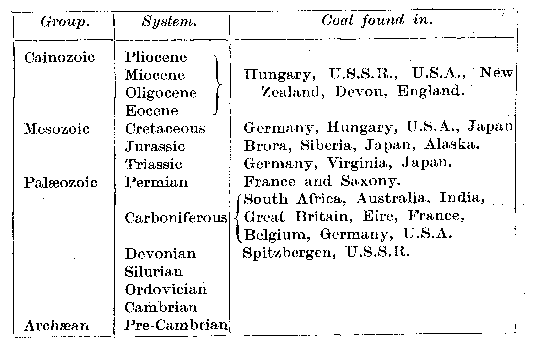
Question 1. — What is the position occupied by the carboniferous system of rocks relative to the rock systems, above and below it ? In which systems are coal found ?
The following table shows the groups comprising the systems into which the rocks of the earth's crust are divided in descending order :—
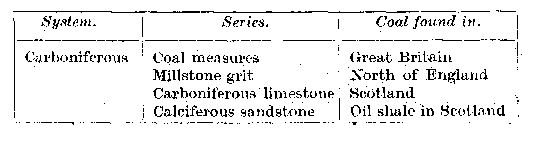
The Carboniferous System in this country consists, in its lower portion, of limestone and calciferous sandstone formed as a marine deposit, and in its upper portion, of sandstone, shales, and grits of freshwater origin. It is generally divided into four series of beds which occur in descending order as follows :—
 |
 |
| Names mentioned in this article | |
 |
 |
| Name | Age | Occupation | Notes |
|---|---|---|---|
| North, F. J. | National Museum of Wales |
 |
 |
| Related Articles | |
|
|
| Pub. Date | Article (Newspaper) |
|---|---|
| 12 Jul 1941 | Mining Geology (The Science and Art of Mining) |
| 26 Jul 1941 | Mining Geology (The Science and Art of Mining) |
| 09 Aug 1941 | Mining Geology (The Science and Art of Mining) |
| 23 Aug 1941 | Mining Geology (The Science and Art of Mining) |
| 06 Sep 1941 | Mining Geology (The Science and Art of Mining) |
| 20 Sep 1941 | Mining Geology (The Science and Art of Mining) |
| 04 Oct 1941 | Mining Geology (The Science and Art of Mining) |
| 18 Oct 1941 | Mining Geology (The Science and Art of Mining) |
| 15 Nov 1941 | Mining Geology (The Science and Art of Mining) |
| 29 Nov 1941 | Mining Geology (The Science and Art of Mining) |
| 13 Dec 1941 | Mining Geology (The Science and Art of Mining) |
| 27 Dec 1941 | Mining Geology (The Science and Art of Mining) |



 Contains public sector information licensed under the

