


| Newspaper Articles |

|
Newspaper Articles |
 |
 |
28th June 1941, Page: 410, Column: 1
Accidents At Mines
In recent issues of this journal, namely Nos. 10, 21, 22, 23, 21, Vol. 51, attention was directed to the statements prepared and circulated by the Divisional Inspectors of Mines relating to accidents that occurred in 1940 at collieries in the eight inspection areas. With the exception of Scotland the experience was not a happy one. Here, despite the increased use of home-grown timber and the transition period in the use of steel props at the working face, investigation failed to support the view sometimes expressed that these innovations led to any increase of accidents. In the opinion of Mr. T. Ashley, the Divisional Inspector, the main solution of falls of roof at the face lies in the rigid and prompt adherence to close and systematic setting of supports.
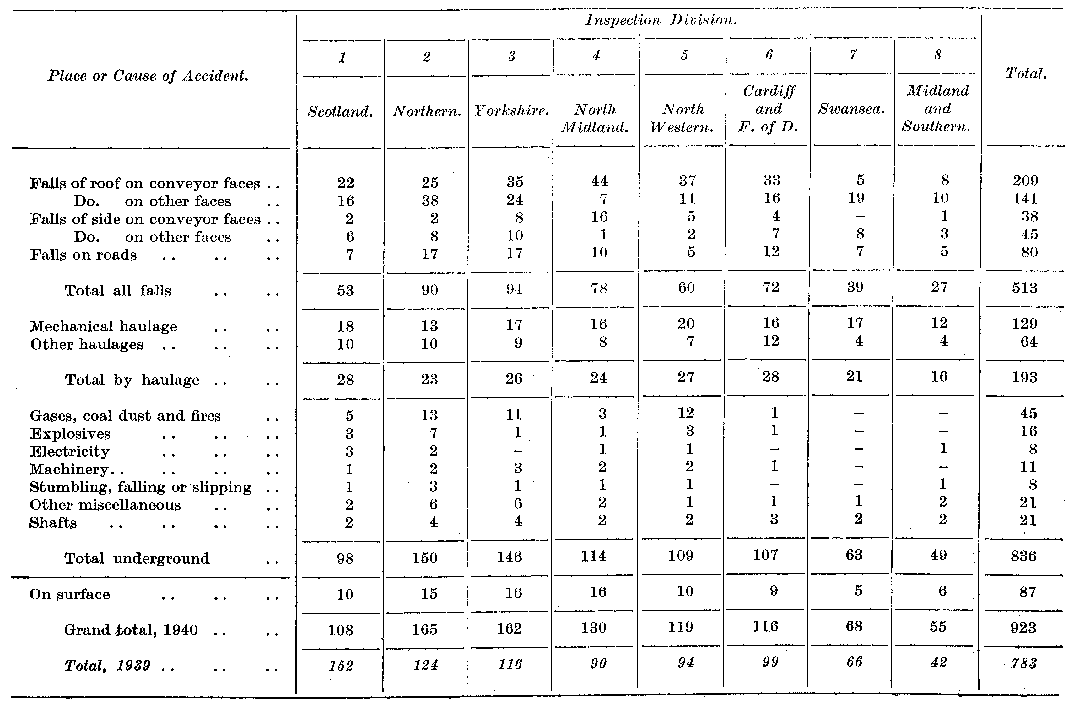
It may be interesting to recall the statement by Mr. P. T. Jenkins, the Swansea Divisional Inspector, showing that there were 68 deaths as compared with 66 in 1939. The difference of 2 looks small, and some might be disposed to write it off as negligible, but as the Inspector puts it, whether it be considered on the basis of persons employed, man-shifts worked, or millions of tons output, the increase, when during the last few months so many collieries were idle and others badly affected by trade conditions, is disconcerting. It may be that there are unusual factors which tend to produce this increase, but if this be so, it becomes the more imperative that a renewed and determined effort should be made by all concerned with a view to ameliorating the position.
Accidents in and about the mines are the concern of all, from the highest to the humblest of the workers, and as the conditions vary not only in the coalfields but also at individual mines the statements of the Inspectors should command close examination, apart from any question of agreement in detail. The safety problem is collective and individual. No man who goes down the mine can conscientiously assert that it is not his business. It is his duty to consider not only himself but all his fellow workers, the relationship is a close one, for the situation would be rare, under which the benefits accruing to the safe worker would fail to be shared by those with whom he comes in contact. The point to note is that the careless act of an individual may endanger all within the mine, including the mine itself.
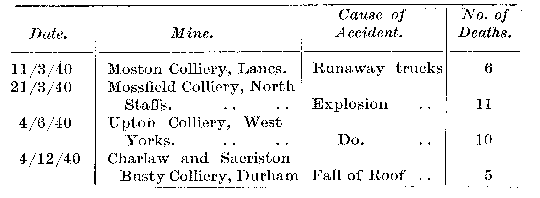
Following the statements broadcast by the Inspectors the Mines Department has issued a provisional statement of the number of deaths by accidents during 1940. Under the Coal Mines Act the deaths numbered 923, the increase being 140, and the percentage increase can only be described as unfortunate. The deaths in 1938 were 858. As an essential contributing factor major disasters may almost be counted out last year, two only answering to this description. The most serious accidents were :—
Falls of ground were responsible for 513 deaths, equivalent to more than 61 per cent. of the underground loss of life. Haulage and transport claimed 193 lives below ground and 33 on the surface, these figures combined being equal to 24½ per cent, of the total fatalities. Taking the two items, falls and transport, it will be seen that they account for 80 per cent. of the deaths at collieries. Machinery claimed 34 victims, 11 below and 23 on surface, the total against electricity being 9. From the detailed table in the Mines Department statement figures are extracted as herewith :—
 |
 |
| Names mentioned in this article | |
 |
 |
| Name | Age | Occupation | Notes |
|---|---|---|---|
| Ashley, Theodore | H.M. Divisional Inspector of Mines | Whos Who Page | |
| Jenkins, Philip Thomas | H.M. Divisional Inspector of Mines | Whos Who Page |
 |
 |
| Related Articles | |
|
|
| Pub. Date | Article (Newspaper) |
|---|---|
| 18 Dec 1926 | Accidents In Mines (The Science and Art of Mining) |
| 15 Jan 1927 | Accidents In Mines (The Science and Art of Mining) |
| 12 Feb 1927 | Accidents In Mines (The Science and Art of Mining) |
| 26 Mar 1927 | Accidents In Mines (The Science and Art of Mining) |
| 09 Apr 1927 | Accidents In Mines (The Science and Art of Mining) |
| 21 May 1927 | Accidents In Mines (The Science and Art of Mining) |
| 18 Jun 1927 | Accidents In Mines (The Science and Art of Mining) |
| 16 Jul 1927 | Accidents In Mines (The Science and Art of Mining) |
| 13 Aug 1927 | Accidents In Mines (The Science and Art of Mining) |
| 24 Sep 1927 | Accidents In Mines (The Science and Art of Mining) |
| 22 Oct 1927 | Accidents In Mines (The Science and Art of Mining) |
| 03 Dec 1927 | Accidents In Mines (The Science and Art of Mining) |
| 17 Dec 1927 | Accidents In Mines (The Science and Art of Mining) |
| 28 Jan 1928 | Accidents In Mines (The Science and Art of Mining) |
| 11 Feb 1928 | Accidents In Mines (The Science and Art of Mining) |
| 10 Mar 1928 | Accidents In Mines (The Science and Art of Mining) |
| 21 Apr 1928 | Accidents In Mines (The Science and Art of Mining) |
| 19 May 1928 | Accidents In Mines (The Science and Art of Mining) |
| 16 Jun 1928 | Accidents In Mines (The Science and Art of Mining) |
| 14 Jul 1928 | Accidents In Mines (The Science and Art of Mining) |
| 11 Aug 1928 | Accidents In Mines (The Science and Art of Mining) |
| 22 Sep 1928 | Accidents In Mines (The Science and Art of Mining) |
| 06 Oct 1928 | Accidents In Mines (The Science and Art of Mining) |
| 03 Nov 1928 | Accidents In Mines (The Science and Art of Mining) |
| 17 Nov 1928 | Accidents In Mines (The Science and Art of Mining) |
| 15 Dec 1928 | Accidents In Mines (The Science and Art of Mining) |
| 26 Jan 1929 | Accidents In Mines (The Science and Art of Mining) |
| 09 Feb 1929 | Accidents In Mines (The Science and Art of Mining) |
| 23 Mar 1929 | Accidents In Mines (The Science and Art of Mining) |
| 20 Apr 1929 | Accidents In Mines (The Science and Art of Mining) |
| 18 May 1929 | Accidents In Mines (The Science and Art of Mining) |
| 15 Jun 1929 | Accidents In Mines (The Science and Art of Mining) |
| 27 Jul 1929 | Accidents In Mines (The Science and Art of Mining) |
| 10 Aug 1929 | Accidents In Mines (The Science and Art of Mining) |
| 08 Apr 1932 | Accidents In Mines (The Colliery Guardian) |
| 27 Jul 1940 | Accidents At Mines (The Science and Art of Mining) |
| 24 Aug 1940 | Accidents At Mines (The Science and Art of Mining) |
| 05 Oct 1940 | Accidents At Mines (The Science and Art of Mining) |
| 14 Dec 1940 | Accidents At Mines (The Science and Art of Mining) |
| 28 Dec 1940 | Accidents At Mines (The Science and Art of Mining) |
| 25 Jan 1941 | Accidents At Mines (The Science and Art of Mining) |
| 05 Apr 1941 | Accidents At Mines (The Science and Art of Mining) |
| 17 May 1941 | Accidents At Mines (The Science and Art of Mining) |
| 14 Jun 1941 | Accidents At Mines (The Science and Art of Mining) |
| 28 Jun 1941 | Accidents At Mines (The Science and Art of Mining) |
| 28 Jun 1941 | Metalliferous and Quarries Accidents (The Science and Art of Mining) |
| 12 Jul 1941 | Accidents At Mines (The Science and Art of Mining) |
| 26 Jul 1941 | Accidents At Mines (The Science and Art of Mining) |
| 06 Sep 1941 | Accidents At Mines (The Science and Art of Mining) |
| 04 Oct 1941 | Accidents At Mines (The Science and Art of Mining) |
| 29 Nov 1941 | Accidents At Mines (The Science and Art of Mining) |
| 13 Dec 1941 | Accidents At Mines (The Science and Art of Mining) |
| 10 Jan 1942 | Accidents At Mines (The Science and Art of Mining) |
| 21 Feb 1942 | Accidents At Mines (The Science and Art of Mining) |
| 21 Mar 1942 | Accidents At Mines (The Science and Art of Mining) |
| 04 Apr 1942 | Accidents At Mines (The Science and Art of Mining) |
| 30 May 1942 | Accidents At Mines (The Science and Art of Mining) |
| 13 Jun 1942 | Accidents At Mines (The Science and Art of Mining) |
| 11 Jul 1942 | Accidents At Mines (The Science and Art of Mining) |
| 22 Aug 1942 | Accidents At Mines (The Science and Art of Mining) |
| 19 Sep 1942 | Accidents At Mines (The Science and Art of Mining) |
| 17 Oct 1942 | Accidents At Mines (The Science and Art of Mining) |
| 14 Nov 1942 | Accidents At Mines (The Science and Art of Mining) |
| 28 Nov 1942 | Accidents At Mines (The Science and Art of Mining) |
| 23 Jan 1943 | Accidents At Mines (The Science and Art of Mining) |
| 20 Feb 1943 | Accidents At Mines (The Science and Art of Mining) |
| 06 Mar 1943 | Accidents At Mines (The Science and Art of Mining) |
| 29 May 1943 | Accidents At Mines (The Science and Art of Mining) |
| 18 Sep 1943 | Accidents At Mines (The Science and Art of Mining) |
| 04 Mar 1944 | Accidents At Mines (The Science and Art of Mining) |



 Contains public sector information licensed under the

