


| Newspaper Articles |

|
Newspaper Articles |
 |
 |
14th June 1941, Page: 388, Column: 1
Coal Mining In India
The Chief Inspector of Mines in India, Mr. W. Kirby, B.Sc, M.I.Min.E., in his annual report for 1939, states that the daily average number of persons employed in the coal mines of British India was 201,989, which is 896 more than the number employed in 1938. Of these persons 53,639 were males employed in cutting coal, 33,820 were males employed as loaders of coal and 23,001 were women. Notwithstanding the small increase in the number employed the quantity of coal produced was lower in most of the principal coalfields, the product per person above and below ground falling from 128 to 122 tons. Comparing these figures with similar figures in other countries it has to be remembered that both men and women are employed in the Indian mines. The tonnage in the various provinces covering a three-year period was :—
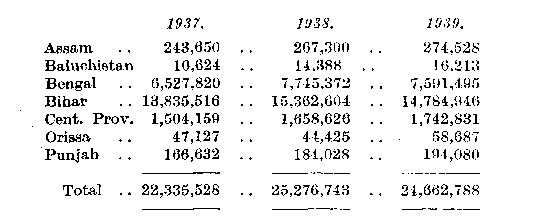
Examining the output figures for the seven principal coalfields, percentage increases were shown in Giridih (9.35), Pench Valley (3.38), and Assam (2.70) ; decreases were shown in Jharia (5.52), Raniganj (1.25), Bokaro (1.67), and Karanpura (9.43 per cent.). As regards the tonnage in each of these coalfields the following table admits of a comparison for the three years :—
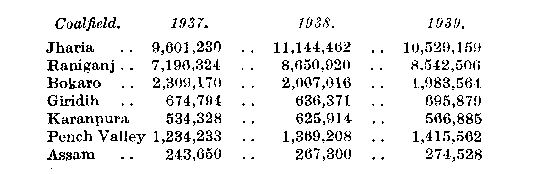
The dispatches of coal were 21,431,990 tons, and 1,519,400 tons, or 6.16 per cent., of the raisings were consumed on the collieries. The quantity of coal used for coking at the collieries was 1,425,854 tons, and 895,958 tons of soft coke and 110,742 tons of hard coke were made. Most of the hard coke was made at the coke-making plants Which do not come under the Mines Act, and 1,639,978 tons of coal were dispatched to coke-making plants of this kind.
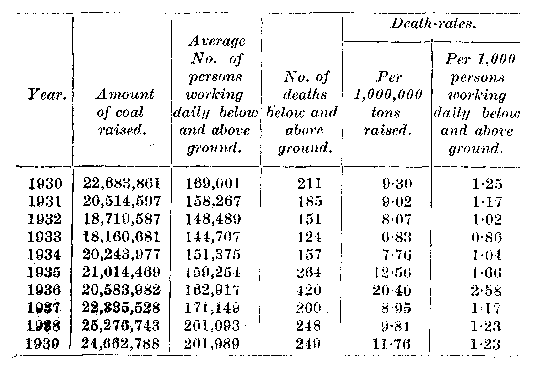
Coal Production and Accident Rates.
The following table shows the amount of coal raised, the average number of persons working daily and the death-rates during the years 1930-1939 in respect of coal mines under the Indian Mines Act:—
Use of Electricity.
The number of coal mines using electrical energy was 144, as compared with 136 in 1938 and 124 in 1937 ; the aggregate horsepower increased from 98,077 to 104,000, that is by 6.05 per cent. The increase was due chiefly to the increased horse-power of motors installed in the Raniganj coalfield. During the year there were three serious and two fatal accidents due to electricity ; one fatal accident occurred below ground and the other one on a surface transmission line.
The number of coal-cutting machines used Was 203, as compared with 180 in 1938 and 140 in 1937. All the machines were worked by electricity. There were 56 machines at work in the Jharia coalfield, 130 machines in the Raniganj coalfield, and 12 machines in the Central Provinces and Berar. Coal-cutting machines were in use in 72 mines, as against 66 in 1938 and 50 in 1937.
Besides coal-cutting machines six pneumatic picks worked by compressed air were in use in one mine.
The total area undercut was 10,816,032 square feet, as compared with 8,827,200 square feet in 1938. It is evident that there has been a steady increase in recent years in the getting of coal by mechanical means.
In 1939, 139 mechanical ventilators were in use, the number being 128 in the previous year and 117 in 1937.
There were 47,040 safety-lamps in use, as compared with 46,520 and 42,932 in the two preceding years.
During the year 3,500,370 lb. of gunpowder, 81,330 lb. of high explosives, and 260,403 lb. of "permitted" explosives were used at coal mines. These figures compare with 3,479,883 lb. of gunpowder, 93.788 lb. of high explosives, and 290,131 lb. of "permitted" explosives used in 1938. In addition, 79,809 lb. of liquid oxygen explosives were used. The latter explosives Were used in quarries in the Bokaro coalfield.
Inspector's Comments on "Bumps."
The number of deaths below and above ground in 1939 was 249, an increase of one compared with the preceding year, the rate per thousand persons employed remaining at 1.23. Per million tons of coal raised the rate rose from 9.81 to 11.70, that of the preceding five years being 11.90. Falls of roof and sides were accountable for most of the deaths.
An accident in which two persons lost their lives and one was injured occurred at the Dhemo Main coal mine, a severe "bump" causing large masses of coal to fall from the sides of pillars. In the course of his comments the Chief Inspector says :—
During the year several accidents due to "bumps" have occurred at this and other mines working the Dishergarh seam at great depths. Above the Dishergarh seam there is usually a few feet of shale and above this shale is a hard sandstone of considerable thickness. Generally, it is found that "bumps" are likely to occur when the "cover" is in the region of 1,000 feet and over, and where there is a strong stratum, e.g., sandstone immediately above or within a few feet of the coal seam. When these strong massive strata begin to break up after large areas of coal have been extracted, depending on the depth of the seam, "bumps" are likely to occur, producing what might be called "shock waves," which are usually transmitted over considerable distances and result in extensive falls of side and roof. Gas may also be liberated in gassy mines.
"Bumps" should be distinguished from ordinary "weighting" due to pressure being thrown on to the working "face" or the pillars in the vicinity during depillaring operations, and which might result in minor falls of roof and sides. "Bumps" are caused by the breaking up of strong massive superincumbent strata at considerable depths, and the effects of "bumps" are transmitted over large areas and are sometimes so violent as to raise dense clouds of coal dust and extinguish flame safety-lamps. As the area of extraction increases and the stage approaches when a "break" of the main roof is likely to take place the frequency and severity of "bumps" are likely to increase.
To mitigate the effects of "bumps" conditions at each mine should be carefully studied and precautions taken accordingly. For instance, if the roof immediately above the coal is sound it would be unsound practice to leave roof coal which would be likely to fall and endanger workers when any "bumps" occur. On the other hand, if the immediate roof is unsound and it is necessary to leave some roof coal as a support, then this roof coal should he adequately supported by "chocks" set at short intervals to prevent roof coal collapsing if a "bump" with the accompanying "shock wave" should occur. It is also essential, as far as practicable, to avoid leaving small pillars or "stooks" behind in goaves so that the main roof may be allowed to settle down evenly. A consideration of the direction of the working "faces" in conjunction with "cleavages" in the roof is of importance, and in some cases a "diagonal" or an "inclined" face has been found to be the most suitable. The management of each mine, where "bumps" are likely to occur, should consider the prevailing conditions at their particular mine and arrange the direction of the working "faces" accordingly.
Air Blasts.
There were no deaths but two persons were seriously injured at the Lodna coal mine in a depillaring area in No. 15 seam, which is about 24 feet in thickness. It appears from the report that depillaring had been proceeding normally and the goaf breaking down to the surface. During the night previous to the morning of the accident, when no persons were at work in the mine the sirdar found signs of "weight" in the depillaring area, and at 6-30 a.m. on the day of the accident he reported this matter to the assistant manager and to the day shift sirdar. The day shift commenced at 6-30 a.m. and the assistant manager went underground with the intention of making an inspection before allowing work to be commenced. On visiting the depillaring section he found that the pillars adjoining the goaf indicated signs of "weighting," and as there Were no persons there, he proceeded to the dip side of the depillaring area to make sure that miners had not gone into the working places to commence work. There were no persons present in the whole of the depillaring section, and accompanied by the sirdar, he was proceeding out of the depillaring area when there was a sudden collapse of the main roof in the goaf, which caused a heavy air-blast. The two injured persons, who were sitting down on a haulage road, were knocked over by the air-blast and received serious injuries. It is evident that the fall occurred very suddenly and the inspecting officer, who investigated this accident, was informed by the manager that it was most unusual for any air-blast to occur, because the local roof usually breaks down very regularly on the withdrawal of props, and this partially filled up the goaf.
Where air-blasts are likely to occur during depillaring operations in thick seams, "safety stations" to which all persons can be withdrawn whenever there are indications of "weight" in the depillaring area should be provided, so that work-persons can be safeguarded from the effects of air-blasts.
Mr. Kirby says that air-blasts caused by the collapse of large areas of roof in goaves are common, in working thick seams, except in those mines where the goaves are stowed. It is in "panel" districts, where there are few openings into the area where air-blasts are likely to prove most dangerous unless precautions are taken to keep the workers clear of the force of the blast, by withdrawing them to "safety stations" when "weighting" is detected.
Safety Hats.
In his general remarks the Chief Inspector says that during 1939 several thousands of "safety hats" made of bamboo were worn by miners at a number of mines in the Jharia and Raniganj coalfields. In the Assam mines, owned by the Assam Railways and Trading Company, Limited, "safety helmets" made of compressed fibre material and imported from Great Britain were used. Over 200 of these helmets were worn by miners employed in "openings" or "chambers" where small pieces of roof or side coal may fall unexpectedly on the miners' heads.
Bamboo hats were first introduced at Sendra colliery. The manager employed a contractor to make these hats and when large numbers were produced the cost worked out at only two annas each. The efficacy of this head protection is illustrated by the following occurrence. An assistant reported to the manager of the mine as follows: "At about 3 p.m. on 1st September a piece of coal fell from a height of 15 feet on to the bamboo 'safety hat' worn by a timber coolie while he was holding with other timber coolies, a prop for erection in the 5th rise of No, 6 west drift (13 seam). The piece of coal pierced through the hat and caused a slight cut on his head. Had his head been bare, the injury might have been very serious or fatal as is evident from the nature of the cut in the hat."
Another case still further indicates the additional safety afforded to miners by Wearing these hats. A manager reporting another occurrence to his Chief Mining Engineer stated: "This is to inform you that a miner of No. 1 pit, Thakur Singh, while working in 14 seam depillaring area on 21st February, Was struck on the head by a piece of coal weighing about 2 lb. falling from a height of about 12 feet. Fortunately his head was not hurt as he was wearing one of the bamboo hats already issued to him. The piece of coal after striking his head struck his shoulder which was scratched and bruised, then the coal fell on to his left heel."
In view of the benefits derived by using such protection the extended use of those hats or of any other type of hat which will protect the miner and reduce the number of accidents due to head injuries is strongly recommended.
 |
 |
| Names mentioned in this article | |
 |
 |
| Name | Age | Occupation | Notes |
|---|---|---|---|
| Kirby, W. | Chief Inspector of Mines in India | ||
| Singh, Thakur | Miner |




 Contains public sector information licensed under the

