


| Newspaper Articles |

|
Newspaper Articles |
 |
 |
17th May 1941, Page: 368, Column: 1
Colliery Accidents In 1940
Swansea Increase Disconcerting
The circular issued by Mr. P. T. Jenkins, the Inspector in Charge of the Swansea Division, indicates that more accidents are occurring, the statistics of serious non-fatal accidents also showing an upward trend during recent years. The outstanding fact presented is the serious increase of fatalities from falls of roof and side last year, and although there was a reduction in the number arising from other causes the position generally cannot be regarded with satisfaction.
Indeed, whether it be considered on the basis of persons employed, man-shifts worked, or millions of tons output, the increase for the year, when during the last few months so many collieries were idle and others badly affected by trade conditions, is disconcerting, says Mr. Jenkins. It may be that there are unusual factors which tend to produce this increase, but if this be so, it becomes the more imperative that a renewed and determined effort should be made by all concerned with a view to ameliorating the position.
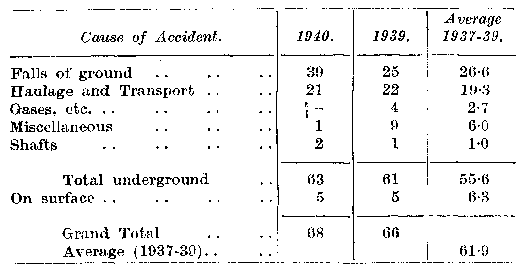
The figures given in the appended table show the fatalities in 1939 and 1940, also the average for the three-year period 1937-39 :
High Percentage of Falls.
Last year's increase in fatalities under the head "Accidents Due to Falls" as compared with the average for the three previous years was 12.4, and the total formed 57.3 per cent. of the whole of the fatalities for the year, underground and surface.
Of the fatal accidents at the face twelve were due to small falls from between converging slips and induced breaks, in beds varying from 3 inches to 3 feet 2 inches in thickness. Others were due to improper setting of supports which reeled out with roof weighting, and from unsupported overhanging clod.
The recurrence, year after year, of accidents at the face from falls of roof of comparatively small areas from between unseen slips and induced breaks indicates, the Inspector says, the necessity for some further preventive measures. He adds that the present method, so persistently adhered to, of supporting the roof with props and lids, should be reviewed, and increased use be made of flats or straps — and cross flats where necessary — to reduce the area of exposed or unsupported roof.
A number of these small falls take place from the freshly exposed roof between the last row of props and the face, and this dangerous part of the roof could be better supported by an extended use of flats.
The need for the conservation of pitwood supplies under present circumstances must be borne in mind and met, but particularly in places where steel flats or straps could be used, additional safety could be achieved without waste of pitwood, and even in some cases with a saving in pitwood. The saving could be effected by the withdrawal and re-use of the supports, and Mr. Jenkins says that in many cases that would be possible if more attention was directed towards the controlling of the roof movement by efficient packing of the gobs.
In many cases in the Swansea Division, an acceleration in the rate of advance would also be an important factor in the improvement of roof conditions at the face.
Haulage Operations.
There were 21 fatalities in connection with underground haulage operations during 1940. Seventeen of the fatalities were under the head of mechanical haulage, an increase of seven over the average for the previous three years.
Of the total, 12 were classified as avoidable with ordinary caution, although a few of these might be attributed to over-zealousness on the part of the persons involved without giving due regard to the risk incurred.
Some of these avoidable accidents were due to illegal riding on journeys, to walking the engine plane while the journeys were in motion, to riding on the "gun," and to haulage hands standing in a precarious position while trams Were being lowered into passbyes.
Active Co-operation Needed.
It is difficult to change long established customs even where they are shown to be conducive to accidents, and frequently the enforcing of discipline and attempts to change these customs are resented. The active co-operation of all parties is needed to attain the desired end, and some form of safety campaign would possibly have more beneficial results than compulsory measures.
Unfortunately, in the Swansea Division very little enthusiasm is shown in that direction, and Mr. Jenkins knows of no safety committees functioning, though in the eastern part of the Division some safety officers have been appointed.
The co-operation of the management and Workmen is essential to overcome this apathy — and probably suspicion — and the matter is one to which the Inspector earnestly invites the consideration of owners, officials and workmen alike.
Protective equipment is not being sufficiently used. In the course of personal contact with the workmen, they seem to appreciate the value of such equipment in preventing serious results in case of accidents, but for some reason unknown to the Inspector they do not respond sufficiently to the appeal to use it. A more enthusiastic attitude is necessary on the part also of officials, who in many cases do not themselves wear safety helmets — example is frequently more potent than precept. After the accumulation of so many proofs of the efficacy of protective equipment in preventing serious injuries, surely the time is opportune, he concludes, for some concerted action to ensure a more general use of such equipment.
 |
 |
| Names mentioned in this article | |
 |
 |
| Name | Age | Occupation | Notes |
|---|---|---|---|
| Jenkins, Philip Thomas | H.M. Divisional Inspector of Mines | Whos Who Page |
 |
 |
| Related Articles | |
|
|
| Pub. Date | Article (Newspaper) |
|---|---|
| 22 Mar 1941 | Yorkshire Colliery Accidents Reviewed, Divisional Inspector on "Safety Measures" (The Science and Art of Mining) |
| 19 Apr 1941 | Colliery Accidents In 1940, Position Reviewed by Mines Inspectors (The Science and Art of Mining) |
| 03 May 1941 | Colliery Accidents In 1940 (The Science and Art of Mining) |
| 17 May 1941 | Colliery Accidents In 1940, Swansea Increase Disconcerting (The Science and Art of Mining) |
| 31 May 1941 | Colliery Accidents In 1940, Cardiff Shows Increase in Falls (The Science and Art of Mining) |



 Contains public sector information licensed under the

