


| Newspaper Articles |

|
Newspaper Articles |
 |
 |
17th May 1941, Page: 359, Column: 1
Prevention Of Gas-Ignition In The Overcut
Some time ago Mr. Robert D. Beilby, B.Sc. (Hons. Min.), spent two months at Holditch Colliery in Staffordshire investigating the effect of mist sprays as a means of clearing and diluting gas in the overcut. Sprays had been in use on the coal-cutting machines in the Four Foot Seam for a considerable period before he carried out the research dealt with in his paper before the North of England Institute of Mining and Mechanical Engineers under the title "The Prevention of Gas-ignition in the Overcut." It will be recalled that a serious disaster occurred at Holditch Colliery some three years ago, due to an ignition of gas in the undercut causing an outbreak of fire and subsequent explosions.
The Working Cycle.
In his paper before the Institute Mr. Beilby explained that the Four Foot Seam lies at a depth of 800 yards and has a section varying from 4 feet 8 inches to 5 feet 2 inches of clean coal. The work was carried out on a longwall conveyor face 420 yards long, having at the time one main intake airway and two return airways, with a dumb road which was to be converted into a second intake airway at a later date. The average quantity of air passing along the face during normal cutting was about 30,000 cubic feet per minute at an average velocity of 1,000 feet per minute. The face was cut by three overcutting machines, each operating over approximately a distance of 140 yards. On one cut two machines worked to the rise, while the third machine worked to the dip and vice versa on the following cut. The depth of the cut was 4 feet 8 inches and approximately 7 inches in thickness, with about 6 inches of coal left up for roof-support purposes. The working cycle was as follows : Filling was carried out on the day-shift, cutting and moving up of conveyors on the afternoon-shift, while packing and stonework was done on the afternoon and night shifts. The face was supported entirely on steel, H-section steel props and steel straps being used with hardwood chocks set solidly to floor and roof at intervals along the face.
The machines used were compressed-air driven telescopic overcutters developing 40-50 h.p. at a pressure of 60 lb. per square inch. The sprays were fitted to all machines, which were also fitted with a cowl at the rear of the jib and which assisted in reducing the amount of dust produced behind the machine. These machines had a cutting speed of approximately 1 yard in just over 1 minute.
The sprays were attached to the machine at the back of the jib on to the framework of the telescopic turret by means of a pin on the framework of the sprays, which is slotted into a groove on the frame of the machine. The atomisers were fitted in such a manner as to enable the direction of the spray to be altered to ensure the maximum effect of the overcut. Each set of sprays contained four atomising nozzles. The atomisers were fitted at the four corners of a diamond, set in a cubical framework, and consisted of two concentric nozzles, water being passed through the outer nozzle and compressed air through the inner nozzle. The atomisers produce sprays of fine mist and these were projected into the undercut by the compressed air.
Sampling With and Without Sprays.
A representative survey of the methane-air mixtures present in the overcut was obtained during actual cutting. In order that samples could be taken, under normal cutting conditions the machine cut 30 yards from the commencement of cutting before the first group of samples were taken over a 10-yard length of face ; when the first group of samples had been taken with either the sprays on or off, the machine cut a further 25 yards under opposite conditions with regard to the sprays before sampling was re-commenced. At the outset, four groups of samples were taken forming two complete series. The first series consisted of 30 samples, 15 with the sprays on and 15 with the sprays off, all taken with the coal-cutter travelling in the same direction along the face as the ventilation. The second series, also of 30 samples as above, was taken with the coal-cutter travelling up the face against the ventilation. There is a considerable difference in the results obtained with the sprays off, whereas with the sprays on, except for samples taken at the back of the cut, there is a decided similarity in the results obtained in both series.
It was felt that the cowl attached to the machine might have had some effect on the results obtained. It was therefore decided to take two further series of samples on two other cuts with the cowl off. The results of these samples show that there is a similar difference in the results obtained between the samples taken, with the sprays off, with the ventilation and against the ventilation, although to a lesser extent than in the first groups of samples. These results show that any effect which the cowl may have had upon the ventilation was not responsible for the difference.
The percentages of inflammable gas in the cut are higher in those samples taken with the cowl on than with the cowl off, but Mr. Beilby does not think that there is sufficient evidence available to express any opinion that these differences were wholly due to the presence of the cowl in the ventilating system.
Combustible Gas Percentages.
In every case without the sprays operating the percentage of combustible gases present in the atmosphere at the back of the cut was generally above the lower limit of inflammability of methane, that is, 5.4 per cent. With the sprays in operation these high percentages were reduced below the lower limit of inflammability of methane, within a distance of 2½ yards from the back of the machine, thus reducing the possibility of ignition of gas in the overcut by heating of cutter-chain or sparks from cutter-picks. In the middle and at the front of the cut, where in many cases without the sprays on inflammable mixtures were present, this danger was entirely eliminated by the use of the sprays.
The following are some examples of the effect of the sprays, taken from the four series showing conditions which were encountered :—
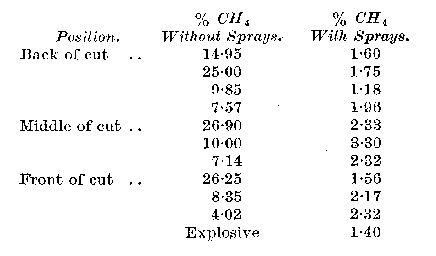
It will be realised, Mr. Beilby said, that under no circumstances is it possible to take samples under exactly the same conditions on different days, as these may vary on each cut from day to day, but with the sprays on the conditions are more stable and much safer than with the sprays off. One very important factor has come to light through the experiments carried out, and that is that there is a considerably lower percentage of methane in the cut when cutting against the ventilation than when cutting with the ventilation ; the most marked effect being noted in the samples taken at the back of the cut with the sprays off, where samples taken against the ventilation are only slightly above lower point of inflammability, while those taken with the ventilation are considerably higher.
On the major subject as to the effect of the sprays on the clearance and dilution of gas in the overcut, the Author says the results show that in every case with the sprays on there is considerable improvement in the conditions with regard to gas ignition than without the sprays. In addition to the effects and benefits which are obtained by clearance of gas from the overcut, the spray system added moisture to dust formed in cutting, and caused deposition of large quantities of dust which would otherwise be carried in the ventilating system of the mine, thus acting as a twofold safety device against any possible ignition. Furthermore, he concluded, it is quite possible that, in the case of an actual ignition by heating of cutter picks or sparks from them, the spray would extinguish the ignition at its source.
 |
 |
| Names mentioned in this article | |
 |
 |
| Name | Age | Occupation | Notes |
|---|---|---|---|
| Beilby, Robert D. |




 Contains public sector information licensed under the

