


| Newspaper Articles |

|
Newspaper Articles |
 |
 |
3rd May 1941, Page: 346, Column: 1
Colliery Accidents In 1940
Serious Increase in Northern Division.
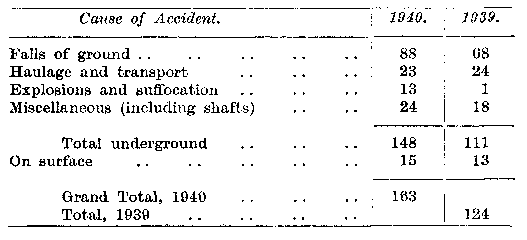
Continuing the examination of the reviews by the Mines Inspectors of the accident position in 1940 (see pp. 292 and 321) it is seen that in the Northern Division there was a large increase in the fatalities, the number rising to 163 from 124 in the preceding year, an increase per cent. of 31 ; Northumberland's total of 53 represented an increase equal to 56 per cent. ; that of Durham (94) an increase of 22 per cent.
Mr. Robert Yates, the Inspector in Charge, appeals to all concerned to take up afresh this matter of accident prevention, in the hope that good will result therefrom. He says the figures must cause deep concern, and the position calls for the closest investigation with a view to effecting a substantial reduction. Under the chief headings the totals are :—
Whilst admitting that there is nothing new in the ameliorative measures which are discussed below, Mr. Yates makes no apology for reiterating them in the endeavour to combat the heavy toll that these casualties impose on the families and friends of those who are killed, on the industry, and on the nation in general.
Timbering Recommendations.
The increase due to falls of ground was more than 29 per cent. and the Inspector says that systematic setting of planks or steel straps should be more generally adopted. On machine faces, the ends should abut the coal face and three props should be set to each plank or strap at the time. The setting of three props obviates disturbance of the roof when the face prop is removed to allow the coal-cutting machine to pass, and it obviates also the hurried setting of a middle prop under circumstances where it is almost invariably badly set. In order to ensure the proper setting and driving up of the props a hammer should be used.
Spiling over the undercut coal when shot down should be more the rule than the exception in arc-wall working, and the permanent roof supports should be erected as the filling proceeds.
When drawing off goaves or juds the value of temporary props, the more extensive use of a Sylvester, and the setting of a special anchor prop are not yet fully appreciated.
The use of releases to enable hard wood chocks carrying the goaf along the faces to be properly set and safely withdrawn should be extended.
The provision of stays at caunch edges and overhanging side has been stressed frequently, but failure to carry out this precaution still results in accidents.
The necessity for securing the roof of a cavity created by a fall by clearing away the debris has again been demonstrated by two separate accidents, one involving five deaths.
Haulage and Gases.
A reduction in the number of fatalities usually associated with horse haulage is offset by an increase in fatalities in connection with face conveyors, due mainly to interfering with machinery, to lack of adequate guards, and to attempting to adjust or clean internal parts while in motion.
An explosion causing three deaths was brought about by the firing of a shot in the coal at the rise end of a longwall face where firedamp had accumulated and the shot-firer had failed to examine for gas before firing. A second explosion, involving four deaths, occurred in a narrow heading, where firedamp was ignited by electrical sparking which took place when the pin and cover of the connector of a drilling machine trailing cable fell out and came into contact with the live terminals in the coupling. The studs securing the cover were flimsy and the coupling had not received proper attention. Two sudden outbursts of gas brought about three deaths during the year.
How Accidents Might be Avoided.
Six separate fatalities were caused by coal or stone projected from shots, due to insufficient shelter having been taken or to unexploded shots having been approached owing to miscalculation or sheer recklessness. A salvage man was travelling inbye with electric detonators and explosives (given to him by a deputy) in the same pocket, in which he was also carrying a torch battery, when the whole lot exploded.
A putter was electrocuted when he came into contact with the rope of a small hauler. Serious defects in the electrical apparatus, due to neglect in maintenance and breaches of the electrical regulations, were afterwards found.
Many fatal accidents could have been avoided by—
1. A more general conformity to known good mining practice in relation to the working of the seams and the support of the roof and sides.
2. The exercise of better discipline and (in some instances) more intelligent supervision.
3. A stricter observance of the regulations.
4. A more intensive inculcation of elementary safety principles.
The position might be improved by colliery officials taking greater interest in safety organisation, on which the war has been allowed to have an adverse effect.
Safety committees should be revived and meetings held frequently to engender a spirit of co-operation between the management and the men in discussing ways and means of preventing accidents.
Safety officers have done excellent work and they have a definite value in the organisation of a well-run industrial concern. This work could with advantage be extended.
Training of Boys. — There has been a great falling off, attributed to the war, in the enrolments for the classes held at various centres in the Northern Division. At some mines the boys are carefully trained and their duties are arranged to suit their mental and physical characteristics, while at others little interest seems to be taken in the matter. Statistics show, Mr. Yates avers, that safety-trained boys are less prone to accident than untrained ones.
North Midland's Unfavourable Comparison.
In his circular bearing on the situation in the North Midland Division, Mr. G. Cook, the Inspector in Charge, has occasion to report 130 deaths from accidents compared with 90 during the previous year, an increase so large as to constitute a matter of serious concern. The following figures are extracted from the table prepared by the Inspector :—
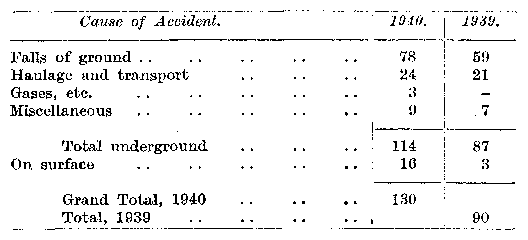
While war conditions have no doubt been a contributory factor in some of the accidents, Mr. Cook says this can only be a partial explanation since the increases are greater in some parts than in others. Compared with 1939 North Derbyshire and Leicestershire account for increases of 31 and 10 respectively, while there was actually a reduction in Nottinghamshire. As increased outputs and full-time working have applied more or less equally to the whole Division, something as well as war conditions must have affected the results. A large part of the increase in underground fatal accidents was due to falls of roof and sides on conveyor faces.
Points for Consideration.
A review of the avoidable accidents from falls of ground at the face indicates that, in addition to more care being necessary in the erection of supports, the following points should be considered :—
Extended Use of Bars. — If bars had been set earlier instead of depending on catch props and lids some of the accidents would have been avoided. In two or three cases the stones which fell were only six inches to nine inches thick, and therefore could easily have been supported by bars.
Delay in Setting Supports. — There is a tendency to delay the setting of supports to weak roof even after the weakness has been detected, the delay arising from the desire to get out more ground to make room for permanent supports.
Working at the Front of Cut Coal. — Accidents to men working in front of the coal are more frequent on conveyor faces than on others. On these faces there is always a temptation to a filler to fill away loose or broken coal from the front, thus exposing lengths of roof which cannot be systematically supported ; there is also danger from falls of coal from the face which are more likely to occur under these conditions. Filling from buttocks should be adopted wherever possible, the supports being set as the buttock advances.
Seams Worked in Two Sections. — Where, on account of bands of dirt or well-defined partings in a seam, the bottom section is filled out first, the support of the upper section does not always receive proper attention, and accidents might have been avoided if the obvious precaution had been taken of either taking down the top coal as the face advanced, or supporting it during the filling of the bottom section.
Mr. Cook would suggest that the Support Rules should be reviewed and amended to meet any changed conditions, and should deal with these points. The rules should be amplified by diagrams to illustrate the proper system of setting the supports in accordance with the methods of operation.
Withdrawing Timber. — There is evidence that Sylvesters are not provided and used as extensively as they ought to be, and the investigations following one or two accidents suggested that although Sylvesters were provided an attempt had been made to cut the props or to use a hammer.
Surface. — There were 16 fatal accidents during 1940 as compared with 3 in 1939. Although the lighting restrictions had a bearing on two surface accidents, there were no extraordinary circumstances connected with the other accidents, and it is difficult to account for the increase.
Accidents Should be Investigated.
Amongst general suggestions Mr. Cook mentions undertaking so far as possible an intensified safety campaign at each colliery to bring the whole question of safety precautions to the fore ; that safety officers should be appointed where they are not already functioning ; and that safety committees should be formed where all questions of safety could be discussed.
If every accident occurring at a colliery was carefully investigated, the results of the investigation placed before the committee, and suitable action taken on their recommendations, he has no doubt that good results would follow. Such a committee would also be able to make suggestions for safer methods of doing various kinds of work.
These points, and others, should be taken up with all officials who, in their turn, should be on the watch to see that unsafe methods are discontinued.
Unfortunately, the Safety Principles Classes for boys have to some extent been curtailed since the beginning of the war, and there is the greater need, therefore, for giving boys an extended training at the mine under competent persons.
Recognising that it is impossible in his circular to do more than touch upon a few of the factors bearing on accidents, Mr. Cook says that those concerned will be able to supplement them from their own experience, and he hopes that as a result of combined efforts there will be a reduction of accidents during the present year.
 |
 |
| Names mentioned in this article | |
 |
 |
| Name | Age | Occupation | Notes |
|---|---|---|---|
| Yates, Robert |
 |
 |
| Related Articles | |
|
|
| Pub. Date | Article (Newspaper) |
|---|---|
| 22 Mar 1941 | Yorkshire Colliery Accidents Reviewed, Divisional Inspector on "Safety Measures" (The Science and Art of Mining) |
| 19 Apr 1941 | Colliery Accidents In 1940, Position Reviewed by Mines Inspectors (The Science and Art of Mining) |
| 03 May 1941 | Colliery Accidents In 1940 (The Science and Art of Mining) |
| 17 May 1941 | Colliery Accidents In 1940, Swansea Increase Disconcerting (The Science and Art of Mining) |
| 31 May 1941 | Colliery Accidents In 1940, Cardiff Shows Increase in Falls (The Science and Art of Mining) |



 Contains public sector information licensed under the

