


| Newspaper Articles |

|
Newspaper Articles |
 |
 |
3rd May 1941, Page: 344, Column: 2
Explosives And Their Substitutes
From paper read at the April meeting of the Associates and Students' Section of the North at England Institute of Mining and Mechanical Engineers.
By J. R. Harding, Cert.Stud.I.M.E.
In the early days of mining ground was broken by simple tools like the mall and wedge. Holes were "jumped" into the coal by a long rod with a chisel end and a heavy ball in the middle to give momentum. By inserting wedges in these holes and hammering them with a mall, coal or stone could be brought down. About 1890, lime cartridges were used as a means of bringing down coal. Cartridges of pure quicklime were put in a shothole along with a perforated tube, through which water was pumped. This caused a rapid swelling of the lime, with the evolution of sufficient heat to produce steam at such a pressure as to break down undercut coal, after an interval of time.
Explosives have been known and used since the 13th century when saltpetre was discovered by the Arabs, Moors and Chinese. Gunpowder was first Used in 1689 by Thomas Epsley in a Cornish mine and was the common blasting agent till the middle of the 19th century. The active application of science began when nitro-glycerine was discovered by Sobrero in 1840. An important constituent of mine explosives is ammonium nitrate, which is prepared by passing ammonia gas through a 60 per cent. solution of nitric acid.
High and Low Explosives.
An explosive is a body containing a large amount of potential energy, which can be liberated by effecting a chemical change in the body by combustion, friction, shock, or blow. The energy is set free in the form of mechanical energy and heat, as the substance rapidly gasifies. The gases tend to occupy a greater volume, thus developing a sudden pressure on their surroundings. There are two main divisions of explosives, namely, high explosives and low explosives, which decompose in two different ways.
A low explosive decomposes by a rapid, progressive combustion and is therefore fired by ignition. Such an explosive is composed essentially of a combustible body and is a supporter of combustion.
A high explosive is either a pure chemical compound or a mixture of chemical compounds, whose molecular structure must be broken up. The chemical decomposition is propagated through the explosive by an explosive wave, which causes violent agitation of the molecules and their consequent disintegration. To cause such an explosive wave a shock or blow is necessary. Gunpowder is the most common low explosive, having as combustible carbon and sulphur, with a nitrate or a chlorate as a supporter of combustion. These ingredients are mixed intimately in a granular form. Usual limits of composition are :—
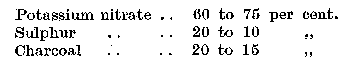
The products of combustion have about equal parts by weight of solid and gaseous residue, the gases being mainly carbon dioxide, carbon monoxide, nitrogen and sulphuretted hydrogen ; the solid residue being potassium carbonate, potassium sulphide, and unchanged sulphur. Gunpowder has a relatively slow action and can therefore strike along planes of weakness, making it very effective for breaking down coal. Unfortunately, the solid residue of combustion may be in the form of incandescent particles capable of igniting firedamp, and the gaseous residue may contain up to 15 per cent. carbon monoxide. Bobbinite is a similar explosive to gunpowder, with the sulphur replaced by ammonium sulphate and copper sulphate or starch and paraffin wax. Its action is similar to that of gunpowder and it has the same faults, which make them useless for use in gassy or dusty mines.
High Explosives Classified.
There are numerous types of high explosive available for all purposes in mining. Incidentally, the varieties are so many as to be almost baffling to the engineer who wishes to select one for a certain purpose. High explosives are classified as :—
1. Nitro-glycerine explosives, comprising (a) gelatines, (b) dynamite, (c) powder explosive.
2. Non-nitro-glycerine explosives.
3. Permitted explosives.
Nitro-glycerine can be made into a gelatinous mass by mixing guncotton with it, forming blasting gelatine, which is a dark brown jelly of high density. It has a tendency to freeze below 45°F. The freezing temperature can be reduced if ethylene glycol is added to the glycerine during manufacture of the nitroglycerine. All nitro-glycerine explosives are made low-freezing in this Way. Blasting gelatine is a mixture containing 92 to 93 per cent. nitro-glycerine and 8 to 7 per cent. guncotton, and is the strongest known blasting explosive, being therefore used a great deal in metalliferous mining. If the percentage of gun-cotton is small and cooling salts are added, these explosives are known as gelignites. Nobel was the first to find an absorbent for nitro-glycerine, namely, kieselguhr, which absorbs three times its own weight of nitro-glycerine, forming a plastic mass known as dynamite. The non-nitro-glycerine group contains explosives made up of varying quantities of T.N.T. guncotton and ammonium nitrate.
Those explosives in the Permitted List comprise any explosives in either of the previous groups which have passed special Government tests. The tests include (a) firing shots in an explosive mixture of firedamp and air, (b) firing shots into coal dust, and (c) firing shots at a ballistic pendulum. To pass the test an explosive must not ignite the gas or coal dust. Non-permitted explosives provide a high temperature flame, which can ignite gas or dust. To counteract this, permitted explosives incorporate some cooling salts to quench the flame. The cooling salts may be explosive in themselves, such as ammonium nitrate and podium nitrate, or non-explosive salts, such as sodium chloride (common salt) and sodium borate (borax). Starch, woodmeal and crystalline substances like the sulphates of copper and magnesium are also used. Sodium chloride is most commonly used.
It has been found that permitted explosives have a shattering effect when used in coal, go that low-density explosives were introduced. The more nitro-glycerine there is in an explosive the greater is its shattering effect, so that a low-density explosive has a low percentage of nitro-glycerine. A high percentage of cooling salts are also included so that a given charge occupies a larger volume. Al Rounkal contains about 35 per cent. of cooling salts and only about 10 per cent. of nitro-glycerine.
Another method used to reduce the flame temperature from an explosive is to surround the cartridge by an annular sheath of cooling salts. When the salts are intimately mixed with the explosive material the sensitivity and power of the explosive is reduced, which though advantageous can be carried too far.
Sheathed explosives were introduced in this country in 1898, but were not popular. Belgium has led the mining world in research into sheathed explosives for more than 20 years. Three types of sheaths are used in Belgium to-day, namely, powder sheaths, semi-rigid sheaths and rigid tubular sheaths, which can be slipped over a cartridge. In Germany, a sheath is used which completely surrounds the cartridge. The sheath is a weak explosive called Bicarbite, which is 15 per cent. nitro-glycerine, 35 per cent. sodium chloride and 50 per cent. sodium bicarbonate, and can therefore transmit the detonation wave from one cartridge to another. Research in England has shown that the most efficient sheath is iron filings, the main disadvantage being that the cartridge diameter would be too great. Sodium bicarbonate is the most economical and efficient sheath. Its action is twofold, as it absorbs heat from the hot gases, being at the same time decomposed, forming a blanket of carbon dioxide. A 1¼ inch cartridge is sheathed to 1 7/16 inches.
Initiation of Explosives.
Gunpowder can be ignited by powder straws, squibs or safety fuse in naked lamp mines. Safety fuse can be used in safety-lamp mines, if a special igniter is used. It is, however, advisable to detonate permitted explosives by electric means as miss-fires are not so frequent and the shot-firer can be in a place of safety when he initiates the explosive. No satisfactory theory has been advanced to explain the mode of detonation in solid explosives. The amount of heat given by a blow is not sufficient to raise the temperature to ignition point. Once started, however, the pressure of the compression wave may be sufficient to allow continued detonation. Continued initiation may be due to the projection forward before the wave front of solid particles of explosive, which have not been immediately transformed in the wave. Electric detonators may be high tension or low tension. They consist of three main parts :—
1. A copper case about ¼ inch in diameter and of a length depending on the strength of the detonator.
2. A fuse head in which two layers of metal foil are separated by cardboard. In a low tension detonator, a bridge of platinum wire is soldered across the ends of the metal foil, and is coated with a flashing mixture of copper acetylide and collodion. A high tension detonator has no bridge and the flashing mixture is copper acetylide, graphite and collodion. In each case the leads are soldered to the other ends of the metal layers. The fusehead is placed in a cardboard cylinder, which is placed in the copper case and sealed by a non-inflammable compound, Seekay Wax.
3. A detonating compound which contains 80 parts of mercury fulminate and 20 parts of potassium chlorate. By varying the quantity of this explosive detonators of varying strength are formed :—

Low tension detonators have a resistance of about 1 ohm and need a fairly high current of about 0.4 ampere. The resistance of a high tension detonator varies a great deal between 10,000 and 30,000 ohms and requires a voltage of about 40 to produce a spark.
A detonator can be made which gives a delayed action by having a time fuse between the flashing mixture at the fusehead and the detonating compound. Such detonators are used when rounds are fired simultaneously in sinking pits and drifts.
Simultaneous Firing.
This practice is only allowed in sinking pits and stone drifts at mines, where permitted explosives are used. There is a remarkably good case for the adoption of simultaneous firing throughout such a mine. Some advantages are :—
1. There is a reduction in the risk of gas ignition, as it has been proved that the second shot is nearly always the igniting shot, gas having been given off from the coal broken down by the first shot.
2. In firing a round of, say 6 shots, only one examination is necessary and that under good roof conditions. At present, after the first shot the man must examine a place in which the roof may be broken and in which fumes are still present, hindering visibility. The second shot may have to be charged under such conditions.
3. It is only necessary to take cover once, thus reducing the possibility of being hit by flying pieces of rock. More than 50 per cent. of shot-firing accidents are due to men not taking proper shelter.
4. Blasting can be more efficient, as more care would be taken over the placing and charging of shot-holes.
5. The time taken to fire a round collectively is less than that taken to fire shots singly, giving the fireman more time for maintenance work.
6. Shots can be fired more easily between shifts, when men are not working on the face.
The main objection to simultaneous firing is the danger from undetected miss-fires, as one miss-fire cannot be detected if several shots are fired at once. This risk can be minimised by careful grading and testing of the detonators and the firing circuit. For efficient simultaneous firing low tension detonators should be used in series, so that individual detonators and the whole circuit can be tested by a galvanometer before firing commences. An exploder should be used which gives a fairly high current instantly, so that the priming compounds in the detonators are rapidly heated. Slow heating of the priming compounds may cause one detonator to fire prematurely, breaking the circuit before the other detonators have fired. A current of 1.1 amperes will fire 10 low tension detonators with certainty. The only suitable exploder, which gives such a current, is a dry battery exploder. These exploders can have a large reserve of power and still comply with the Explosives in Coal Mines Order.
[To be continued.]
 |
 |
| Names mentioned in this article | |
 |
 |
| Name | Age | Occupation | Notes |
|---|---|---|---|
| Epsley, Thomas | |||
| Harding, J. R. | |||
| Nobel, — | |||
| Sobrero, — |
 |
 |
| Related Articles | |
|
|
| Pub. Date | Article (Newspaper) |
|---|---|
| 13 Jan 1940 | Accidents And Their Prevention (The Science and Art of Mining) |
| 27 Jan 1940 | Accidents And Their Prevention (The Science and Art of Mining) |
| 09 Mar 1940 | Accidents And Their Prevention (The Science and Art of Mining) |
| 23 Mar 1940 | Accidents And Their Prevention (The Science and Art of Mining) |
| 06 Apr 1940 | Accidents And Their Prevention (The Science and Art of Mining) |
| 20 Apr 1940 | Accidents And Their Prevention (The Science and Art of Mining) |
| 04 May 1940 | Accidents And Their Prevention (The Science and Art of Mining) |
| 18 May 1940 | Accidents And Their Prevention (The Science and Art of Mining) |
| 01 Jun 1940 | Accidents And Their Prevention (The Science and Art of Mining) |
| 15 Jun 1940 | Accidents And Their Prevention (The Science and Art of Mining) |
| 29 Jun 1940 | Accidents And Their Prevention (The Science and Art of Mining) |
| 03 May 1941 | Explosives And Their Substitutes (The Science and Art of Mining) |



 Contains public sector information licensed under the

