


| Newspaper Articles |

|
Newspaper Articles |
 |
 |
8th March 1941, Page: 280, Column: 2
Book Notice
U.S. Coal Facts
Minerals Yearbook (1940). — Compiled under the supervision of H. Herbert Hughes of the Economic and Statistical Branch of the United States Department of the Interior. Price 2 dollars. Cloth cover, pp. x,1514. Washington; D.C. : Superintendent of Documents.
The Minerals Yearbook presents an economic and statistical review of developments in the U.S. mineral industry in 1939. The foreword informs that the course of mineral production during the year represented an encouraging measure of recovery from the depressed levels of 1938. The suggestion is conveyed that domestic demand contains encouraging elements sustained by prospective needs for a comprehensive programme of national preparedness that promises to require some years for completion. The present emergency has emphasised the need for more detailed and in some instances more frequent statistical surveys. The Bureau plans to expand and expedite its surveys of the more important commercial minerals, thereby providing producers and consumers of mineral products with the means for following short-time changes in conditions of supply and demand of the leading mineral commodities. At present in some instances the estimates are conditional owing to final figures not being available. The idea of presenting statistics so that exact comparisons may in all cases be made is to be commended, and Will be appreciated not only by those in the home States who are directly concerned, but also by students abroad who also may be usefully informed by the statistics of other countries relating to the industries in which they are presently engaged. The Yearbook covers a vast amount of ground, the metals and minerals dealt with being numerous and varied, from A to Z.
Gold and Silver.
In the section on metals it is noted that the steadily increasing gold production of the world is of especial significance to the United States in view of the large accumulation of that metal in the States, amounting to 61 per cent. of the total known world monetary supply at the end of 1939 and to 64 per cent. four months later, stocks, rising to 66 per cent. in June last. The mine production of recoverable gold in the States in 1939 totalled to 5,672,485 fine ounces, a 10 per cent. increase over the previous record high annual output in 1938. The preliminary data indicate that the world output increased 6 per cent. over 1938 to approximately 39,818.000 fine ounces, the highest in history. Four countries — Union of South Africa, United States, U.S.S.R., and Canada — produced approximately 72 per cent. of the total world output of gold. Incidentally, it is stated that approximately 69 per cent. of the total world output of silver — estimated at 265,977,000 ounces — came from Mexico, United States, Canada and Peru.
Soft Coal.
The output of bituminous coal was 393,065,000 tons (net), a 13 per cent. increase over 1938. In common with general business activity the coal industry made substantial gains during the latter half of the year, the soft coal consumption rising by 33½ million tons to a total, of 377,978,639 tons. All the more important classes of consumers shared the increase, which ranged from 69 per cent. for beehive coke ovens to 7 per cent. for railroads.
Data indicate a continuation of advance in mechanical loading, the sales of equipment increasing by 21.4 per cent. Conveyor sales, totaled 1,095 as compared with 749 in 1938 and 682 in 1936.
Regarding the trend of fuel efficiency, since the Great War improvements in the technology of fuel application have contributed to a continuing decline in the demand for coal for industrial uses: the rate of decline in recent years has been smaller due to the remaining margin of possible increase in fuel efficiency becoming progressively less. For railroad freight service the average energy consumption, converted to coal equivalent, was reduced from 115 pounds per'thousand gross ton-miles to 112 pounds. Public utility power plants lowered the average fuel consumption from 1.41 to 1.39 pounds per kilowatt-hOur. The average consumption of coke in iron blast furnaces was reduced from 1.801 to 1.778 pounds per net ton of pig iron produced, representing a drop from 2,583.9 to 2,547.3 pounds of coking coal per net ton (2,894 and 2,853 pounds per gross ton) of pig iron. It is ascertained that improvements in combustion practice among domestic consumers and small industrial and commercial establishments also are helping to decrease the aggregate volume of fuel consumption.
While improvements in fuel technology have acted to lessen the demand for coal in the industries affected, it is ascertained that these same improvements have constituted a defence of coal against the spread of other sources of energy into the previous markets for coal, e.g., in the electric utility field consumption of coal has increased coincident with the development of hydroelectric projects. Despite the improvements in fuel economy the total coal consumption for power generation in the last seven years has continued to increase.
Statistics for 1939 show an increase of 10 per cent. in the use of coal and oil by railroads, electric utility power plants, and steamships. In the domestic field the use of oil and gas appears to be growing more rapidly than coal, basing estimates upon sales of new equipment. This comparison is not quite conclusive, however, as oil-burner sales cover virtually all installations in which oil is used, while the sales of coal cover only mechanical stokers, which show a 9 per cent. increase, and do not consider new installations of hand-fired equipment.
Accepting the preliminary data, the total supply of available energy in the form of coal, oil and natural gas, and water power in the year under review was 24,415 trillion B.Th.U., an increase over 1938 of 7.2 per cent. The proportion of soft coal was in the neighbourhood of 10 to 9. Coal remained the largest source of energy.
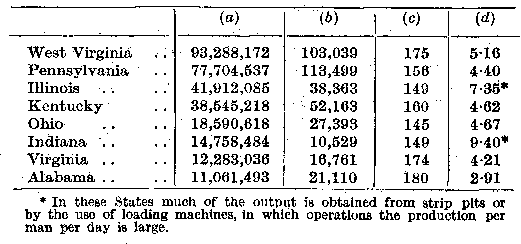
Figures are extracted relating to the chief soft coal producing States showing (a) the total quantity produced in 1938 ; (b) number of employees ; (c) average number of days mines operated ; (d) average tons per man per day. Thus :—
Pennsylvania Anthracite.
Regardless of the fact that production in the anthracite industry has suffered drastic reductions in recent years, it is of great economic importance in the 500 square miles comprising the Pennsylvania anthracite region. The value of anthracite production at the mines in 1939 was 187,175,000 dollars. The volume of output was 51,487,000 tons, an 11.7 per cent. increase on the 46,099,000 tons raised in the year preceding. In the industry's exhibit at the New York World's Fair stokers, furnaces, boilers, cooking stoves, thermostats, and other equipment were on display. Of the 1,152,330 persons who visited the exhibit, thousands saw anthracite as a thoroughly modern fuel for the first time, and there is little doubt that a favourable impression Was made on the consuming public.
The calculated consumption of anthracite — omitting illicit coal — was 49,700,000 tons, a 10 per cent. increase over 1938, the railroads increase being 20 per cent. and that of electric power utilities 14 per cent. The estimated illicit production was 3½-4 million tons or about 8 per cent. of the total output. The main anthracite region embraces three sub-regions, namely, Wyoming, Lehigh and Schuylkill. Of the production from mines 11,773,833 tons was mechanically loaded and 30,797,715 tons was hand loaded underground; strip pits produced 5,486,479 tons. From culm banks the amount produced was 2,583,814 tons, whilst 703,860 tons represents that obtained from river dredging. In all 93,000 men were employed in the anthracite region.
The percentage of total deep-mined production loaded mechanically continues to increase, the figure for 1939 being 27.7 per cent. of the total, and an equivalent increase of 16 per cent. on 1938 as against a 10 per cent. increase hand loaded. Returns indicate the use of 535 scrapers and 1,997 conveyors. There were fewer coal-cutting machines (225 as against 242), but they produced 1,881,884 as against 1,588,407 tons in the preceding year.
Coke and By-products.
The total production of beehive and by-product coke increased about 36 per cent., from 32,495,815 to 44,326,641 net tons. The output from beehive ovens was 1,444,328, and that by by-product coke was 42,882,313 tons or 97 per cent. of the total. The quantity of coal consumed in coke ovens was 63,513,700 tons, the average coke yield in per cent. of coal charges being 69.69. The byproducts included gas, tar, ammonium sulphate or equivalent, crude light oil, and miscellaneous products.
Coke is produced by four different industries in the United States. In addition to that made in the familiar beehive and by-product ovens, it is obtained by refining petroleum and tar, and in manufacturing coal gas. Moreover, within the last few years production of a smokeless fuel by low temperature carbonisation of coal has been established commercially. The commodity produced by each of these processes, however, differs greatly from other cokes in character, and the problems affecting the several industries are quite distinctive. Only coke from byproduct and beehive ovens is adapted to blast-furnace and foundry uses, which consume the larger part of all the coke products.
The terms "furnace coke" and "foundry coke," as used in the trade, refer to the size and grade of the coke as well as to the use for which it may be intended. By-product furnace coke ordinarily is run-of-oven coke from which the breeze and all small coke less than, say, ¾ inch diameter have been removed. Byproduct foundry coke ordinarily is a blocky coke of maximum size much greater than that of furnace coke, from which all sizes under 2½ to 3 inches are screened out. Coke of smaller size than furnace or foundry (exclusive, however, of breeze) often is called domestic coke. It may result from the screening of foundry or furnace coke or, where the principal demand is for domestic coke, may be obtained by crushing the larger fragments.
Briquettes and Packaged Fuel.
The domestic production of fuel briquettes and packaged fuel has risen to 1,107,720 tons. This production seems small compared with Germany's 56 million tons or even the 8 million tons of France. Conditions that favour the operation of plants in Germany are the abundant supplies of brown coal, which can be briquetted without a binder to make a product that finds a ready domestic market.
The development of the industry in the States, however, is symptomatic of the current trend of thought toward conservation of national resources and directs attention to the vast deposits of low-rank bituminous and sub-bituminous coals and lignites, as also to the rapidly diminishing known reserves of petroleum. Briquettes have been made in the States in past years mostly from high-quality, low-volatile bituminous screenings or slack. Asphaltic pitch is the preferred binder in the briquetting of coal and petroleum coke. All but 2.2 per cent. of the total production in 1939 was made in pillow-shape and cylindrical briquettes weighing less than 5 ounces, the pillow shape being the most popular.
Packaged fuel, it may be explained, consists of 3 to 4-inch cubes (usually six to a package), wrapped tightly in heavy paper and sealed with gummed tape. It is made from various types of high-quality coal or coke screenings, usually mixed with a neutral binder. This fuel has achieved its popularity because of its cleanliness and convenience in handling, the purchaser finding it especially adapted to the home equipped with stoves or central heating.
The Minerals Yearbook offers to those whose business it is to collect and study the statistics of the metal and mineral statistics a vast amount of material upon which to work. They will find it a useful work of reference on the progress of the various industries, and readers in North America should be particularly interested in the production.
 |
 |
| Names mentioned in this article | |
 |
 |
| Name | Age | Occupation | Notes |
|---|---|---|---|
| Hughes, H. Herbert |




 Contains public sector information licensed under the

