


| Newspaper Articles |

|
Newspaper Articles |
 |
 |
8th March 1941, Page: 279, Column: 2
Preparation Of Coal For The Market
Coal Breaking.
In the 1938 Report of the Fuel Research Board Dr. F. S. Sinnatt, C.B., referred to certain breaking trials which had been carried out on Scottish coals. The results quoted were on the usual basis of hand-screening of the products after a single passage of the large coal through a jigger-type pick-breaker.
The Director of Fuel Research returns to the subject in his Report for the year ended 31st March, 1939,* and the appended extracts may be of service to readers :—
The normal practice of the colliery concerned was to recirculate through the breaker all material over 3-inch round holes in the products. A more detailed examination of this recirculated, material has been shown to consist of about 75 per cent. of durain whereas the average for the unbroken large coal was 20-25 per cent. of durain. The recirculated material consisted mainly of laminated pieces, of average weight 0.67 lb., and a considerable proportion of them could be made to pass 3-inch round holes by "hand-placing." The failure to pass through in ordinary commercial screening was obviously due to their shape.
The selective action of the breaker in concentrating durain into the oversize fraction was not unexpected, but it is a factor which may usefully be noted for certain applications, and it will undoubtedly play a part in any attempted two-stage breaking. It is therefore of interest to compare the breaking of this oversize material with the breaking of similar sizes of material in the unbroken large coal. With this latter material it has previously been established that, for all pieces over 10 lb. in weight, size had no influence on the screen analysis of the products. For pieces below 10 lb. in weight, the percentage of smaller sizes made decreased in a more or less regular fashion with the weight of the pieces. For comparison with the breaking of the recirculated material two results from the previous series of tests applicable to unbroken large coal pieces are included in the table.
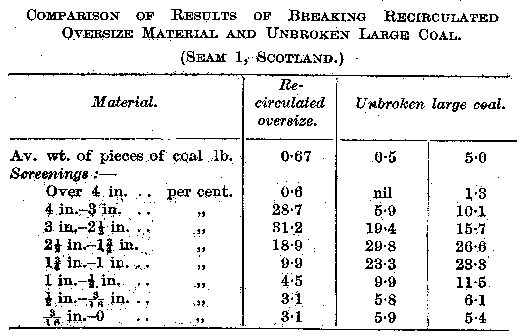
The pronounced difference in breaking properties of the two materials will be noted. An examination of the products from the breaking of the oversize established the following interesting facts :—
(a) Some of the pieces had obviously passed through the machine without further fracture.
(b) Several pieces of durain had remained unbroken despite the fact that they bore pick marks as deep as ½ inch.
(c) There was a further definite concentration of bright coal into the smaller sizes. The material below 3/16 inch consisted almost entirely of bright coal.
Breakage of Coal.
Transport, Storage and Handling. — The original programme of work on these subjects has now been completed, the only outstanding items at the end of the previous year being certain storage experiments on two South Yorkshire coals. In the 1938 report the breakage which occurred when the South Yorkshire coal R was put down on the storage ground and immediately picked up and re-screened, was mentioned. The actual amount of duff (below 3/16 inch) made in this operation was given as 1.6 per cent., and the total amount found after 6-12 months' storage was 1.45-2.4 per cent. The obvious discrepancy in these results is probably due to some lack of uniformity of treatment, but possible variation of the material in the different heaps examined cannot be ruled out. In spite of this discrepancy it appears that although the coal was moved and screened with care, this handling was responsible for a considerable proportion of the observed breakage.
Certain interim results of this work carried out on a variety of coals have been reported in the last three annual reports, and it is now possible to review the work and compare the behaviour of the Coals examined. The method of procedure was to take an adequate sample (about 2,000 lb.) of the coal at the colliery while it was being loaded into the wagon and to screen this sample as gently as possible on round-hole screens. On arrival at the Fuel Research Station the whole wagon-load of coal was screened in the same way as the sample had been screened at the colliery, in order to assess the breakage on transport.
The breakage due to storage was assessed by screening one of the stored heaps after six months, another after nine months and the third after twelve months. The residual strength of the correctly-sized material was determined by trommeling.
It was observed that two main types of breakage occurred in these experiments. With some coals the particles tended to split mainly along the bedding planes, and so give rise to a relatively large size of undersize. With other coals the tendency for small pieces to break from large pieces was more marked, and so relatively large proportions of duff (below 3/16 inch size) were observed.
In general, increases in the amount of large undersize spoil the appearance of graded coals, but the presence of such material is not so deleterious as that of duff. The presence of fine coal in graded sizes can be serious both to the producer and to the consumer, and for this reason it is generally admitted that relatively small increases in the duff content are significant.
A table prepared by the Director shows that the method of handling the coal at the colliery can make a considerable difference to the amount of breakage on transport, and probably to other breakage also. In an extreme case the difference between carefully hand-screened nuts direct from the breaker and nuts which had been "punished" by rough treatment on the colliery soreena is the difference between 3.1 and 0.8 per cent. increase of duff. It must not be overlooked, however, that the "punishment" referred to was undoubtedly responsible for a considerable loss of yield. The differences in the breakage properties of the coals from different coalfields are very marked.
In all instances where all causes of breakage have been separately analysed, the breakage on transport was relatively small and those coals which arrived containing considerable proportions of undersize changed very little from the "as loaded" condition.
Influence of Dustproofing on Degradation in Storage. — Claims have been made that dustproofing treatment reduces degradation on storage, but the results of a test on coal treated with calcium chloride solution do not in general support this claim. On the basis of the results obtained after 4 months' storage, the treatment of South Wales steam coal with just under one gallon per ton of oil appeared promising, but later results indicate a reduction in the formation of undersize that is hardly significant when account is taken of experimental errors.
It is unwise to generalise from the one result shown for calcium chloride solution, but it is certainly not very promising. Only in two instances could any differences in strength be detected; and in both cases maximum quantities of oil had been used. These were the Warwickshire and the Durham coals, and the reductions of undersize formed on trommeling by comparison with untreated material were 13.5 and 27.0 per cent. respectively.
* H.M. Stationery Office. Price 3s. 6d. net.
 |
 |
| Names mentioned in this article | |
 |
 |
| Name | Age | Occupation | Notes |
|---|---|---|---|
| Sinnatt, Frank Sturdy, Dr. | Director of Fuel Research | Whos Who Page |




 Contains public sector information licensed under the

