


| Newspaper Articles |

|
Newspaper Articles |
 |
 |
8th March 1941, Page: 275, Column: 1
Bearing Lubrication
By R. G. Pomeroy.
[A paper on the "Significance of Safety Factor in Bearing Lubrication" was read by Mr. R. G. Pomeroy at the December meeting of the South African Institution of Engineers. The paper is given in the Journal of the Institution, from which extracts are appended.]
Confusion in the selection of lubricants often arises from the difficulty of "weighing" the variety of factors which enter into the problem, and insignificant factors are often permitted to cloud the main issues. This is evidenced by the continued substitution of heavier oils whenever machine parts fail or run hot.
The results of tests of the physical and chemical properties, factors of safety, and limitations of most engineering materials correlate fairly closely with actual service performance. In the case of oils, however, the results of laboratory tests often bear little or no relation to the actual performance of an oil in service, and this still is a deterrent to satisfactory oil specifications. In practice a great variety of operating conditions and types of bearings is met, and it is impracticable to simulate all, or even a small number, on laboratory testing machines, but such machines have served to confirm many of the mathematical laws of lubrication mentioned in this paper. At the outset, therefore, it must be appreciated that the choice and application of high quality lubricants to the diverse needs of modern machinery, call for specialised knowledge and a keen appreciation of the mechanical conditions and lubricating requirements involved.
Lubrication is no longer regarded simply as a means of decreasing metallic friction. It has long been known that the rubbing surfaces of a machine may be completely separated by a thin film of oil which transmits all the forces on the bearing and minimises wear of the surfaces. This is fluid film lubrication, and includes all cases of frictional resistance between solid surfaces completely separated by a film of fluid of sufficient thickness to conform with the laws of fluid flow. Other types of friction are :—
(a) Dry or solid friction which occurs between, perfectly clean, dry, solid surfaces ;
(b) Rolling friction ; and
(c) Boundary or thin film friction.
The last named occurs between solid surfaces separated by a greasy layer or film of such extreme thinness that the inter-molecular forces between the fluid and the solid surfaces play a part and determine the character of the frictional resistance. The minute film no longer exhibits the same properties of the lubricant as in the case of thick film fluid friction.
Viscosity.
Viscosity is the internal friction of a fluid or the resistance to internal movement or shear, and is brought about by the effect of the intermolecular forces within the fluid which cause the molecules to offer resistance to motion of the one over the other. The obvious way, therefore, of measuring viscosity is to measure this resistance to shear, and, in scientific work, the expression "Absolute Viscosity" is applied to observations of this type expressed in fundamental units of time, force and mass.
Newton's law states that at any point in a fluid the shearing stress is directly proportional to the rate of shear.
All mineral lubricating oils, in common with most liquids, become thinner on heating and more viscous on cooling. Brillie explains this phenomenon by the fact that the cohesion of a liquid results from the fields of force which constitute the molecules, and that the average distance between the centres of the fields of force is constant for a given temperature but increases rapidly with the temperature, resulting in a decrease in viscosity or internal friction.
Whereas temperature has the effect of thinning lubricating oils, pressure increases their viscosity. The influence of pressure on the internal friction of liquids has been known for some time, but engineers have not allowed for it in lubricating problems because of the comparatively low pressures generally employed in bearings, and because of lack of precise information about the behaviour of different types of oil when under pressure.
Specific Gravity and Density.
The specific gravity of a petroleum oil is the ratio Of the weight of a given volume of oil, at a temperature of 60°F., to the weight of an equal volume of distilled water at the same temperature, both being corrected for the buoyancy of air.
The specific gravity of an oil has no real relationship to service conditions, except possibly with siphon oilers and the separation of the oil from water, and, apart from its uses in Teflning, it is also of service for weight volume calculations and conversions from kinematic to absolute viscosity. For such conversions it is necessary to know the density of an oil at a given temperature. This value is obtained by multiplying the specific gravity of the oil at 60°F. by the density of water at 60°F., and this latter figure is usually taken as 0.999. The density of the oil at other temperatures can then be calculated from —
D = d — kt,
where D — the required density, d — the density of the oil at 60°F., k = 0.00035 for mineral lubricating oils, t = the temperature above 60°F.
Hydrodynamic Theory. — The hydrodynamic theory, which explains the load carrying power of the oil film, assumes that
(a) the bearing is absolutely rigid ;
(b) the journal is in perfect alignment with the bearing ;
(c) the load is steady ;
(d) there is streamline flow in the oil film ;
(e) there is no side or end leakage ;
(f) the viscosity across the oil film is constant; and
(g) the bearing and journal are geometrically perfect.
Surface Irregularities.
All machined or ground surfaces, When examined under a microscope, will be seen to have a series of projections and depressions.
It might be argued that even if the minute projections on the shaft and bearing were to come into contact, the "oiliness" of the lubricant should prevent seizure and the running-in process would remove the major high spots. This will depend on the finish of the machined surfaces, and, whilst a certain amount of initial wear might take place during "running-in" without detrimental results, continued operation under thin film conditions is undesirable in the case of certain classes of machinery owing to the increase in the coefficient of friction and consequently the power loss.
Coefficient of Friction.
Dry or solid friction is measured by the force parallel to the surface required to make a body of a given weight slide over a horizontal surface. The ratio of the force required to the weight of the body is called the coefficient of friction. The coefficient of static friction is applied to cases where motion is imparted to the body from rest, and the kinetic coefficient refers to the frictional resistance to be overcome to keep the body in motion. The case of pure solid friction is quite rare and the laws of solid friction are mostly empirical. Only rough approximations result from the difficulty of obtaining really "clean" surfaces.
In the case of bearings involving rotary motion the coefficient is defined as the ratio of the equivalent friction to the total load, the equivalent friction being the ratio of the friction torque to the radius. It will be seen that, by using the above definition, a freak case can occur when the load is zero, the coefficient then being infinity. In accordance with Newton's Law, viscosity may be defined as the ratio of the shearing stress to the rate of shear.
Or S = ZR,
where S = the shearing stress, Z = the absolute viscosity of the oil, R = the rate of shear.
If F is the total tangential friction force, D the diameter, and L the length of the bearing, then
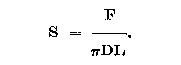 When the oil film is of even thickness, that is in the ideal case, the rate of
shear R is equal to the velocity divided by the thickness of the film,
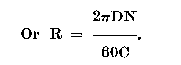 From first principles, then, it would appear that, in the ideal case which is
only approached in practice, the total friction force
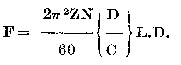
This relation is based on the assumption that the journal runs concentrically with the bearing, a condition not realised in practice. The above equation also shows that the friction torque would be independent of the load, but the load has the effect of varying the film thickness. The assumption of even film thickness and uniform velocity in the film cannot, therefore, be used and eccentric running of the journal in the bearing brings about a difference between the torques on the bearing surface and journal. Side or end leakage will also influence the coefficient of friction.
Oiliness. — This property is often considered to be the panacea for all lubricating troubles, but under thick film conditions it plays no part. Its importance is not denied, however, in cases where the quantity of oil supplied to a bearing is small, where loads are extremely heavy, or where the mechanical or operating conditions are such that the formation of a continuous stable fluid film is prevented.
 |
 |
| Names mentioned in this article | |
 |
 |
| Name | Age | Occupation | Notes |
|---|---|---|---|
| Pomeroy, R. G. |




 Contains public sector information licensed under the

