


| Newspaper Articles |

|
Newspaper Articles |
 |
 |
8th February 1941, Page: 241, Column: 1
Storage Of Coal
Space has been devoted in recent issues to the paper by Messrs. Frank Scarf, Douglas A. Hall and Cecil W. Yearsley on "The Storage of Coal : Effects without Rise in Temperature."
Some of the problems associated with the storage of coal are discussed in the last Report of the Fuel Research Board (3s. 6d. net, H.M. Stationery Office). It is the practice in a number of industries to store considerable quantities of coal, and the characteristic affected most rapidly during the storage is that of the caking power.
An investigation into the effects of weathering during storage, carried out in two experimental dumps laid down in the Forest of Dean, is discussed in the Report. Several different grades of coal from the Coleford High Delf seam were stacked at the Cannock and Princess Royal Collieries in order to examine particularly the loss of caking power and volatile matter during storage. The heaps of coal were sufficiently small (10 tons) to prevent appreciable self-heating. The experiments showed that the effects of storage increased, though not proportionately, with decreasing particle size. In grades larger than ½-inch the changes in two or three years were hardly measurable, except in the caking properties, the results thus confirming the view that caking power is the most sensitive criterion of deterioration on storage. For "pearls" after 28 months' storage the oxygen content rose from 7.62 to 8.34 per cent., a difference sufficient to account for the greater part of the changes in other analytical data.
The Edinburgh Experiments.
In the work carried out by the Edinburgh Corporation Gas Department at their Granton works twenty Scottish coals were systematically laid down in heaps of about eight tons each. They covered the range from caking to non-caking, and with four exceptions were run-of-mine ; the exceptions were washed coking smalls. In addition seven coals were laid down in 200-ton heaps and tested initially and after 44 months in a setting of Woodall-Duckham continuous vertical retorts.
The Report states that the information obtained from analytical data was generally in agreement with existing knowledge. A loss of caking properties Was clearly demonstrated, the poor caking coals losing these properties entirely whereas those of higher caking power retained sufficient to form a fairly coherent coke. The loss in calorific value was slight even after the maximum period of storage. Cannel coals changed little if at all. The small-scale carbonisation tests in horizontal retorts showed a tendency for the calorific value of the gas and the yield of gaseous therms to fall. These losses were not quite equivalent and there was a slight fall in the gas yield by volume. The proportion of breeze increased, especially with coals that had initially low caking power. Similarly in the vertical retorts, the coke produced showed an increase in the amount of breeze it contained, and the coke from the coals with only a small reserve of caking properties was sometimes not large enough to prevent the coke from running through the extractor at the bottom of the retort during the discharging process.
The general conclusion is that storage is likely to be very unprofitable with a coal that has not a reserve of caking properties great enough to enable, it, at the end of its period of storage, to form a satisfactory lump coke and to be satisfactorily controlled during the operation of the retort. If the caking properties are initially high enough, they may fall and still be sufficient after a period of storage to produce a satisfactory coke ; but before a coal is selected for storing some knowledge of its suitability from this point of view is necessary. Since the gas yield is but little affected by storage, the deciding factor in assessing the suitability or otherwise of certain coals might well be the deterioration of coke quality.
Storage Under Water.
From time to time interest is aroused in the storage of coal under water. It is known that under-water storage is resorted to in a few isolated places, primarily for safety's sake, and occasionally to mitigate the dust nuisance ; however, there is no systematised information available on the practice and consequences of under-water storage.
By the courtesy of Lambton, Hetton and Joicey Collieries, Ltd., of Co. Durham, the Fuel Research Board is able to record an observation bearing on the deterioration of coal under water, as follows : At the Company's coke works there is a spoil bank of pit and washery refuse abutting on a pond, of which it forms a bank some 200 yards long. The bank contains some good coal, and some of this coal, which had lain for at least ten years below the level of the pond, which does not vary, was taken up and examined. There is, not unnaturally, no analysis of fresh coal actually corresponding to the original coal, but the accompanying table shows a comparison between the old coal and the fresh as marketed at the present day, together with an indication of the range of the figures representing the general run of the good coal as it was when the spoil was formed. In order to avoid an effect due to the contamination of the material, especially the old coal, by dirt or washery tailings, the analyses were conducted on fractions floating in a liquid with a specific gravity of 1.4.
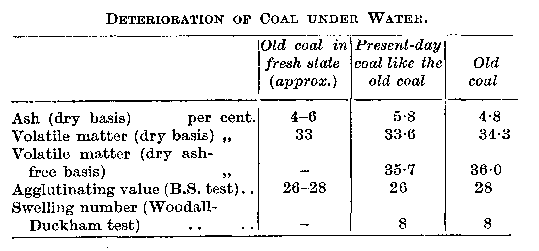
This isolated set of observations, says the Director of Fuel Research, suggests that under-water storage has the desirable effect of nearly or completely suppressing deterioration. Since the old coal is perfectly preserved in caking power, it is likely that no other deterioration would be detectable. Incidentally, it may be mentioned that this particular type of Durham coal is usually susceptible to the deleterious effects of exposure.
 |
 |
| Names mentioned in this article | |
 |
 |
| Name | Age | Occupation | Notes |
|---|---|---|---|
| Hall, Douglas A. | |||
| Scarf, Frank | |||
| Yearsley, Cecil W. |




 Contains public sector information licensed under the

