


| Newspaper Articles |

|
Newspaper Articles |
 |
 |
11th January 1941, Page: 218, Column: 2
Old Documents Re-Examined — IV
Theory and Practice 50 years ago
Arc Lamps
The Johnson and Phillips open type focusing arc lamp is differential in operation. Its striking and feeding mechanism consist of a brake wheel and two solenoids. When the lamp is not in use an adjustable weight, attached to the positive holder, keeps the carbons in contact. When current is switched on the series coil sucks its core downwards, and in doing so imparts an upward motion to the other end of the yoke to which it is attached. This motion is impeded by the resistance of the dash-pot, and the consequent jerk, due to the sudden pull of the core of the series coil, is suitably cushioned. The brake grips the wheel and turns it round, winding up the flexible copper strip of the positive carbon, at the same time unwinding the silk cord attached to the negative carbon. The carbons are drawn apart, and the arc is struck. The lamp is made in two types, one burning 12 to 14 hours, and the other 18 hours.
Mr. F. Billioti, referring to the double lamp of the Johnson and Phillips type, says : This lamp is designed on the same principle as the single lamp, but two sets of carbons are placed side by side, and there are two brake wheels, one for each set of carbons, although there is only one pair of solenoids. The two brakes are so set in relation to each other that one set grips the brake wheel a little in advance of the other, and causes the carbons to come apart, while the others are still in contact, thus breaking that particular circuit and causing the other set to strike the arc. When these carbons are burned out, the arc is struck immediately by the other set as the first set of carbons are apart and the circuit is open. In order to keep the first set of carbons apart, and to prevent the burning of the carbon-holders, the lengths of the flexible strips are adjusted so as to prevent the feed from taking place any further ; both carbons coming, therefore, to a standstill, the arc dies out . . . . The two sets of carbons are set to work one after the other, and come into action automatically, thus reducing considerably the expense of trimming, a very important consideration when lamps are placed at a long distance from the central station.
The globe is fixed to a ring which is attached to the lamp body by two spring cams ; two internal rods sliding through the bottom frame of the lamp serve to steady it. For trimming, the two spring cams are disengaged, and the globe gear slides down, remaining suspended to the lamp body.
. . .
There are two types of Crompton arc lamp, the "S" lamp and the "SS." The "S" lamp is of the vertical carbon pattern, the carbon holders being attached to flexible cords, which carry the current and are wound in opposite directions on two drums, insulated from each other by a mica disc, but arranged to rotate on the same axis. A third drum, of a larger diameter, is also mounted on the same axis, and the striking and feeding of the lamps are actuated by a band brake passing over this drum. The top of this band brake is attached to a rocking lever, to the two ends of which are hung two mild steel cores, one of these hanging inside a solenoid, which is wound with thick wire, and the windings of which arc coupled in aeries with the arc. This coil is called the main solenoid. The core, on the other end hangs in and is controlled by a similar solenoid, wound with flue wire, and coupled in parallel with the arc. This is the shunt solenoid. These two solenoids are so placed that when the main solenoid attracts its core downwards the lever lifts the brake cord, the lower end of which is attached to a flat spring.
To fulfil certain conditions and requirements the "SS" lamp was designed. It was similar in design with this difference : There are two sets of drums, each controlling one pair of carbon holders, each acted upon by a separate brake cord attached to a separate spring, the tops of the two brake cords, however, being attached to the same lever, which is acted upon by a main and shunt solenoid as before.
. . .
In the type of flame arc manufactured by Messrs. Crompton and known as the Crompton-Blondel system, the design of the well-known "S" type arc lamp has been modified, and new features have been introduced, notably in regard to the arrangement of the carbons (the positive being below the negative) and the ventilation of the globe. The carbons used are heavily mineralised, and give a long and curious shaped flame of great intensity, emitting light of a pale yellow or primrose colour which is most pleasant to the eye. The colour has been described as a mean between the orange-coloured light given by most of the inclined carbon lamps and the white light of the ordinary arc. Most of the light is given out by the flame itself, which is of considerable length, other light coming from the incandescent ends of the carbons, and a certain amount being reflected from the surfaces of the economiser which when in use rapidly becomes coated with a fine white deposit well suited to this purpose.
Horse-power.
The unit, by which the work performed by engines and machinery is usually measured is termed horse-power. As power is rate of work its conception necessarily involves the consideration of the element of time. One horse-power = 33,000 foot-pounds per minute.
Nominal Horse-power. — This term is meaningless.
Indicated Horse-power. — This term is used to express the power expended by the steam in driving the piston. The power of an engine is the product of the mean pressure acting upon the piston throughout its stroke, the area of the piston, and the piston speed.
Rule. — Multiply the area of the piston in inches by the mean pressure per square inch, and by the piston speed in feet per minute ; dividing the product by 33,000 the quotient is the indicated horse-power.
Or,
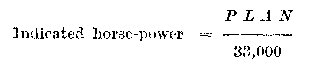
Where —
P = Mean pressure on piston in lb. per square inch ; L = Stroke in feet; A = Area of piston in square inches ; N = Number of strokes per minute.
Brake Horse-power is the power available for external work.
Mechanical Efficiency. — This term expresses the proportion of the indicated power to the total available for external work.
Rule. — Brake power divided by indicated power = mechanical efficiency) or
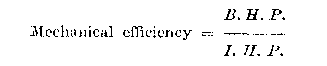
Where,—
B.H.P. — brake horse-power ; I.H.P. — indicated horse-power.
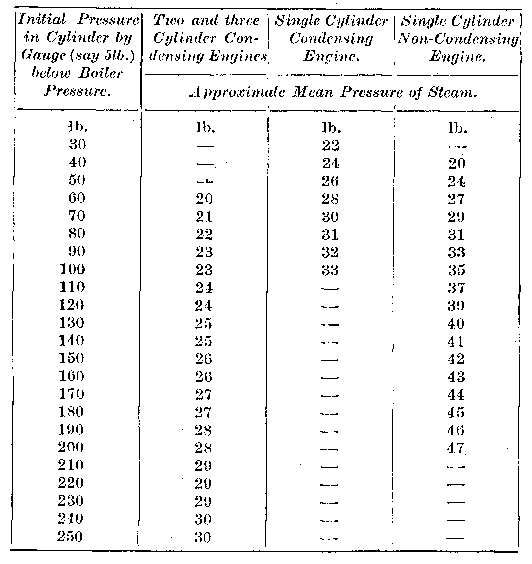
Mean Pressure.
The following table, in which the terminal pressures given are those which experience has shown to give the best results, will be found very useful in calculating either the horse-power obtainable from any given cylinder, or conversely the size of cylinder required for any given horse-power. The table may be relied upon to give closely approximate results. Allowance has been made for back pressure. Of course, initial condensation losses are variable quantities increasing with the ratio of expansion, and for this reason an additional pound or so may be subtracted from the mean pressures given in the higher ratios of expansion — especially for single cylinder engines.
 |
 |
| Names mentioned in this article | |
 |
 |
| Name | Age | Occupation | Notes |
|---|---|---|---|
| Billioti, F. |
 |
 |
| Related Articles | |
|
|
| Pub. Date | Article (Newspaper) |
|---|---|
| 14 Dec 1940 | Old Documents Re-Examined — II, A.C. Motors (The Science and Art of Mining) |
| 28 Dec 1940 | Old Documents Re-Examined — III (The Science and Art of Mining) |
| 11 Jan 1941 | Old Documents Re-Examined — IV, Theory and Practice 50 years ago (The Science and Art of Mining) |
| 25 Jan 1941 | Old Documents Re-Examined — V, Theory and Practice 50 years ago (The Science and Art of Mining) |
| 22 Feb 1941 | Old Documents Re-Examined — VI, Theory and Practice 50 years ago (The Science and Art of Mining) |
| 08 Mar 1941 | Old Documents Re-Examined — VII, Theory and Practice 50 years ago (The Science and Art of Mining) |
| 22 Mar 1941 | Old Documents Re-Examined — VIII, Theory and Practice 50 years ago (The Science and Art of Mining) |



 Contains public sector information licensed under the

