


| Newspaper Articles |

|
Newspaper Articles |
 |
 |
11th January 1941, Page: 218, Column: 1
Coal Ash
With further reference to the Annual Report for the year ended March (1939) of the Fuel Research Board (3s. 6d. net, H.M. Stationery Office), there are one or two notes on work undertaken and revealing unusual elements in coal ash. As Dr. F. S. Sinnatt says, although usually present in very small amounts, certain of these elements are known to exert a considerable influence on the behaviour of the coal in certain processes. Sensitive methods for the detection and estimation in the presence of large amounts of other elements are therefore being developed.
In the section on the Survey of the National Coal Resources it is recorded that coal samples have been taken and examined of the Queen and Top Queen or Prince seams from a colliery in the northern part of Denbighshire. These seams proved to be of outstanding quality, both the ash and sulphur contents being exceptionally low. In the course of measuring up the pillar sections of these seams it was noticed that silvery flakes were present on the surface of the bright coal in the top part of the sections. When pieces of coal abounding in these flakes were picked out, lead was found to be present in the ash, and further investigation showed that the flakes consisted of galena. A sample of the ash from the Top Queen seam was examined spectro-graphically by the National Physical Laboratory. This examination showed that, in addition to the usual elements present in coal ash, analytical amounts of lead, boron and germanium were present, together with smaller quantities of barium, strontium, lithium, tin, zinc, nickel and cerium.
Boron. — This element has previously been reported in coal ash, but no quantitative work appears to have been carried out. A method of determination has been devised, employing the well-known separation of boron by the distillation of methyl borate.
Germanium. — The ash was prepared under oxidising conditions at as low a temperature as possible. The method of determination Was that devised at the Fuel Research Station.
As to the abnormal composition of samples of vitrain from "cauldron bottoms" in the roofs of Northumberland and Durham coal seams, these vitrains gave ashes containing relatively large amounts of titanium and nickel, and appreciable amounts of less common constituents of coal ash, such as vanadium, chromium, lead and germanium. Possible explanations of these unusual occurrences include derivation from the mineral matter in the Coal-Measure vegetation, and the selective leaching out of silica under alkaline conditions. It is pointed out that neither of these explanations accounts for the presence of so much nickel nor for the presence of comparatively rare elements. Further investigation of possible causes is in progress.
Under the sub-head Methods of Analysis of Coal and Coke the statement is made that the less common constituents of coal ash, occurring generally in traces, are assuming more importance each year, particularly when catalysis is being considered. It is therefore becoming necessary to have trustworthy tests, both qualitative and quantitative, for a wide range of elements, and the tests are required to be sensitive to minute amounts of the elements sought in the presence of relatively large amounts of other elements.
Co-operation with the British Standards Institution has been extended to a consideration of the factors influencing the determination of ash from coal or coke. One of the factors that has received comparatively little attention previously, but is now under investigation, is the effect that the products of combustion of one coal may have on the ash from another when several samples of coal are incinerated simultaneously in one furnace. The problem has been noted at the Birmingham and Nottingham Coal Survey Laboratories, in particular with reference to contamination by sulphurous gases. It is known from the work at the latter laboratory that contamination can be reduced to a minimum if the rate of heating is carefully controlled, so that the temperature of the coal is raised to 400°C. in 30 minutes, maintained at 400°C. for 30 minutes, then raised to 800°C, and the heating continued for one hour at that temperature. Examples showing the uniformity of results from six determinations carried out simultaneously on 1 g. portions of coal, and also the divergence introduced by the older and more rapid heat treatment (up to 800°C. in one hour, maintaining this temperature for a further hour) are given in the table, herewith :—
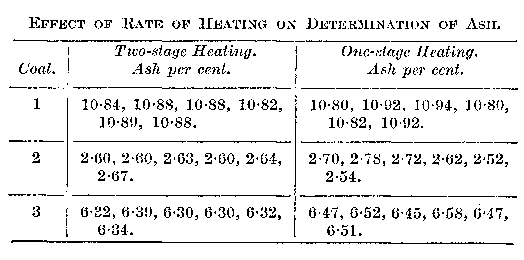
It will be observed that the slower rate of heating gives a slightly lower amount of ash with each coal ; this was shown to be due to a decrease in the amount of fixation of oxides of sulphur, which was considered to be the effect of oxidising the sulphur compounds at a temperature sufficiently low to ensure relative inactivity of the bases in coal.
The Report informs that in some laboratories where a complete accurate analysis of coal ash may not be necessary there is still need for more rapid methods of determining the amount of one or more of the main constituents of ash, with possibly a slight loss of accuracy. Such methods must be as simple and direct as possible, involving little or no separation work. Various methods of this type are being examined with regard to their application to coal ash and to the possible loss of accuracy involved. A good example of this direct typo is the method used for determining calcium, where, after removing silica by hydrofluoric acid treatment and adding tartaric acid to prevent the precipitation of hydroxides, calcium is precipitated as oxalate, giving a result which is usually low to the extent of about 0.5 per cent. of the ash.
 |
 |
| Names mentioned in this article | |
 |
 |
| Name | Age | Occupation | Notes |
|---|---|---|---|
| Sinnatt, Frank Sturdy, Dr. | Whos Who Page |




 Contains public sector information licensed under the

