


| Newspaper Articles |

|
Newspaper Articles |
 |
 |
28th December 1940, Page: 203, Column: 1
Old Documents Re-Examined — III
A two-phase alternator is simply a single-phase machine with two independent windings spaced 90° apart — that is, the. two windings are displaced one-half of the distance between any one pair of poles. Bach phase must be considered independently. For instance, if a 1,000 kilowatt two-phase alternator is designed so that its potential is 2,500 volts, each phase gives 2,500 volts and develops 500 kilowatts.
. . .
"In high-speed engines," Mr. T. H. Massey pointed out, "carrying high pressure it is also advisable to give the valve an amount of lead or opening before the piston reaches the end of its stroke. This is necessary to check the piston before it reaches the end of its stroke, by cushioning the moving mass gradually, thus bringing the piston to a momentary standstill by the steam from the boiler acting upon it directly. It will also be obvious that a piston of great weight and high velocity will require more lead than a piston of less weight travelling at the same velocity."
. . .
It is frequently desirable to know what number of one-sized pipes will be equal in capacity to another given pipe for the delivery of steam, air, or water. At the same velocity of flow two pipes deliver as the squares of their internal diameters, but the same head will not produce the same velocity in pipes of different sizes or lengths, the difference being usually stated to vary as the square root of the fifth power of the diameter. The friction of a fluid within itself is very slight, and therefore the main resistance to flow is the friction upon the sides of the conduit. This extends to a limited distance, and is, of course, greater in proportion to the contents of a small than of a large pipe. It may be approximated in a given pipe by a constant multiplied by the diameter, or the ratio of flow found by dividing some power of the diameter by the diameter increased by a constant. The following is a close approximation to the relative flow in pipes of different sizes under similar conditions :—
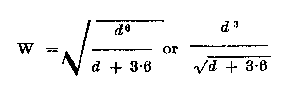
W being the weight of fluid delivered in a given time, and d being the internal diameter in inches.
. . .
In any engine running at high speed the moving parts can only be kept in compression upon the up-stroke by very powerful cushioning. Sometimes, when a high speed engine exhausts into a vacuum, sufficient cushion cannot, by the usual means, be obtained at all. In the Willans engine the requisite cushioning is obtained independently of compression in the cylinders. It is provided by the guide pistons. On the up-stroke these compress the air contained in the guide cylinders, and thus any desired amount of cushion can be obtained, according to the clearance allowed. The work expended in compressing the air is given out again by its expansion on the succeeding down-stroke — the loss, as proved by indicator diagrams, being negligible. There are holes in the guide cylinders which are uncovered by the guides at the bottom of the stroke. As the casing or chamber surrounding the guide cylinders is open to atmosphere, air compression always commences at atmospheric pressure, and is always constant and invariable in its results, whatever alteration may be made in the exhaust steam pressure.
. . .
In practical work the voltmeter and ammeter are of paramount importance. They are essential to the switchboards of all lighting and power systems. Except in the case of electrostatic instruments, the voltmeter consists of many turns of fine wire of a high total resistance, and is connected in parallel; the ammeter, consisting of a few turns of thick wire, is connected in series.
The Weston ammeter is an instrument of the permanent magnet type. Its construction may be briefly described as follows : Soft-iron pole pieces, hollowed out so as to form a cylindrical cavity, are attached to the poles of a horse-shoe magnet. In the space between the pole-pieces a soft-iron cylinder is introduced. This cylindrical core is embraced by the moving coil to the ends of which hair springs of phosphor bronze are attached. The outer end of the top spring is soldered to an arm projecting from a small slotted circular plate. This plate may be rotated through a small angle by slackening two small screws, and the pointer may then be adjusted to the zero of the scale when no current is passing through the instrument. Both the pointer and the frame on which the coil is wound are of aluminium. By the "damping" effect produced by the motion across the field, the instrument is rendered "dead-beat," by which is meant that the pointer indicates the current passing at the moment of observation without oscillating to parts of the scale under and above the correct reading.
Permanent-Magnet instruments are of the class known as polarised instruments. With them a reversal of the direction of the current produces a reversal of deflection.
Soft-Iron Ammeters. — The principle of all such instruments may be concisely stated by saying that any mass of soft-iron always tends to move from weak to strong regions of a magnetic field. The movable part of the instrument is a piece of soft-iron, and the fixed part is either a coil or a coil provided with a core.
 |
 |
| Names mentioned in this article | |
 |
 |
| Name | Age | Occupation | Notes |
|---|---|---|---|
| Massey, T. H. |
 |
 |
| Related Articles | |
|
|
| Pub. Date | Article (Newspaper) |
|---|---|
| 14 Dec 1940 | Old Documents Re-Examined — II, A.C. Motors (The Science and Art of Mining) |
| 28 Dec 1940 | Old Documents Re-Examined — III (The Science and Art of Mining) |
| 11 Jan 1941 | Old Documents Re-Examined — IV, Theory and Practice 50 years ago (The Science and Art of Mining) |
| 25 Jan 1941 | Old Documents Re-Examined — V, Theory and Practice 50 years ago (The Science and Art of Mining) |
| 22 Feb 1941 | Old Documents Re-Examined — VI, Theory and Practice 50 years ago (The Science and Art of Mining) |
| 08 Mar 1941 | Old Documents Re-Examined — VII, Theory and Practice 50 years ago (The Science and Art of Mining) |
| 22 Mar 1941 | Old Documents Re-Examined — VIII, Theory and Practice 50 years ago (The Science and Art of Mining) |



 Contains public sector information licensed under the

