


| Newspaper Articles |

|
Newspaper Articles |
 |
 |
28th December 1940, Page: 193, Column: 1
The Storage Of Coal
Effects Without Rise in Temperature
By Frank Scarf, Douglas A. Hall, and Cecil W. Yearsley.
From paper presented at recent meeting of the South Staffordshire and Warwickshire Institute of Mining Engineers. Investigation carried out by the Fuel Research Board and published by permission of the Department of Scientific and Industrial Research.
Processes Due to Storage.
As soon as the atmosphere is allowed access to coal in mining operations two processes are initiated : the first, a chemical change, is oxidation, while the second is of a physical nature, namely, disintegration or size degradation, i.e., change in size grading. Under any given storage conditions the rapidity of these processes depends upon the size grading and the rank of the coal, but they doubtless occur even in large anthracite. In lignites, oxidation is so pronounced as to preclude the possibility of bulk storage in open dumps, and in bituminous coal storage precautions have to be taken to prevent spontaneous ignition. It is evident that when severe heating occurs the effects upon the nature and composition of the coal will be mainly a function of the temperature attained and its duration, and thus deterioration of every possible degree between the just measurable and that representing total combustion could be experienced. Were it not impracticable, therefore, it would be preferable to leave coal in situ until it is required. In practice, however, the methods of coal production, distribution, and utilisation render it necessary that reserves of wrought coal should be available. Storage dumps form the most convenient reservoir ensuring steady flow between winning and utilisation. It is difficult to estimate, even roughly, the amount of coal in storage at any time, but it must aggregate many millions of tons. The U.S.A. Bureau of Mines estimated the amount of coal in stock during the decade 1916-1925 as varying between 20 and 63 million tons. These figures are exclusive of household stocks, and represent mainly those held by industrial and power-plants. On the basis of these figures it seems likely that, even in normal times, in Great Britain similarly held stocks may approximate up to 20 million tons ; on this quantity a deterioration of quality amounting to 1 per cent. represents a wastage of up to 200,000 tons.
Except in cases where it is possible to exclude oxygen almost completely (e.g., under-water storage), the phenomena referred to above proceed in all stored coal and must represent a very large annual fuel wastage. Where it is not practicable to eliminate this loss by exclusion of air from stocks it can be minimised by observing during the formation of dumps precautions which are directed towards securing a low rate of oxidation by the prevention of spontaneous heating. The recent general trend towards the more scientific use of coal has brought with it a wider appreciation of the fact that coal does deteriorate during storage. It has also revealed a lack of systematic and co-ordinated data on the subject; at the same time it has provided users with a supposed cause for complaint, which, in many cases at least, is based only on a marred appearance of the fuel. In this way, very poor weathering qualities have been imputed to Coleford Highdelf coal from the Forest of Dean. The present work gives no support to such a reputation ; it has been shown that this coal, in size grades of over ½ inch, suffers no serious deterioration during two years of storage at atmospheric, temperatures.
Points not Realised.
The fact that coal undergoes alteration during the interval of time between its mining and its eventual consumption appears to have been known for a considerable time. It is probable that attention was first drawn to it by the phenomenon of spontaneous combustion, which would undoubtedly occur as soon as the practice of placing mined coal in large heaps was adopted, whilst the necessity for taking precautions against such combustion had not been realised. That coal is affected by exposure to the air when there is no visible evidence of heating or combustion, appears not to have been recognised until about the middle of the last century.
Many investigators into the loss of calorific value of coal during storage have failed to take account of the effects of changes in weight due to absorption of oxygen or to changes in the quantity and character of the mineral constituents in the fuel. As a result of the process of weathering it is generally held that coal increases in weight (at normal temperatures) and suffers a decrease in carbon-content, volatile matter, and calorific value. Frequently there has been a failure to make allowance for weight changes in computing the latter losses, but more recently reliable investigators have recognised that, so long as the temperature of the coal does not reach a point at which carbon oxides are evolved, the reduction in carbon percentage is mainly or wholly due to the dilution caused by increase in weight. On the other hand, the reduction in calorific value is due not only to dilution but also to oxidation, and is therefore greater than the decrease in carbon percentage, being to some extent a real loss. There appears to be a general consensus of opinion that even where heating has not been observed the apparent loss in calorific value may be as much as 10 per cent., but it is evident from more recent work that the real loss is very much smaller and may be negligible. Nevertheless, even where the whole of the apparent loss has been accounted for by the gain in weight, on purely theoretical grounds the chemical absorption of oxygen must necessitate an evolution of heat-energy, and this heat represents an equal amount which will eventually not be available when the coal is burned.
Effects of Ventilation.
Efficient storage of coal may be achieved either by exclusion of air (preservation approaching that of coal in the seam) or by ventilation. The effects of ventilation are twofold : (a) The provision of an adequate supply of oxygen which enables oxidation to proceed at its maximum rate for the particular size and temperature of the coal, and (b) a cooling current of air through the dump which sweeps away heat liberated in the first process. A dump cannot fire spontaneously without some ventilation to provide the necessary oxygen. Insufficient ventilation may provide all the oxygen necessary for oxidation (spontaneous combustion) without giving an appreciable cooling effect. Thus a little air may be a great source of danger. Ventilation, therefore, to be effective, must be efficient. In like manner it will be seen that storage by exclusion of air must be thorough to be satisfactory, although it is not necessary that the exclusion shall be comparable with that provided by the overburden of a coal-seam in situ. It should be noted that efficient storage by exclusion of air is preferable to storage by efficient ventilation in that the coal will absorb less oxygen and so suffer leas deterioration (particularly loss of calorific value and coking power). Air may be excluded from stored coal by a variety of methods, e.g., immersion under water, protection by an impervious cover, rolling during formation of dumps, or filling the voids with an inert gas.
Investigations on Coleford Highdelf Coal.
The experimental investigation into the effects of storage without rise in temperature on Coleford Highdelf coal involved the periodical removal and analysis of coal-samples which had been deposited in dumps ; auxiliary branches of the investigation were instituted which. did not involve the dumps. In all cases the conditions were such as to preclude the possibility of there occurring any greater rises in temperature other than those due to meteorological variations. The changes which took place from one sampling time to the next were frequently small, and this rendered accuracy in sampling and analysis and constancy in technique of paramount importance. The experimental tolerances permitted were sufficiently small to restrict analytical errors within narrow limits.
Summary and Interpretation.
The effects of storage without rise in temperature on various grades of Coleford Highdelf coal having been investigated, it has been shown that these effects increase, though not proportionately, with decreasing particle size. In grades above ½-inch they are hardly measurable in the space of 2 to 3 years by ordinary analysis, except in so far as loss of coke-forming propensity is concerned. This appears to be a property which is influenced by oxidation more quickly and to a greater extent than others. Thus the accompanying increase in coke-yield, changes in elementary composition (increase in oxygen and decrease in carbon-contents), decrease in calorific value and increase in moisture-holding propensity, can be measured with any degree of certainty only after the lapse of a considerable time. It is evident that the value of a coal for coke or gas manufacture may be seriously affected long before its composition or its heating value, but if the fuel is in lump form the deterioration is slow. Conversely, it may be said that, in the storage of coking coals, in practice no other criterion of value need be considered than the coke-forming propensity, for if the coking powers are retained the fuel will not have suffered any material deterioration.
In the case of grades below ½-inch the effects of weathering gradually become more pronounced with decreasing particle size ; disseminated particles below 1/400 inch suffer in a few days deterioration which is easily measurable by analysis. Nevertheless, as has been shown, the rate of increase of deterioration is very much less than the rate of increase of specific surface area, and it seems from this that weathering is penetrative in its effects on coal substance.
Changes in mineral impurities present in the coal become evident to the eye in the early stages of storage and produce a rusty appearance ; the coal loses its initial brightness. The quality of the fuel, however, as indicated by analysis, is not in any way impaired by this. It has been shown that the pyrites oxidises to sulphate, which reacts with carbonates. The latter are decomposed, carbon dioxide being evolved, and finally, in exposed conditions, the sulphates produced are leached-out. There is, therefore, a slow fall in the quantity of mineral impurities present in the coal, at least until all the pyrites has been oxidised and removed. At the same time the impurities remaining tend to concentrate in the fine grades. The removal of sulphates and carbonates has other effects, notably on the gaseous products of carbonisation. The investigation into mineral-matter distribution and changes has also shown that in fresh coal the mineral-matter content does not continually increase with decreasing particle size, but reaches a maximum in the size grade of 1/180-1/400 inch. Thus the fraction below 1/400 inch contains less sulphur and less mineral matter than the slightly coarser-grained fraction. This has been found to hold not only for all samples of fresh pearls (such samples have been taken over a period of 4 years without variation in the phenomenon) but also for similar grades from coalfields other than the Forest of Dean. We therefore agree with Heywood that "the commonly held generalisation that in natural coal dust the finer the material the higher is the ash-content is not correct." Heywood says that this holds only down to a fineness of 100 to 270 meshes per inch, beyond which "ash percentage invariably decreases." This fineness closely corresponds to the fraction which we have found to contain the highest ash-contents in fresh coal. In weathered coal, however, the 1/400-0 inch fraction does contain more mineral matter than the 1/180-1/400 inch fraction, so that Heywood's use of the word "invariably" is hardly justified.
Disintegration of coal was observed to take place during storage, but the methods used in the present investigation for the placing of samples in the dumps were not amenable to the measurement of the disintegration.
No weight records were obtained, as, in the absence of heating, it can be assumed that the coal-substance during weathering has absorbed and retained in its structure as much oxygen as is represented by the increase shown in the analyses, and has thus increased in weight to the same extent. On this basis the degree to which analytical changes are due to dilution, and are therefore unreal, may be calculated.
The deterioration in large coal and doubles was found to be very small. The composition before and after weathering of the pure coal of the dump pearls on the mineral-free dry basis was as follows :—
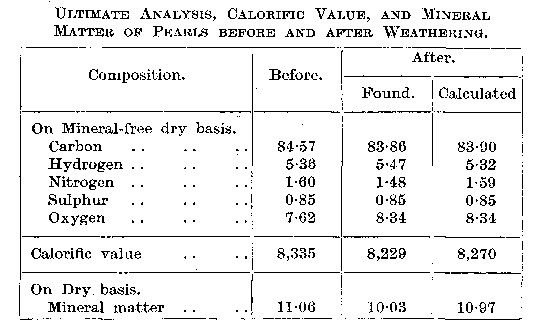
On the basis outlined above, therefore, 100 parts of the fresh coal-substance became 100.79 parts, with an oxygen percentage of 8.34, by the absorption of 0.79 part of oxygen. The calculated analysis of the weathered coal, assuming no gains or losses in carbon, etc., is as shown in the last column of the table. By comparison of these figures with those actually found after weathering (shown in the middle column of the same table) it would appear that the reduction in carbon-content is only that due to dilution by oxygen. Of the fall in calorific value, however, less than two-thirds is accounted for thus, the remainder — over 40 calories per gramme, or about ½ per cent. of the total heat-value of the coal — being the true loss caused by the evolution of heat during oxidation. Almost the whole of the observed reduction in mineral matter is real, as also is the increase in moisture-content.
It appears probable that oxidation produces compounds in the coal-substance which have carboxyl groups attached and which on heating break up into carbon dioxide, carbon monoxide, and water, and a residue which is less volatile than the original unoxygenated compounds. This would cause an increase in the carbon-dioxide content of the gases evolved in carbonisation, an increase in the coke-yield, a decrease in volatile matter, and possibly a loss of coke-forming propensity ; it would account for the increase which was actually found in the coke-yield from pearls (0.6 per cent. was found after allowing for the change in mineral matter). This, therefore, is a real change, as dilution per se would cause a reduction in the coke formed.
The apparent heat-loss due to dilution is, of course, also a real loss in the fact that it leads to loss of efficiency, but its assessment as real loss is not directly calculable.
In the case of the pearls cited above, the reduction in heating value as a fuel is probably about 1 per cent. in 28 months ; the reduction in coking power is very much greater and may be sufficient to rob the coal of its value for carbonisation purposes. It is evident, however, that the results obtained in this work do not substantiate statements that Coleford Highdelf coal has poor storage qualities, at least in so far as storage without rise in temperature is concerned.
The effects of exposure upon any one type of coal depends mainly upon such factors as particle size, time, temperature, degree of degradation (affecting particle size), and the nature of the exposure (wind, frost, rainfall). It has been shown that the mixing of large coal with much fines is conducive to rapid deterioration in the fine coal; in a large dump this may cause a rise in temperature sufficient to set up serious deterioration in the large coal ; it may lead eventually to spontaneous ignition. Experiments designed to investigate the effects on coal of storage with rise in temperature are at present in progress. In this new series, Coleford Highdelf and other coals are stored in a number of dumps such as are used in practice. It is hoped that the results of these experiments will provide practical data upon coal-storage, in addition to showing the effects on coal of storage with rise in temperature.
 |
 |
| Names mentioned in this article | |
 |
 |
| Name | Age | Occupation | Notes |
|---|---|---|---|
| Hall, Douglas A. | |||
| Heywood, — | |||
| Scarf, Frank | |||
| Yearsley, Cecil W. |




 Contains public sector information licensed under the

