


| Newspaper Articles |

|
Newspaper Articles |
 |
 |
30th November 1940, Page: 170, Column: 1
Notes On Managers' Examinations. — I
Report of Central Examiners
The Board for Mining Examinations in their efforts to meet the situation arising out of the war conditions, decided that for the current year the number of examinations for each class of certificate should be reduced to one. This examination was held in July, followed by the oral examination in August.
The Central Examiners have issued their report, and their comments on the work of candidates are given below with the text of the questions, the comments being in italics. The official Question Papers, containing also the plans and diagrams, are obtainable (1s. 6d. net) through H.M. Stationery Office.
In some notes on the examiners' comments on the oral examinations it is stated that generally seven examiners thought the quality to be good. Two examiners found that the second class candidates were not good, but one examiner considered the first class candidates above the average. One examiner found that candidates were nervous, another that the examination seemed to tire candidates so that the quality of their answers became lower as the examination proceeded. One examiner detected a lack of opportunity of seeing the mechanical side of mining, whilst others found a lack of enterprise in learning about matters with which they were not directly concerned. An examiner noted evidence of specialisation, the candidates being good in one special line but poor generally.
Dealing with the subjects :—
No. 1 Subject. — Weakness in general mining knowledge was commented on by five examiners.
No. 2 Subject. — Weakness concerning ventilation was mentioned by four examiners.
No. 3 Subject. — One examiner found weakness in knowledge of coal dust.
No. 4 Subject. — Weakness in machinery was mentioned by ten examiners, but two examiners found that candidates had good knowledge of this subject.
No. 5 Subject. — Weakness concerning surveying was mentioned by five examiners, whilst one examiner found candidates well prepared iri this subject.
No. 6 Subject. — Weakness in knowledge of the Coal Mines Act and Regulations was referred to by twelve examiners. The weakness was noted particularly in Regulations recently made.
Winning and Working (1st Class).
1. A level seam of coal, 4 feet thick, is divided in the middle by a 4-inch band of dirt. The two portions of the seam are of different quality and it is desired to keep them separate. Describe, with sketch, the method of work you would adopt on a longwall machine-cut conveyor face to achieve this object. (50)
Moderately good answers. In some cases details of layout and method of timbering were omitted.
2. Sketch and describe the machinery and appliances used for boring through coal measure strata to a depth of 600 yards by the diamond method. (40)
Most candidates appeared to understand the principles, but sketches on the whole were poor.
3. Water is met with in a sinking pit and it is decided to wind it in tanks. Describe, with sketch, the kind of tank you would use for getting out the water quickly and without manual labour in filling. State what provision you would make to empty the tank expeditiously at the surface. (40)
Answers on the whole were fairly satisfactory. Several types were put forward, but there appeared to be some confusion as to their operation.
4. Describe Aqueous, Metamorphic, Arenaceous and Calcareous rocks. In which rocks do you find stratification ? (40)
Moderately good answers on the whole, with a few exceptionally good ones.
5. Describe, with sketch, the method of supporting the roof at roadheads with which you are familiar. By roadhead is meant the area around the junction of the gate-road with the face. (40)
Good answers generally. In spite of the description of "road-head" in the question, a few candidates explained how they would support the junction of two roads.
6. What are the essential features of a good pack and what do you consider to be the best method of building it ? (40)
Good answers on the whole, which showed that the majority had studied recent publications on the subject.
7. In a double unit conveyor district the following electrically-driven units are in use, the system being 550 volts A.C. Longwall coal-cutter, coal drilling machine, face belt-conveyors and gate belt-conveyor. The loading point is lit electrically. Enumerate the switchgear you would require to control these units and state where you would place it. (40)
The knowledge shown by most candidates teas satisfactory. Some would install a multiplicity of switchgear which is quite unnecessary.
Ventilation (1st Class).*
* No notes are available on the subject of Ventilation, owing to the death of the Examiner concerned.
1. An airway carrying 54,000 cu. ft. per min. of air divides at "A" into two airways that later come together at "B" and carry on as a single airway. Particulars of the two airways from "A" to "B" are—
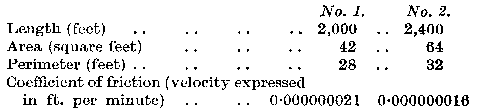
In what proportions would the air-current divide in the two airways ? (50)
2. What gases are met with in the atmosphere of mines ? State how each is detected, and what are the effects of each gas on the workmen. (30)
3. Because of extending workings, the fan plant at a colliery is no longer adequate and you invite offers for a new ventilating plant, including the driving unit. What would you tell the makers so that they may offer suitable plant ? (30)
4. What method is employed to produce an air-current in a large mine ? What apparatus may be used for this purpose ? With the aid of a sketch, describe one type which is commonly employed. Give the important particulars, including arrangements for reversing the air. (30)
5. In connection with collieries, what is meant by a "ventilation survey" ? How may a ventilation survey be carried out and what kind of information is to be expected from it ? (30)
6. It is considered to be desirable to increase the air-current passing along the faces in a mine. State the factors that you would take into account in considering what should be done. (30)
7. Describe the type of safety-lamp that you would adopt for a fiery mine, giving details. Would you adopt the same lamp for the officials ? What proportion of flame safety-lamps would you adopt for a fiery mine where electric safety-lamps are used at the face ? (30)
Explosions, Etc. (1st Class).
1. After an explosion of firedamp, a fire breaks out which cannot be reached owing to a large fall in the intake airway. The fire extends and it becomes necessary to seal the district. What places would you select for the stoppings ? How would you build the stoppings and what precautions should be taken for the safety of those engaged on the work ? (30)
Time is an important factor in such a case ; some of the seals suggested by candidates would take much too long to construct.
2. A pair of old shafts, each 250 yards deep, one 10 feet diameter, the other 8 feet diameter, and 5 yards apart, are lined with cast-iron tubbing to a depth of 80 yards from the surface. The mine was ventilated by a furnace for many years ; the tubbing has become weakened by corrosion and cracked in several places, allowing much water to flow into the shafts. How would you deal with the situation to render the shafts safe and serviceable ? (25)
Most candidates answered this question ; the majority suggested cementation through vertical boreholes around the shafts instead of radial boreholes from within the shafts.
3. What precautions should be taken when rise workings (not undersea) are approaching the outcrop of the seam under irregular deposits of quicksand and moss ? In undersea workings, what percentages of coal may be worked with safety in seams averaging 6 feet in thickness, at depths below the sea bottom of 200 yards 300 yards and 400 yards, respectively ? (25)
The first part of the question was well answered, but few candidates gave satisfactory answers to the second part.
4. A heading, with the necessary boreholes, is being driven towards old workings which contain a dangerous accumulation of water. Make a sketch with dimensions of a bulkhead, or emergency door, and show how it should be erected in the heading, so that it could be closed quickly in the event of a sudden inrush of water. (25)
Answered by most candidates but very few gave satisfactory answers. The door was either too large or too weak, and information should be sought concerning such doors.
5. State what you know of the recommendations included in the Report of the "Water Dangers Committee," which was published in 1927. (25)
Very few candidates attempted to answer this question, and the answers were generally poor.
6. Make a sketch of a panel of workings suitable for a seam of coal, 4 feet thick, and inclined at 1 in 4, which is liable to spontaneous heating. The coal is to be cut by machine and brought out by conveyors along the face and gate road. Show the connections with the main haulage road and return airway, respectively. What provisions should be made for dealing with a fire on the coal face and for dealing with spontaneous heating in the waste or goaf? (25)
Although the sketches were crude in many cases, the answers were generally satisfactory.
Machinery (1st Class).
1. Describe a transformer, suitable for underground use where there is no firedamp, for obtaining 3-phase current at 400 volts between phases from a 3,000-volt supply. What does it mean when it is said that the windings are delta-connected on the primary side and star-connected on the secondary side ? (28)
Few good answers. Some candidates gave only theoretical explanation of transforming with no reference to the construction of a 3-phase transformer.
2. When a 3-phase squirrel-cage motor is connected direct to the power supply, the starting current may be over six times the full load running current. What devices may be adopted to reduce the demand on the system for current at starting under various conditions ? How do the devices act ? (28)
Most candidates quoted a star-delta starter and an auto-transformer starter. Only a few referred to a double-cage winding on the rotor or a centrifugal friction clutch. There is much confusion between current and voltage and power. A number of candidates confused the square root of 3 with its reciprocal.
3. Describe, both mechanically and electrically, a 3-phase induction motor with wound rotor suitable for medium tension current. If using 50-cycle current, how is a speed of about 730 revolutions per minute (750 synchronous) obtained ? What is the purpose of a wound rotor as distinct from a squirrel-cage rotor ? (28)
Few good descriptions of an actual motor. The question of "poles" in an induction motor confuses many candidates. The purpose of a wound rotor was generally understood.
4. What distinguishes water-tube boilers of Babcock type from those of Stirling type ? Illustrate your answer by simple sketches. (28)
Often well answered. It was frequently stated that a Babcock boiler has only one steam-and-water drum. The connecting pipes of drums of Stirling boilers were often shown incorrectly.
5. Describe an apparatus suitable for preventing overwinds by a steam-driven winding engine and for preventing overspeed during the wind, especially when the downgoing cage is approaching the bottom landing, carrying men. (28)
This question, often attempted, was badly answered. The apparatus may be complicated, but simple adequate descriptions are available.
6. Discuss the choice and use of a rope for a colliery winding plant. What working conditions would you regard as helpful to the rope and what conditions would operate to shorten the life of the rope ? (28)
Answered by nearly all candidates. Chief weakness was in dealing with qualities of steel.
7. Describe a pump suitable for draining the advancing end of a dipping incline, so as to keep it as dry as possible for the workmen. Water collects at the rate of about 150 galls./min. and has to be raised a maximum of 100 feet to a sump higher up the incline. Deal both with the driving and water handling parts of the pump but not with any auxiliary plant. Either compressed air or electric power is available. (28)
A number of candidates would use a centrifugal pump without attachment for running on air. Some candidates would aim to raise 24 hours' water in (say) 16 hours, but this is not appropriate to the conditions. Where a three-throw pump was offered driven by compressed air, it was often not explained how the compressed air would be applied.
8. A gunmetal valve seat (in the valve box of a pump) is 4 inches internal diameter, 3 inches deep, and at the top is bevelled or coned to a diameter of 5 inches at an angle or slope of 45 degrees (from vertical). The cover of the valve box comes to 2 inches above the top of the valve scat. Design and draw a gunmetal mushroom valve to fit the valve seat. The lift of the valve is to be limited by the top of the valve, when open, coming into contact with the box cover. Show the valve., full size, by plan and sectional side elevation and give the leading dimensions, including the lift allowed. (38)
There were few adequate drawings. A number showed a valve with a round stem beneath, calling for a guide in the valve seat. No such guide was mentioned, and the question called for a valve having wings or vanes to keep it in position.
Surveying, Etc. (1st Class).
1. The following are the notes of an underground traverse made with a theodolite in part of a main airway in a level seam.
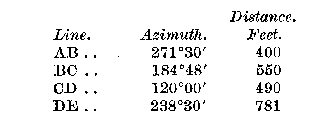
It is proposed to improve the ventilation by driving a new roadway in a direct line between the points A and E, and in order to complete the work with the maximum of speed, to drive simultaneously on four separate faces. Calculate the position of a point P on the line CD at which two faces are to be set out, and state the quadrant bearing of PE. (40)
Less than one-third of the answers were correct or even approximately so. Errors in co-ordinate calculations were frequent.
2. The plan . . . shows an area of workings which have reached a large fault with displacement up to west. It also shows a cross-measures drift AB which has been driven to form a landing. It is proposed to continue the latter drift in the direction shown on the plan, but at such gradient from B as will enable it to intersect the seam on the west side of the fault near the point C. Draw in your Answer Book, from the data shown on the plan, a section of the proposed oross-measures drift ABC and a roadway driven in continuation thereof in the seam to about the point D. Assume the angle of the fault plane to be 33° from vertical, and that the inclination of the seam to the north is as indicated by the levels shown on the plan. (30)
Surprisingly few accurate, or reasonably accurate, answers were obtained to this by no means difficult question.
3. An exploring heading in a certain seam is believed to have almost reached the leasehold boundary, and it is desired to determine accurately the position of the face of the heading in relation thereto. The seam is being worked by a drift, 600 feet in length, dipping into the measures from the surface at a gradient of 12 inches to the yard, and the heading face is about half a mile distant from the mouth of the drift. Not more than six settings of an instrument will be necessary in making a traverse between the mouth of the drift and the heading face. State fully how you would carry out the necessary work so as to obtain the maximum of accuracy, and illustrate your answer by a sketch. (30)
Answers generally were fairly satisfactory.
4. The floor of a seam of limestone is cut by a vertical bore at a depth of 75 yards, from the surface. The core of limestone taken from the bore is 20 feet long, and shows that the strata dip at 33°. If the surface rises uniformly at 1 in 12 in the same direction as the strata, calculate — (a) The breadth of the seam at the outcrop measured on the slope of the rockhead, assuming that a thickness of 10 feet of alluvium overlies the rockhead ; and (b) The thickness of the limestone seam measured at right angles to the plane of stratification. (20)
Answers to the second part of the question were generally correct, but the first part obviously puzzled many candidates.
5. A slightly undulating and moderately straight underground roadway, about 8 feet in width and 400 yards in length, in which a main and tail haulage operates, is about to be reconditioned by the erection of steel arches, and to be widened to give a finished width of 12 feet, prior to the installation of an endless haulage. The roadway is to be made straight throughout its entire length, and to be re-graded so as to give a uniform inclination from end to end. Describe fully the various steps which you would take to give effect to the requirements above-stated. (20)
Many good answers.
6. You are asked to carry out a short traverse in a level but crooked roadway, using a dial with vernier attachment. You have also had definite instructions to start and finish your traverse with a "free bearing." If, on completing the traverse, you found that your final free bearing was 35 minutes in excess of the vernier azimuth reading, and that a check survey could not conveniently be made, how would you amend your vernier bearings before plotting them ? Illustrate your answer by a sketch, and assume that five settings of the instrument were necessary in the traverse between the points at which the first and final magnetic bearings Were obtained. (20)
There were very few entirely satisfactory answers to this question.
Management and Legislation (1st Class).
1. Compulsory. — The appointment is made at some mines of a special official — variously designated Safety Officer, Safety Engineer or Safety Inspector — to devote his whole time to safety problems. What is your opinion of the usefulness of such appointments ? What qualifications should such officials hold and what should be their status ? (30)
Generally well answered. All candidates considered such appointments to be of value in reducing accidents provided persons of sufficient experience, tact and personality were appointed to them, and almost all considered that-such persons should hold a first or second class certificate of competency.
2. There has been very little variation in the death-rate from haulage accidents for many years. Discuss this statement and suggest the means by which you consider improvements might be effected. (25)
Some very good answers, candidates stressing the need for roomy, straight and even roads with well laid tracks, well lighted junctions and proper training for all haulage workers. One candidate, unfortunately, read "Haulage" to spell "Falls of Ground."
3. In what mines are permitted explosives required by the Explosives in Coal Mines Order to be used ? What persons are allowed to fire shots in such mines and what qualifications have such persons to possess ? To whom may detonators be issued ? (25)
By far the least well answered question. Except in rare instances, a proper knowledge and understanding of the Explosives in Coal Mines Order was lacking.
4. What are the requirements of the General Regulations in regard to the construction of stoppings between main intake and main return airways ? What is the object of these requirements ? What is the definition of "main airway" in the Coal Mines Act, 1911? (25)
Answers in reference to stoppings between main airways and their purpose were generally good, but very few candidates could define a main airway.
5. What, in general, are the requirements of the Coal Mines General Regulations (Precautions against Coal Dust), 1939 ? (25)
Answers varied considerably ; some were very good but almost all were in too much detail — for which the question did not ask.
6. What steps would you take, as manager of a mine, to enforce the provisions of the Explosives in Coal Mines Order ? (25)
Candidates generally would provide proper storage for explosives at the surface and all the impedimenta required by a shot-firer, but few seemed to consider it their duty to see their shot-firers actually at work. Those who did were well marked ; the others missed the point of the question.
 |
 |
| Related Articles | |
|
|
| Pub. Date | Article (Newspaper) |
|---|---|
| 27 Jan 1940 | Board for Mining Examinations (The Science and Art of Mining) |
| 23 Mar 1940 | Board For Mining Examinations (The Science and Art of Mining) |
| 05 Oct 1940 | Examination Results (The Science and Art of Mining) |
| 16 Nov 1940 | Notes On Surveyors' Examination, Central Examiner's Report (The Science and Art of Mining) |
| 30 Nov 1940 | Notes On Managers' Examinations. — I, Report of Central Examiners (The Science and Art of Mining) |
| 14 Dec 1940 | Notes On Managers' Examinations — II, Comments on Work of Candidates (The Science and Art of Mining) |
| 27 Dec 1941 | Mining Examinations 1940 Report (The Science and Art of Mining) |



 Contains public sector information licensed under the

