


| Newspaper Articles |

|
Newspaper Articles |
 |
 |
30th November 1940, Page: 161, Column: 1
Report Of Fuel Research Board
Chairman Surveys Programme
The Report of the Fuel Research Board with the Report of the Director of Fuel Research, for the year ended 31st March, 1939, has been issued by the Department of Scientific and Industrial Research and published by H.M. Stationery Office (price 3s. 6d. net). The contents deal with the Physical and Chemical Survey of the National Coal Resources ; Methods of Examination of Coal and Coke ; Preparation of Coal for the Market; Carbonisation and Gasification of Coal ; Treatment of Tars and Oils ; Synthesis of Hydrocarbons from Carbon Monoxide and Hydrogen ; Production of Lubricating Oils ; Hydrogenation of Coal; Steam Raising and Power Production ; Domestic Heating.
Sir Harold Hartley, who is the chairman of the Fuel Research Board, says that broadly speaking the carbonisation industry may be considered as having three main branches : (a) The gas industry which is concerned mainly with the supply of coal, gas to meet domestic and industrial requirements, but which also produces coke for domestic and industrial purposes, as well as other byproducts. (b) The coke oven industry, which produces coke suitable for all branches of the metallurgical industry, as well as for domestic purposes and other industries, and which also yields other by-products, (c) The low-temperature carbonisation industry, which requires about 500,000 tons of coal per annum and manufactures a free-burning smokeless fuel suitable for the open fire and other domestic heating appliances.
In all these branches the use of suitable coal is of primary importance, and in both the coal gas and the coke-oven industries coals possessing high caking power are required. Since the production of gas is the primary concern of the gas industry and coke that of the coke-oven industry, a distinction in the characteristics of the coals required for the two branches of the carbonisation industry can be recognised. The gas industry requires coals containing as high a percentage of volatile matter (or "volatile therms") as is consistent with the secondary consideration of producing a saleable coke, while the coke-oven industry selects coal of the highest caking properties, and containing a lower percentage of volatile matter. It is recognised that the national preserves of caking coals of the highest grade are not unlimited, and it is of importance to the country to obtain an accurate knowledge of the position and properties of the reserves of coals that are suitable for the several branches of the carbonisation industries.
One of the main purposes of the programmes of the Board is to extend the range of coals that may be used for the manufacture of coal gas and coke, and thus to conserve the highly caking coals. One well-known method is to blend caking coals with coals that are non-caking or not sufficiently strongly caking to be carbonised alone. When the process of blending is carried out efficiently, considerable proportions of non-caking coals may be added to strongly caking coals without reducing the quality of the coke produced. Experiments upon the blending of coal have been carried out in both the horizontal retorts and intermittent chamber ovens at the Fuel Research Station. The process is accompanied by some reduction in the output of the plant as a gas making unit. It may be advantageous in certain districts, however, to blend local coals that alone are unsuitable for gas or coke manufacture with coals possessing high caking properties, which may have to be transported a considerable distance.
Sir Harold says that importance is attached to the finding of new outlets for certain low volatile coals from South Wales. A process has been developed at the Fuel Research Station for the complete gasification of this type of coal in a normal water-gas plant. A technique was elaborated by which such coals could be completely converted into gas without great alteration to the ordinary water-gas plant. Application of this process would have the effect of reducing the demand for caking coals for manufacturing the coke normally used in water-gas plants. With coal and coke at the same price, the gas produced from low volatile coals should cost less than when coke is used.
A further development of this process is the enrichment of the gas by converting a portion of it into methane by treatment with suitable catalysts. The conversion of water-gas into methane by means of catalysts forms a part of the general programme, which also aims at the synthesis of liquid hydrocarbons from mixtures of hydrogen and carbon monoxide.
A further investigation is in progress upon the combustion of pulverised coal in oxygen in the presence of steam. A small plant is being assembled for operating the process under pressure in order to obtain gas rich in methane. This method of treating coal would provide another means by which non-caking coals could be used in the manufacture of gas.
The range of coals available for use in the gas industry has been increased as the result of investigations carried out by the Fuel Research Station in collaboration with the gas department of the City of Edinburgh. It was found that weakly-caking coals having a high percentage of volatile matter could be used for gas making if charged in the form of sized grades, which yielded non-adherent lumps of strong coke of slightly larger size than the original coal. Coals of the type required can be found in a number of coalfields. The coke produced was found to be suitable for use in the open domestic grate. The yield of gas was such as to make the combined products from the plant compare favourably with those when carbonising ordinary gas coal.
It has been found that when certain coals are carbonised at a low temperature, and the resulting coke is steamed at a high temperature in vertical retorts, active carbon is produced. The chief necessity is the choice of coal having certain properties, and in order to discover the coal seams having these properties an extensive survey was made.
Fuel Director's Summary.
In his introduction and summary, Dr. F. S. Sinnatt, Director of Fuel Research, referring to investigations into the constitution of coal and into the methods of laboratory examination and analysis of coal and coke, says that of particular interest in this section are the reports on the occurrence of unusual elements in coal ash. Although usually present in very small amounts, certain of these elements are known to exert a considerable influence on the behaviour of the coal in certain processes. Sensitive methods for the detection and estimation in the presence of large amounts of other elements are therefore being developed.
Experiments concerned with breakage during transport, storage and handling, and with dustproofing, have been practically completed, but certain ancillary problems arising out of these programmes have caused an expansion of work on other programmes in this group. Reference is particularly made to work on the physical structure of coal, which is not limited in its significance to the preparation of coal. This structure is being studied from different angles, the chief of which dealt with are various aspects of moisture retention.
Work on the carbonisation and gasification of coal is directed chiefly to the investigation of means of increasing the flexibility of the carbonising industries, so that the amount and the nature of the various products may be controlled to suit market conditions, and also to the conservation of the limited and rapidly diminishing supplies of strongly-caking coals by the substitution, when possible, of non-caking and weakly-caking coals. These two aspects are to some extent complementary and the investigations include not only the types of plant and the processes available, but also the selection of particular varieties of coal.
The complete gasification of coal affords another means of conserving the supplies of strongly-caking coals, since non-caking coals can be used ; the adoption of this process would also provide a means of adjusting the yields of products to market conditions, since the production of coke is avoided and the methods available permit of the process being operated with or without the production of tar.
The programme dealing with hydrogenation of tars and oils is mainly concerned with the treatment of tars to produce oils and spirits, but attention is also given to obtaining special products by the hydrogenation of various materials and to study of the mechanism of the hydrogenation process by the treatment of pure compounds.
The removal of sulphur is an important reaction in the hydrogenation process, and the study of the treatment of pure compounds has therefore been widened to include several organic sulphur compounds.
Perhaps the most striking aspect of the work on hydrogenation lies in the fact that as the process has been developed, more active catalysts have become available, with the result that the scope of application of the process has been considerably extended.
Regarding the direct hydrogenation of coal this process is flexible ; the mildest conditions of temperature and hydrogen pressure result in a solid product of increased caking properties, While under the severest conditions almost complete conversion into oils of widely varying boiling point is obtained. Between these two extremes of operating conditions other products are obtainable, which may result in a broadening of the application of the process.
One of the main items in the domestic heating programme is the reduction of smoke emission from chimneys. In the course of this work a new open domestic grate has been designed which, during refuelling periods, has reduced in some instances the smoke emitted by over 60 per cent.
Hilt's Law.
In the section devoted to the survey of the National Coal Resources, mention is made of the sinking of a new shaft at Mount Pleasant, Swillington, in the West Yorkshire area, having provided a valuable opportunity to study a number of seams together in one vertical sequence. Normally, the work of the survey proceeds laterally, that is to say, a particular seam is examined at a number of points spaced over the coalfield. It is clearly an important part of the work of the Survey, however, to take every opportunity to investigate these undeveloped seams, upon which the future of the coalfield must necessarily depend, and advantage is taken of opportunities of sampling such seams during sinking operations, etc. Nineteen seams from the Mount Pleasant sinking, varying in thickness from a few inches to over seven feet, and extending from about the horizon of the Lidgett seam to the Upper Beeston seam, were examined, most of them during the year under review.
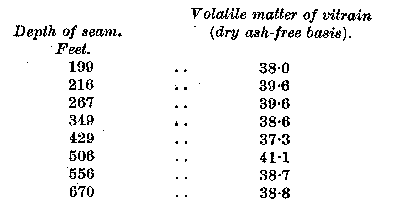
The work afforded an interesting opportunity to examine the validity of Hilt's "Law," which states that the volatile matter content of coal seams decreases with increasing depth. For this purpose, samples of vitrain were selected, as the results of previous workers were considered to be open to criticism in that no attempt has previously been made to select samples of similar petrological composition. The results, which are appended, give no indication that the "law" is valid. It is possible that 500 feet of measures are not a sufficient criterion, but it would appear that if any "law" exists its scope is much too generalised to apply to this particular case. The figures obtained, and the depth from which the samples were taken, are given below :—
Sulphur in Coal.
In the course of work on storage of coal at Birmingham Coal Survey Laboratory it became necessary to examine critically the determination of the forms of sulphur in coal of different size grading, and also the constancy of the amount of organic sulphur in fresh commercial grades. In order to determine the reliability of gravimetric analyses of the sulphur forms, parallel tests were carried out by different operators using (a) the gravimetric methods of Powell and Parr (U.S. Bureau of Mines) and (b) the volumetric (titanium chloride) method. In (c) the pyritic sulphur is determined by precipitation after extraction, and any organic sulphur is dissolved by the reagents is included. In (b) the iron of the pyrites is determined volumetrically, and the equivalent sulphur is calculated.
As a result of these investigations, the following conclusions were drawn :—
(1) The gravimetric and volumetric methods gave concordant results with all the samples tested, showing that there had been no appreciable solution of organic sulphur during the nitric acid extraction of pyrites.
(2) Grinding to pass through a 240-mesh B.S. sieve was not necessary, at least in samples containing up to 3 per cent. of pyritic sulphur.
(3) The organic sulphur content of the screen fractions tested, calculated to a pure coal basis, was substantially constant.
(4) The organic sulphur content (on a pure coal basis) of each commercial grade of the coal used (High Delf) from one colliery was substantially constant for different consignments, but there was a slight change from one grade to another with a tendency for increasing organic sulphur with decreasing particle size.
(5) The organic sulphur content on a pure coal basis was not affected by weathering when there was no rise in temperature.
Barium in Coal.
Concerning the interest attaching to the occurrence of barium in coal, attention is directed to the result of work carried out at the Chester Coal Survey Laboratory, and the publication of a paper showing the widespread occurrence of barium in coals from North Wales, North Staffordshire, Yorkshire, Nottinghamshire and Derbyshire. In 25 samples of coal, amounts of barium, calculated as BaO, of 0.2 to 4.76 per cent. of the ash, or 0.002 to 0.100 per cent. of the coal, were determined. Two samples of ash were found to contain 0.20 and 0.44 per cent. respectively of lead (calculated as PbO), together with traces of strontium. Visual examination showed the presence of flakes of what proved to be barytes on the cleavage planes of coal from near the roof or the floor of the seam. These particles of barytes were further examined at the Fuel Research Station and were found to contain at least 1 per cent. of strontium. The examination of samples of coal taken at various places along a seam showed that the presence of barium was general, and not localised. A study of the amounts of chlorine in the coal samples richest in barium was made, and it was found that barium chloride was present in the water from the seam workings to the extent of 1.3 g. per litre.
A statement was made in the paper referred to that a barium mineral was being worked in the Coal-Measure strata at Brancepeth colliery, and that this was apparently the only case of its kind in the North of England. It has since been learned that about half the world demand for witherite (BaCO3) is supplied from the Morrison North pit of the Holmside and South Moor Collieries, Ltd., of Stanley, Co. Durham, and that the witherite occurs in a nearly vertical fault fissure which has been proved down to the deepest workable coal seam. A large quantity of water has been met in the vein and has been found to contain up to 10 gr. of barium bicarbonate per gallon. Probably arising from contact with this water, the coal in all seams in the immediate proximity of the witherite vein contains barium carbonate, one sample containing as much as 3 per cent. Witherite has also been mined from the Craghead Busty pit, of the same Company, a few miles from, and in a fault parallel to, the main Holmside deposit. A mixed calcite and witherite deposit containing a little barytes occurs in a vein, 6 feet thick in places, at another colliery a few miles away.
It has been learned that strontium has been found in coal from the Brockwell seam, whitish incrustations on the coal having been identified as strontianite, but it is considered that the amount of strontium in the seam is insufficient to justify mining for this element specially.
Hydrogenation of Coal,
In the course of some general remarks under this caption it is stated that the treatment of coal with hydrogen under a high pressure and at a high temperature with the object of producing aviation and motor spirit is now being conducted on an industrial scale in this country. On account of its flexible nature, the process must be regarded as a potential producer of other materials than of these spirits only.
The coal gas industry, though principally concerned with the production of gaseous fuel, is nevertheless intimately connected with smokeless solid fuel — the use of which will reduce atmospheric pollution — and also with the tar produced during coal carbonisation. This tar is a raw material of supreme importance in many directions. The production of these widely differing materials calls for a careful balance between the various manufacturing processes available to the gas industry, and it is thought that hydrogenation may provide an additional process to assist in maintaining this balance.
It is known that the treatment of coal with hydrogen under conditions of temperature and pressure milder than those employed in the conversion of coal into oil and for a shorter time ("partial hydrogenation"), results in a product that is fluid under the conditions of treatment employed but solid under ordinary conditions. This product in most cases is possessed of greater coking properties than the coal from which it was originally produced, and when carbonised gives rise to higher yields of tar. This increased tar yield could be utilised to supplement the decreased yield which may result from the adoption of processes of complete gasification. At the same time, the resulting coke residue would provide an auxiliary supply of good quality coke suitable for use in blast furnaces. Coals that provide a good coke for the latter purpose are not so plentiful in this country as formerly.
When the hydrogenation of coal is carried to the stage of complete liquefaction, the resulting crude oil contains many of the chemical substances which at present are obtained from coal tar. For example, phenol itself is produced to the extent of 1 per cent. of the coal when a medium-caking Yorkshire coal from the Beamshaw seam, of oxygen content 7.8 per cent., is hydro-genated. The same coal yields simultaneously 0.9 per cent. of mixed cresols. Aromatic hydrocarbons are present in the spirit boiling below 170°C. to the extent of 1.3 per cent, of the coal.
 |
 |
| Names mentioned in this article | |
 |
 |
| Name | Age | Occupation | Notes |
|---|---|---|---|
| Hartley, Harold, Sir | Chairman | Whos Who Page | |
| Parr, — | U.S. Bureau of Mines | ||
| Powell, — | U.S. Bureau of Mines | ||
| Sinnatt, Frank Sturdy, Dr. | Director of Fuel Research | Whos Who Page |
|
|
| Links to Collieries/Mines mentioned in this article | |
|
|
 | Brancepeth Colliery |
| | Craghead Colliery |
| | Morrison Busty Colliery |
 |
 |
| Related Articles | |
|
|
| Pub. Date | Article (Newspaper) |
|---|---|
| 01 Aug 1925 | Industrial Smoke (The Science and Art of Mining) |
| 12 Sep 1925 | News (The Science and Art of Mining) |
| 10 Oct 1925 | The Enrichment Of Coal Gas (The Science and Art of Mining) |
| 24 Oct 1925 | Science And Industry (The Science and Art of Mining) |
| 07 Nov 1925 | Fuel Research Board Reports (The Science and Art of Mining) |
| 06 Dec 1925 | Smith Seam In S. Lancashire Coalfield (The Science and Art of Mining) |
| 02 Jan 1926 | Survey Of Scottish Coalfields (The Science and Art of Mining) |
| 27 Feb 1926 | News (The Science and Art of Mining) |
| 18 Dec 1926 | Fusion Process Of L.T. Carbonisation (The Science and Art of Mining) |
| 29 Jan 1927 | The Fuel Research Board (The Science and Art of Mining) |
| 29 Jan 1927 | News (The Science and Art of Mining) |
| 12 Feb 1927 | The Multiple Retort (The Science and Art of Mining) |
| 26 Mar 1927 | National Coal Resources (The Science and Art of Mining) |
| 09 Apr 1927 | Caking Coal (The Science and Art of Mining) |
| 07 May 1927 | Decomposition Of Coal (The Science and Art of Mining) |
| 07 May 1927 | Coal Output (The Science and Art of Mining) |
| 30 Jul 1927 | Fuel Research, Annual Report of Board (The Science and Art of Mining) |
| 13 Aug 1927 | Physical And Chemical Survey Of Coal Seams (The Science and Art of Mining) |
| 06 Oct 1928 | Fuel Research, Annual Report of Board (The Science and Art of Mining) |
| 18 May 1929 | X-Ray Analysis Of Coal (The Science and Art of Mining) |
| 09 Aug 1930 | Fuel Research (The Science and Art of Mining) |
| 04 Apr 1931 | Coal Trade Problems (The Science and Art of Mining) |
| 09 Jan 1932 | Fuel Research Director (The Science and Art of Mining) |
| 23 Jan 1932 | The Yard Seam In Northumberland (The Science and Art of Mining) |
| 20 Feb 1932 | Safety In Mines Research Board (The Science and Art of Mining) |
| 05 Mar 1932 | Pulverised Fuel (The Science and Art of Mining) |
| 17 Sep 1932 | The Brockwell Seam In Durham (The Science and Art of Mining) |
| 29 Oct 1932 | Appointments (The Science and Art of Mining) |
| 19 Apr 1933 | Gas-Making Tests, The Northumberland Yard Coal Seam (The Times) |
| 29 Apr 1933 | Gas Making Experiments (The Science and Art of Mining) |
| 24 Jun 1933 | Hutton Seam In Durham (The Science and Art of Mining) |
| 25 Nov 1933 | Analysis Of Coal And Coke (The Science and Art of Mining) |
| 23 Dec 1933 | Coal As Manufactured Product (The Science and Art of Mining) |
| 31 Mar 1934 | Ministry Of Fuel? (The Science and Art of Mining) |
| 07 Jul 1934 | Research Station Investigations (The Science and Art of Mining) |
| 29 Sep 1934 | The Plessey Seam Of Northumberland, A Valuable Industrial Coal (The Science and Art of Mining) |
| 08 Dec 1934 | Fuel Research Board's Report (The Science and Art of Mining) |
| 06 Feb 1935 | Outlet for Steam Coal (The Science and Art of Mining) |
| 22 Jun 1935 | Motor Spirit From Tar (The Science and Art of Mining) |
| 07 Dec 1935 | Fuel Research Board's Report, Increased Efficiency Affecting Coal Consumption (The Science and Art of Mining) |
| 15 Feb 1936 | Conversion Of Coal Into Oil (The Science and Art of Mining) |
| 29 Feb 1936 | Colloidal Fuel (The Science and Art of Mining) |
| 28 Mar 1936 | Problems Of Coal Utilisation, Research and Changes in Market Requirements (The Science and Art of Mining) |
| 20 Jun 1936 | Coal And Its By-Products, Scientific and Industrial Research Exhibit (The Science and Art of Mining) |
| 05 Dec 1936 | Coal Survey (The Science and Art of Mining) |
| 05 Dec 1936 | Preparation Of Coal For Market, Research Board's Programme (The Science and Art of Mining) |
| 05 Dec 1936 | Boiler Tests (The Science and Art of Mining) |
| 19 Dec 1936 | Initial Stages Of Carbonisation (The Science and Art of Mining) |
| 02 Jan 1937 | Microspores (The Science and Art of Mining) |
| 27 Feb 1937 | The Beaumont Seam In Northumberland (The Science and Art of Mining) |
| 05 Jun 1937 | Fuel Process Test (The Science and Art of Mining) |
| 09 Oct 1937 | The Hydrogenation-Cracking Of Tars (The Science and Art of Mining) |
| 18 Dec 1937 | Research On Coal, Fuel Research Board's Report (The Science and Art of Mining) |
| 01 Jan 1938 | Coke In The Domestic Hearth (The Science and Art of Mining) |
| 01 Jan 1938 | Coal Preparation Technique, Sizing and Grading of Yorkshire Coals (The Science and Art of Mining) |
| 15 Jan 1938 | Pulverised Fuel Notes (The Science and Art of Mining) |
| 12 Feb 1938 | The Trencherbone Seam, Fuel Research Survey Papers (The Science and Art of Mining) |
| 12 Feb 1938 | The Busty Seam (The Science and Art of Mining) |
| 23 Apr 1938 | The Smoke Problem (The Science and Art of Mining) |
| 07 May 1938 | Cumberland Coal, The Little Main Seam (The Science and Art of Mining) |
| 21 May 1938 | South Derbyshire Coal, The Stockings Seam (The Science and Art of Mining) |
| 24 Sep 1938 | "Active" Carbon From Coal (The Science and Art of Mining) |
| 31 Dec 1938 | Research On Coal, Cumulative Value of Coal Survey (The Science and Art of Mining) |
| 31 Dec 1938 | North Wales Coalfield, The Main Seam (The Science and Art of Mining) |
| 14 Jan 1939 | Research On Coal — II (The Science and Art of Mining) |
| 03 Jun 1939 | The Bensham Seam (The Science and Art of Mining) |
| 17 Jun 1939 | The Barnsley-Warren House Seam (The Science and Art of Mining) |
| 07 Oct 1939 | Grading Of Notts. And Derby Coals (The Science and Art of Mining) |
| 04 Nov 1939 | Low Temperature Carbonisation (The Science and Art of Mining) |
| 04 Nov 1939 | Hydrogenation-Cracking Of Tars (The Science and Art of Mining) |
| 18 Nov 1939 | Coal Gas Fuel (The Science and Art of Mining) |
| 23 Mar 1940 | The Cumberland Coalfield (The Science and Art of Mining) |
| 30 Nov 1940 | Report Of Fuel Research Board, Chairman Surveys Programme (The Science and Art of Mining) |



 Contains public sector information licensed under the

