


| Newspaper Articles |

|
Newspaper Articles |
 |
 |
16th November 1940, Page: 154, Column: 1
Welding Applied To Mining Practice
By C. W. Brett, M.Inst.W.
Managing Director of Barimar Ltd., Scientific Welding Engineers.
There is no industry in which scientific welding is not of value for constructional and repair purposes, but there are few where the opportunities are greater than in mining and its associated activities.
Welding is a term widely used by engineers in connection with blacksmith's work, and the blacksmith's shop is a very important part of the equipment of any large mine ; a large number of special fittings, usually of wrought-iron or mild steel, are needed for a hundred and one purposes. The work of the blacksmith upon wrought-iron is of a very high standard, whilst the results obtained are strong and durable, therefore modern methods of scientific welding have by no means taken the place of the competent craftsman in the production of such components as drawbars, couplings, hooks, brackets, and a multitude of other parts. Somewhat similar conditions arise in regard to chains of various kinds. In this connection it has been found that mild steel is somewhat superior to wrought-iron for many purposes, and welds in mild steel by the oxy-acetylene and electric processes are stronger and more reliable than blacksmith's "fire welds."
Some of the more important tests for comparing the results of fire welding with the modern processes have been carried out upon chains. The blacksmith's wrought-iron chains compare favourably with electrically welded iron chain of the same material, but the position is reversed with mild steel chain ; so much so, that automatic methods for electrically welding chain are being used more and more extensively. For economical reasons, however, it has been found desirable to concentrate on certain sizes of chains, and the blacksmith still holds the field for special types and unusual sizes. Nowadays a great deal of welding of all kinds is done at the collieries by the maintenance staff, for extensions above and below ground combined with the inevitable factor of heavy wear and tear must be coped with constantly.
Even those who have only an elementary knowledge of mining know the way in which mechanical means for cutting coal has superseded purely manual methods. This great change in operations procedure is periodically described in this journal. Welding is ideal for reconditioning parts which are broken, or it may be that wear alone has set in. Such components can be reunited, or built up, as the case may be, using specially hard metal calculated to resist to the maximum possible the strains that are imposed and the insidious effects of abrasive substances. In this way gear wheels, levers, shafts, pins, ratchets, and many other items are being welded with conspicuous success.
In these days steel tubs are largely taking the place of wooden ones. Some tub components are stamped out in one piece, but this form of production is economical only when a large number of repetition parts are needed. When a varying range of different sizes is required it is far more economical to produce them by welding.
Naturally, damaged tubs are of frequent occurrence, but those that are of metal construction lend themselves to rapid and efficient repair by welding. Axle shaft bearings are apt to wear rapidly when they are of the simple type and, unless the design is such that they can be replaced at very small cost, it is far more economical to weld them.
Ventilation plant requires miles of pipe line, and no form of joint is more reliable or positively sealed than one that is welded. This is equally true of water pipes, the most modern plumbing practice being to weld any considerable lengths.
Another significant application of welding is the way in which it is taking the place of riveted construction. Even in the case of boilers needing repair, a riveted patch is regarded as an obsolete method ; not only is it unsightly but it is also inefficient. This is because a lap joint must be used, and this provides ledges which offer an invitation to scale. When Welding is used a butt joint is possible, and this allows equal or greater strength but leaves a perfectly clean surface both inside and out. When plates are grooved locally it may not be necessary to cut out the defective area, for new metal can be welded to the weakened place, thus restoring the original thickness. It may be added that boiler repairs by scientific welding engineers has the full approval of Insurance Companies.
Plant for the washing, screening and general handling of coal before it reaches the consumer, offers almost unlimited opportunities for welding as a means for maintaining it in a thoroughly efficient condition. Even colliery locomotives frequently receive attention of this nature. Only a few weeks ago the crankshaft of an engine of this type was most successfully reunited after breakage, this being a variety of repair which is far more common than is generally supposed. Cracked cylinders and broken flanges also need welding attention.
A "money back" guarantee is given with all work undertaken so that there is no risk of loss to the owner, although this is so rare a contingency that it may be set aside as being of no practical account, provided that the operator is skilled and experienced, for successful welding still depends to a large extent upon craftsmanship notwithstanding the elaborate variety of equipment that is available.
Although it has been mentioned that some work is done by the colliery's own staff, important welding jobs are usually carried out on the site by specialists with mobile plant, whilst other and more mobile repairs which need machining subsequent to welding are mostly dealt with in the factories of welding specialists, who have equipment for handling and machining very big jobs often involving metal of great thickness.
Illustrations accompany these notes showing the application of welding jobs done at the Barimar Welding Works.
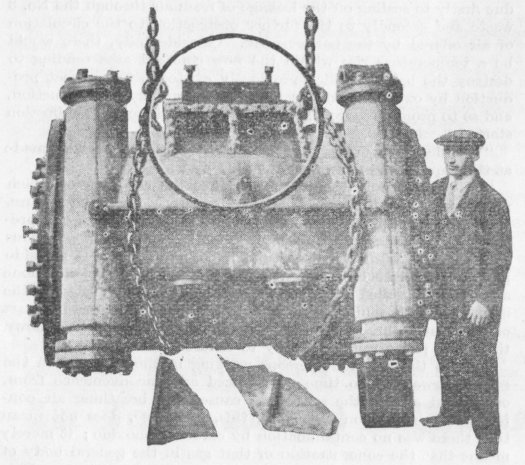
Figure 1. — Low pressure steam engine cylinder weighing 8 tons. A large piece was broken out of the jacket by steam from the high pressure cylinder. The internal supporting web was also broken away.
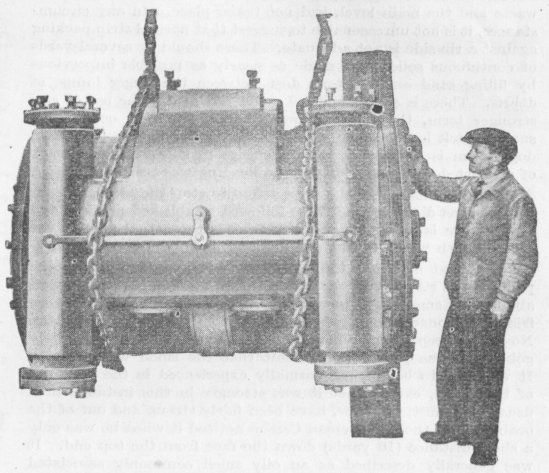
Figure 2. — The same cylinder after all the damage had been successfully repaired by scientific welding. The jacket had to stand high pressure so it was reinforced, and thoroughly tested. The cost of the repair was small compared with price of new cylinder, and delivery was quicker.
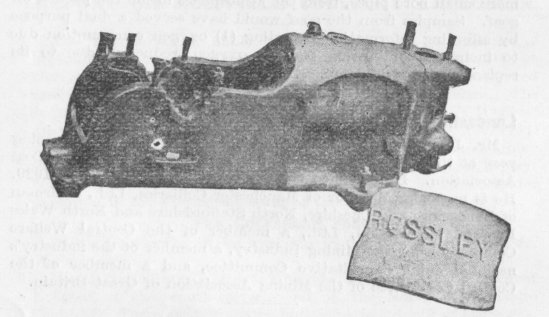
Figure 3. — Gas engine with water jacket broken out by frost. A quick repair was essential.
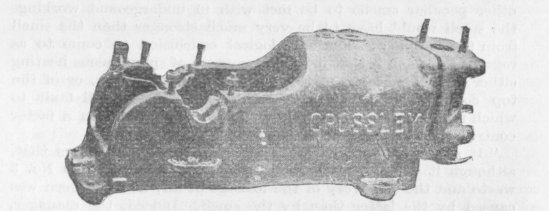
Figure 4. — The engine was ready for service in about 48 hours. There was not a sign of repair to be seen.
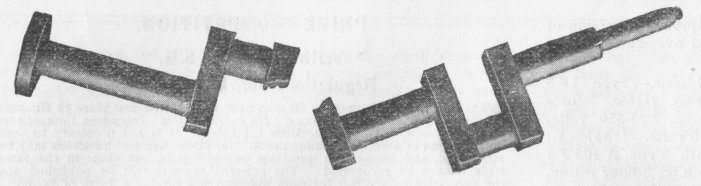
Figure 5. — Broken crankshaft of Diesel engine. Breakages occur to all kinds of crankshafts, and cause serious dislocation.
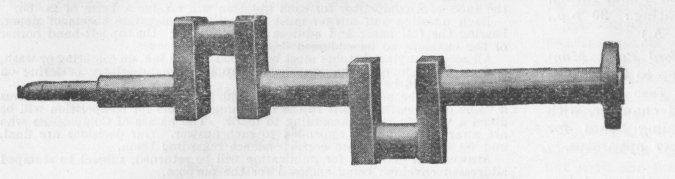
Figure 6. — Here is the repaired shaft. The cost was small, the job was guaranteed, and it was completed within a few days.
 |
 |
| Names mentioned in this article | |
 |
 |
| Name | Age | Occupation | Notes |
|---|---|---|---|
| Brett, C. W. | Managing Director |




 Contains public sector information licensed under the

