


| Newspaper Articles |

|
Newspaper Articles |
 |
 |
2nd November 1940, Page: 133, Column: 1
Lancashire's First Locomotive
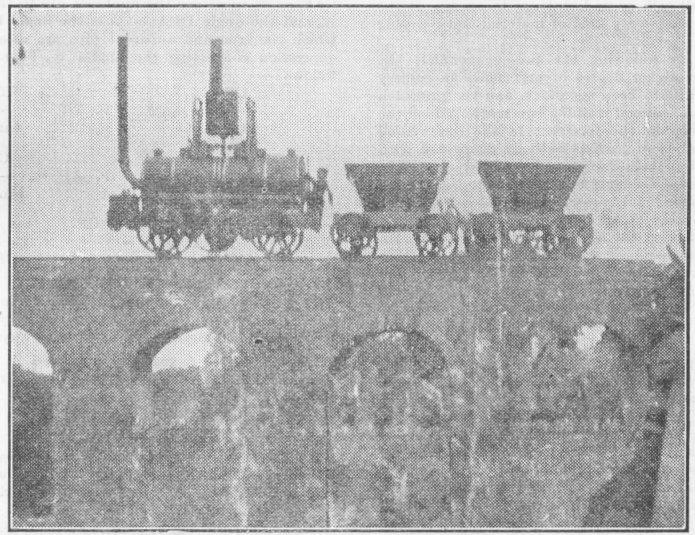
The picture on this page will interest readers of this journal. It shows a model of the first locomotive to run on rails in Lancashire. The original was named the "Yorkshire Horse," and conveyed coal from John Clarke's colliery to the Leeds and Liverpool Canal at Gathurst in the years 1813 to 1822. This engine was made by Robert Daglish, of Orrell, along with two others, two of them embodying John Blenkinsop's patent rack wheel drive as seen in the model; the other transmitting its power direct to the rail without the intervention of gears. Mr. E. Banks, of Pemberton, Wigan, has designed the model shown herewith. The original engines weighed approximately 5 tons, the limit imposed by the cast-iron rails and stone sleepers then in use, many of which broke, causing considerable expense.
The locomotive frames were made of oak and the wheels of cast-iron. The boiler, also of cast-iron, was oval in shape, being bolted together at the centre and finally lagged with pine boards. The flue was 24 inches in diameter for half the length of the boiler, and then 12 inches in diameter to the chimney, which was necessarily very tall to produce the natural draught required for steaming. Two calibrated safety valves were placed on the boiler, as pressure gauges had not then come into use ; also two taps at the side to register variations in water level. The cylinders were sunk vertically into the top of the boiler, the pistons being connected by a system of rods and levers to the cranks. Exhaust steam was carried to atmosphere through a silencer, which was a box-like contrivance. The boiler pressure of 30 pounds per square inch was considered high at that time. A water tank was placed in front with an immersed pump worked by a lever from an eccentric. The speed of these engines was from 2½ to 3½ miles per hour.
Mr. Banks, who is a member of the Wigan and District Model Engineering Society, made the model from drawings supplied by the South Kensington Museum. He has given lectures on Us history and has also made a replica of the "Arches" over which this historic locomotive ran. It is his intention to present the model to Wigan, and he is attaching a coin operating device so that the proceeds may be used for some charitable object.
The following extract from a letter written by Mr. Robert Daglish preserved in the Wigan Library, may also be of interest: "April 1st, 1856. To all whom it may concern. This is to certify that I made the first locomotive engine in Lancashire in the year 1812, and put it into action at the beginning of 1813 on the extensive colliery in my direction belonging to the late John Clarke, Esq., in the township of Orrell, near Wigan, for the conveyance of coal, etc. ; by trains of wagons from his colliery near Orrell Mount to the Leeds and Liverpool Canal, which was upwards of sixteen years before any locomotive engines were put fairly into action on the Liverpool and Manchester Railway. Robert Daglish, M.L.C.E."
 |
 |
| Names mentioned in this article | |
 |
 |
| Name | Age | Occupation | Notes |
|---|---|---|---|
| Banks, E. | |||
| Blenkinsop, John | |||
| Clarke, John | |||
| Daglish, Robert |




 Contains public sector information licensed under the

