


| Newspaper Articles |

|
Newspaper Articles |
 |
 |
7th September 1940, Page: 74, Column: 1
Winding Rope Pointers
An American Technical Review
Extracts from Technical Paper 602 of the U.S. Bureau of Mines on "Inspection and Maintenance of Mine Hoisting Ropes." Issued for sale at 5 cents net by the Superintendent of Documents, Washington, D.C.
By L. C. Ilsley and McHenry Mosier.
Construction of Wire Ropes.
The construction of wire rope is an interesting study and much more involved than one who has not considered the question would imagine. Wire rope is not simply several pieces of wire ; it is a complete machine. Nearly every type of service requires a different type of rope. Ropes used in marine work differ greatly from those used in the oil fields, ropes used in logging camps differ from those used in mines, and ropes used in mines on room hoists and drag lines differ from those used on shaft or slope hoists and skips.
In rope construction a factor emphasised hy rope engineers that should not he overlooked is the strength of the outer wires relative to the inner wires. As the outer wires (which are subject to abrasion) usually fail first, considerable emphasis is placed upon the remaining strength of the inner wires. The remaining strength of the inner wires of 6 by 19 hoisting rope depends on the types of construction and may range from 29 to 47 per cent. This factor should always be considered when estimating the remaining life of a rope.
The lay of a rope has a double meaning. It not only applies to the way the wires are twisted in the strand but also to the twist of the strands about the rope core. Wires twisted in the same direction as a right-screw thread are termed "right lay," and those twisted in the opposite direction "left lay." In "regular-lay" ropes the exterior wires parallel the longitudinal axis of the rope, and in "lang-lay" ropes the exterior wires are diagonal to the longitudinal axis of the rope.
Regular-lay ropes are more common than lang-lay ropes because they are easier to handle. The outer wires in lang-lay ropes afford a better wearing surface. Preformed ropes with lang-lay construction have the advantage of this wearing surface without the disadvantage of the regular lang lay.
The manufacturing of preformed ropes is a comparatively recent innovation in rope construction in which each strand and the wires of each strand are given a helical form of twist of the exact shape they take in the finished rope. Preformed ropes are made either regular or lang lay. Several advantages are claimed for preformed rope, but the chief one is the fact that they are "dead," that is, the wires in the strands or the strands themselves do not tend to untwist when one end of the rope is free to move.
A non-spinning rope has a "two-operation" construction. In the first operation the inner strands are lang lay while the outer strands are regular lay, thus the tendency to untwist or rotate is neutralised. Non-spinning ropes have been used at many mines in shaft sinking and at installations where guides and crossheads were not provided.
Selection and Handling of Rope.
A new rope should be long enough to permit several short lengths to be cut from each end during the life of the rope, and after the final cut to have at least three wraps of rope on the drum of the hoist when the cage or skip is at the bottom of the shaft. Many operators cut sections from the cage or skip end only, but it is important to cut short lengths from the hoist end as well, particularly where there is more than one layer of rope on the drum. At the cage or skip end the length of section removed should be 6 to 10 feet, depending on the way the rope is attached and the frequency of cutting. At the hoist end the amount cut off should be equivalent to 1¼ laps on the drum so that the wear from the abrasion at cross-over points between layers and at contacts of adjoining laps on the drum will be spread over a larger area.
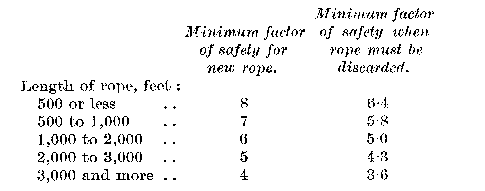
Ropes should be selected that have an ample factor of safety. The factor of safety is the ratio of the static load to the tensile strength of the rope. This is not a true factor of safety because it does not take into consideration the bending stresses at sheaves and drums, rope oscillations, shocks, rope speed, rope attachments, or stresses due to acceleration and deceleration. The last two are more important where short ropes are used than in deep shafts where the resilience of the rope tends to minimise the effect of these stresses.
The Bureau of Mines recommends the following safety factors for hoisting ropes for various depths of shafts :—
A wire rope is a costly piece of equipment and should be treated as such. Reels containing wire rope should never be dropped from cars or trucks or moved by prying against the coiled rope.
Wire rope not placed in service immediately should be stored in a dry place free from acid fumes and extremely high temperatures. The outside layers of the rope should be coated with a good lubricant.
It is very important that rope should be uncoiled in such a manner as to avoid kinks. Wire rope should never be unreeled or uncoiled like a hemp rope. The short life of ropes can often be traced to failure at a single point as a result of a kink. A kink in a rope distorts the relation of the strands and the wires making up the strands, causing unequal stresses in the strands at that point.
In preparation for an idle period at a shaft the hoisting ropes should be thoroughly lubricated with a lubricant that will keep out moisture. This should be done as the rope is being wound on the drum.
Deterioration of Ropes.
Hoisting ropes used in mines are subject to three kinds of deterioration — abrasion, corrosion, and fatigue. Ropes in active service soon show abrasion of the outer wires owing to friction on rope drum and sheave. Internal wires, by rubbing against each other, also suffer abrasion. Every time a wire is bent by running over a drum or sheave, bending stresses are induced ; every time a rope is loaded, tension stresses are caused in the wires ; and every time the load is varied, bending stresses are created. These stresses eventually cause fatigue of the steel, and if they continue long enough the wires will break. Sudden kinetic loads cause severe stresses in the wires. At one installation the king bolt on the skip was equipped with a nest of coil springs to reduce the initial shock to the rope when hoisting was started. When water or corrosive atmospheres come in contact with the steel wires corrosion takes place. In some mines acid water aggravates corrosion.
Breaks in the outer wires usually are caused by fatigue combined with abrasion or corrosion. These broken wires are warning signals that the condition of the rope is becoming dangerous. Tensile-strength tests of discarded hoisting ropes give the best indication of the number of broken wires in a given lay that can be tolerated before removal of the rope, provided internal corrosion is not serious. The number of broken wires should be stated in terms of a given rope lay and with reference to the strands in which they occur. They should be given for the worst lay in the rope. A sudden increase in the number of broken wires indicates rapid deterioration of the rope.
Where service conditions are severe the tonnage hoisted by previous ropes provides a measure of the expected life of a rope of the same size and quality of steel.
The sections of rope deteriorating most rapidly under average conditions are those at the cage or skip fastening, at the drum, at the head sheave when the skip is at the loading station, and at a point in the shaft midway between the head sheave and the loading station.
Lubrication.
The lubrication of hoisting ropes has been given much attention by rope manufacturers. A rope should be considered as a machine with many wearing surfaces that need constant lubrication. The lubricant should penetrate the spaces between the wires and strands and should not harden. A lubricant that hardens cracks when the rope is bent and forms crevices where moisture accumulates, which may cause internal corrosion. Tar should never be used. If possible the rope should be lubricated when dry. The lubricant should be applied often enough to keep the wires well covered and to prevent the hemp core from drying out.
Before a lubricant is applied the rope should bo cleaned, and all accumulated dirt and gummed lubricant should be removed from the valleys between strands. Superheated steam, compressed air, or both are recommended for cleaning ropes. Steam without superheating should not be used because it leaves moisture on the rope.
A point worthy of emphasis is the importance of adequate rope lubrication from the standpoint of safety. Lack of lubrication may result in early destruction of the hemp core and premature deterioration of the rope. Proper lubrication is essential to the prevention of both internal and external corrosion. Where internal corrosion has taken place, even if its presence is recognised, there is no method by which an accurate estimate can be made of the remaining strength of a hoisting cable. On the other hand, the amount of wear and the number of broken wires, considered in connection with previous service records, give a good indication of the condition of the rope, except for corrosion.
Sheaves and Drums.
The satisfactory installation of a hoisting rope requires due consideration of the lay-out and design of sheaves and drums. All ropes wear in service, and their diameters are reduced by abrasion of the outside wires of the several strands and by the strands becoming seated in the hemp centre. Some abrasion occurs at the drum, but most of it is due to contact of the rope with the head sheave.
Rope wear is increased when sheaves are out of alignment or do not move freely on their bearings. The rope should have proper clearance in the groove in the sheave.
Sheave- or drum-groove diameters should always be larger than the actual calipered diameter of the rope.
The groove diameter should be checked at regular intervals. It is essential to do this before installing a new rope so that the proper contour can be provided. This will prevent wedging as a result of an undersized groove and cutting as a result of the cable riding on a sharp shoulder. Grooved drums should be checked before a new cable is mounted. Corrugations in the grooves on the drum of the hoist are a frequent source of injury to ropes. A drum may be trued and its surface smoothed without being removed from the hoist by means of a lathe tool rigged on a suitable support in front of the hoist. The proper rotation of the drum can be obtained by lowering the skip or cage on the brake.
Another method of reconditioning the grooves on a drum is to smooth them by automatic grinding while operating the hoist. For this work a counterweighted floating grinding wheel moves across the face of the drum as the rope unwinds.
Severe wear may occur on drums with multiple layers of rope at the point where the cable rises to the next layer. This wear may be reduced by means of a wedge or spiral on the flange of the drum.
Many larger sheaves have replaceable steel liners. Their hardness should be such as to insure gradual wear. Large-diameter sheaves reduce wear on both cable and sheave liners.
Tests by manufacturers have shown that fatiguing action on a 6 by 19 rope takes place rapidly with sheaves at 72 times the diameter of the rope, that it is much less at 80 diameters, and that it becomes negligible at 90 diameters. The appropriate ratio is determined by economic considerations.
Grooved drums that carry the entire rope in one layer will prolong the life of the rope.
Where ropes are used for hoisting men only, the load on the rope is usually lighter and the service in general such as to prolong the life of the rope, sometimes several times that of a rope used to hoist material from the same mine. The number of days it has been used, rather than tonnage hoisted, is a better gauge of the life of a rope used under these conditions.
The deterioration of a rope progresses at a continually increasing rate to the point of failure. For this reason the rope requires more frequent inspections when the factor of safety approaches its lower limit.
Conclusions.
In the opinion of the writers, the safety and economy of hoisting-rope installations is based upon the following practice :—
1. Good engineering in laying out the hoisting-rope system.
2. Intelligent maintenance, including attention to wearing surfaces, such as drums, sheaves, and rollers.
3. Thorough inspection at regular intervals by capable, conscientious men.
4. Accurate records, comprising a written report of each inspection and a file covering the description of the rope and the complete history of its performance.
5. Judicial interpretation of inspections in comparison with records of previous installations.
6. Emphasis on safety rather than on the realisation of the maximum life of the rope.
 |
 |
| Names mentioned in this article | |
 |
 |
| Name | Age | Occupation | Notes |
|---|---|---|---|
| Ilsley, L. C. | U.S. Bureau of Mines | ||
| Mosier, McHenry | U.S. Bureau of Mines |




 Contains public sector information licensed under the

