


| Newspaper Articles |

|
Newspaper Articles |
 |
 |
24th August 1940, Page: 49, Column: 1
Notes On Safety Organisation. — II
These notes are based on the Mines Inspectors' Reports for 1938. The price of each Report is 1s. net. Copies are obtainable through H.M. Stationery Office.
Popularise Protective Equipment.
Whilst the use of protective equipment is increasing in Scotland it is the opinion of the Inspectorate that at least twenty-seven accidents might have been alleviated or avoided if the protection afforded by such equipment had been accepted. Mr. T. Ashley suggests that an exhibition of protective articles should be set out in a well-illuminated show case, with the prices marked, at some window which the underground workers pass.
In the Northern Division there is an apparent lack of progress. Workers interviewed individually almost invariably agree with the beneficial effect to be derived from the use of suitable equipment, but the excuses advanced for not taking advantage of facilities offered are many and diverse. Mr. W. J. Charlton can sympathise to some extent with the contention that it is difficult to wear a safety helmet in some of the thin seams, but even in such cases, which are a small proportion only of the total, a safety helmet has its merits even if only used while travelling. The complaint sometimes made that the older types of hats were uncomfortable is now met by constructional improvements in the newer types.
Almost every large colliery could probably quote a case in which the wearing of a safety helmet had saved the wearer from severe or fatal injury, and the Inspector appeals to all who have influence with workmen to lend support to popularising the use of safety helmets. Arrangements whereby protective equipment is supplied to workmen at reduced prices are fairly general. In this connection the retailing at the pits of canvas caps fitted with headlamp brackets is to be deprecated, as safety helmets with these or similar brackets are, of course, available.
Enquiries regarding accidents to boys and other haulage workers have shown that in a large proportion the hands and fingers are involved. Many of these injuries might be avoided or minimised by the wearing of gloves. Their virtues are becoming more widely appreciated, but Mr. Charlton would be glad to see a more rapid increase in their use.
Differing Degrees of Enthusiasm.
Saturation level has not been reached in Yorkshire in this matter, and Mr. H. J. Humphrys avers that at only a few collieries do more than 80 per cent. of the underground workmen wear safety hats. It is estimated that the figure varies between 10 and 40 per cent. for the majority of mines, while at some the number of safety hats used is almost negligible.
It is difficult to account for the differences which exist between collieries in the extent to which protective equipment is used. Hot mines and thin seams may he expected to be obstacles to such use, but progress has been slow at some mines where seam thickness and temperature are not unfavourable. Great differences, in fact, exist in the use made of protective equipment between mines working under approximately similar conditions, and the question may be asked if this is not due to the differing degrees of enthusiasm with which the colliery managements have approached the subject. Fatal accidents which might have been prevented by the use of safety helmets received a good deal of publicity in the press.
A number of instances have again been recorded of injuries prevented or minimised by the use of protective equipment, furnishing conclusive proof of the value of such equipment. The usual procedure in such cases is to display the hat prominently at the colliery with a suitable caption, for a period, and then hand it to Mr. Humphrys for transmission to the Chief Mining Engineer to the Safety in Mines Research Board, who has it photographed and supplies a number of copies to interested parties.
There is a growing tendency on the part of workmen to use safety boots, though there were at the end of the year probably fewer safety boots worn than safety hats.
It is with regret that the Inspector reports that, with the exception of one or two collieries, little extension has been made in the use of gloves, goggles, and shin guards. Hand injuries are by far the most numerous of all non-fatal accidents, and eye injuries may be very serious. Though progress has been slow, few managers doubt the need for the protection of hands and eyes. It is sometimes said, however, that where the coal seams are not thick and the dip of the strata not great, there is little need for shin protection. The only guide to this at any particular colliery is the number of injuries that occur to the lower parts of their legs.
At Waterloo Main Colliery there is a protective equipment club with more than five hundred members. The payment is sixpence a week and each member has a card on which each square represents the sum of sixpence and a stamp is placed in it for each contribution. If an article worth 10s. 6d. is purchased this is represented by 21 squares. If there are less than this number of stamps on the card, the stamps would be obliterated and the word "Due" marked on other squares making 21 in all. The card thus shows at a glance the state of the member's account.
Value of Official Example.
An estimate of the number of safety helmets used in the North Midland Division, in the view of Mr. G. Cook, would show that about fifty thousand persons employed below ground take advantage of this form of protection. Nearly twenty-eight thousand don't wear the hats. It might interest the latter to know that statistics obtained by the Midland Counties Research Committee co-operating with the Safety in Mines Research Board at each of six collieries in the Division show that the number of head injuries over a period of one year was reduced by 77 per cent. following the general adoption of helmets.
Various objections are raised at mines where few safety helmets are in use, but there cannot be much ground for these objections when at many mines helmets are worn without demur by over 90 per cent. of the underground workers. If helmets of correct size and suitable for the conditions are chosen the objections would probably disappear. Mr. Cook says that much can be done by way of example, and if officials, from managers downwards, wore helmets, less difficulty would be experienced in persuading the workmen to do so.
There has been a considerable increase in the number of mines at which gloves are used. The gloves chiefly used by haulage hands and persons engaged at loading points of conveyors have been the means of preventing many accidents to fingers, and the protection afforded by them is being more recognised. Gloves are rarely used by workmen on the face. This, according to the Inspector, is due chiefly to the difficulty of gripping tools properly when wearing them ; but trials were being made with different types in an endeavour to produce one sufficiently flexible to overcome this and yet one which affords protection to the hands. A glove similar to that used by cricketers when batting would appear to be the most suitable for face workers.
The use of safety boots continues to increase throughout this Division. Reports show that many injuries have, in fact, been avoided by their use, and that the severity of many others would have been lessened had safety boots been worn. For example, a ripper sustained a broken ankle when a very small piece of stone fell on it; this would not have happened had safety boots been worn.
Mr. Cook informs that more extended use is being made of goggles, especially by men using picks, and some men also wear them where the ventilating current is strong or where they are working in dusty places. At one mine all the 800 men employed underground were supplied with goggles. At first, one pair was shared between two men, and the resulting decrease of eye injuries was such that it was decided to issue a pair to every man. In the six months before goggles were introduced the number of eye injuries, involving more than three days' absence from work, was 22, as compared with 24 in the 18 months that followed, a reduction of almost two-thirds. It can therefore be expected that the full complement of goggles will still further reduce the number of accidents.
A pad for the protection of the spine has been designed by Mr. Kirk, agent for the Staveley Collieries. It is made in three sizes and consists of eight steel strips cut to suitable lengths and enclosed in a leather casing. It is supported over the shoulders by webbing and is secured by a belt round the waist. The pad weighs only one and a quarter pounds, and the cost is approximately 4s. 6d. Mr. Cook considers it should serve a very useful purpose, as it will withstand a severe blow and thus prevent or minimise injury to this most vital part of the body.
"A Real Pal — A.R.P."
In various sections of his report covering the North Western Division Mr. E. H. Frazer records accidents that might have been less severe had protective clothing been worn. He gives as follows accounts of accidents mitigated because persons had taken sensible precautions beforehand.
A North Staffordshire contract collier was loading coal on to a conveyor when a piece of inferior cannel roof, triangular in shape, slipped down a heap of blown-down coal, from a height of nearly six feet, on to his left foot. His safety boot was badly crushed, the uppers were torn from the sole, but his foot was only bruised. He sent to the surface for a new pair of safety boots and continued working. Had he been wearing ordinary boots he would have been on the compensation list.
A coal-cutting machine was being flitted down a face in a Lancashire mine when a coupling in the air-hose caught a prop and pulled it out violently. The prop struck a collier on the head, smashing the neb of his safety helmet and inflicting a wound on his forehead. Had he not been wearing a hard hat his injuries would have been serious.
The manager of a Lancashire pit introduced a topical allusion to Air Raid Precautions when he exhibited a damaged safety helmet in the show case at the pithead. The accompanying notice read : "This helmet saved the life of a workman yesterday. It was A Real Pal — ARP."
A collier was recovering pieces of a demolished chock from the edge of a waste in North Staffordshire when the roof collapsed. The falling stone struck him on the head and pitched him forward into the waste. His hard hat was badly dented and distorted but his head was uninjured, though his left arm was broken in two places. His helmet saved him from death.
In a working place 6½ feet high a loader was following behind a coal-cutting machine, clearing the cuttings to enable supports to be set. A fall of top coal struck his head with such force that he was knocked violently into a sitting position on the loose cuttings and his coccyx was fractured. His hard hat was damaged but saved his head from injury.
By courtesy of the Lancashire and Cheshire Safety in Mines Research Committee and the North Staffordshire Institute of Mining Engineers' Safety in Mines Committee Mr. Frazer is enabled to present the following details of protective equipment in use at the beginning and end of 1938 :—
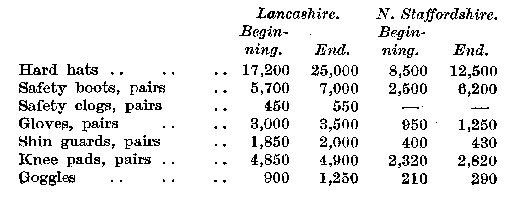
North Staffordshire, for its relative size, is well ahead in this comparison, except in regard to shin guards and eye protection. It may be thought that, with its thick seams, this coalfield would appreciate the advantage of shin guards more than Lancashire, but the above statistics do not support the supposition.
Part Played by Imagination.
There is still room for improvement. So says Mr. E. Rowley of the Midland and Southern Division. He thinks that many men are deterred from using gloves, goggles and shin pads by the fear of ridicule. To some extent, though not so much as formerly, this also applies to hard hats, particularly where men have to wear them in the street. It is certainly true that there is less difficulty in persuading men to wear them at pits provided with baths, though even at some of these pits many men object on the score that the hats are too hot, or that they give one a headache. This is very largely imagination, the Inspector believes, but the feeling is there and needs to be overcome.
In many cases the hats are supplied at a merely nominal price, and in some cases are even given free, but still men refuse to wear them. Certain pits have made the wearing of a hard hat a condition of employment, but in areas where good miners are not too plentiful such a drastic step cannot be taken, and Mr. Rowley suggests that a better idea would be for the workers' representatives to use their influence.
Little difficulty is experienced in getting the men to use safety boots ; they are good and cheap. Even here, however, the need for propaganda exists, as the following incident of which the Inspector recently heard, shows :—
A miner went into the colliery office and ordered a new pair of boots, but stipulated that they must not be like "the last lot with a hard toe cap." On being asked his reason for this, he replied that a piece of coal had fallen so heavily on the toe cap that it was bent inwards, and he had been unable to straighten it out again. Apparently it had not occurred to him, Mr. Rowley concludes, that the boot had saved his toes from being smashed.
Organised Campaign Succeeds.
Mr. P. S. Lea expresses surprise that officials and workmen do not fully appreciate the value of protective equipment, in the use of which he considers the position is not very satisfactory. The statement is made in his report that 33 per cent. of all reportable accidents in 1938 involved the lower leg and feet, and 9 per cent. the head, of those unfortunately concerned in the accidents. The Inspector suggests that in many of these cases the wearing of shin guards, or safety boots, or helmets would have mitigated the effects of the accident.
Following an intensive campaign in the Cardiff and Forest of Dean Division for the purpose of impressing upon workmen the benefits of wearing safety equipment for the prevention not only of serious accidents, but of the hundreds of minor injuries which incapacitate them for only a few days, many more workmen availed themselves of the protection afforded by this equipment. At some collieries it is now a condition of employment, Mr. J. Macleod Carey reports, that every man shall wear safety equipment, especially helmets, which are made available at prices as low as one shilling each in order to encourage the men to wear them, and the response has been very encouraging. In one large group of collieries, employing about 12,000 men, the demand has been so great that it could not be supplied by one firm alone, and the assistance of other firms has been enlisted to keep up the supply. At one mine in this group, where 2,000 men are employed, every man descending the mine, from the manager to the youngest boy, wears his safety helmet.
Safety boots are also supplied in increasing numbers — especially amongst haulage hands, many of whom also wear shin guards and gloves. It is very rarely that the Inspectors notice men working without gloves at conveyor loading points, and if the coal dust concentration is high they wear respirators as well.
First Aid and Ambulance.
It is pleasing to learn that in Scotland the ambulance leagues continued their useful work in helping to foster the interest of all mine workers in first aid, and the competitions arranged by them had good entries. The general standard of first-aid equipment is high. Mr. Ashley says that sometimes, however, the underground first-aid stations could be improved both as regards situation and equipment.
First-aid rooms on the surface require to be swept and dusted daily and should not be used for any other purpose. Care is constantly needed to keep the first-aid boxes carried by the first-aid men in proper order. The simple requirements of the Third Schedule of the General Regulations (First Aid), 1930, somehow seem difficult to carry out, sometimes because articles are carried in the boxes other than those required by the regulations to the exclusion of some of those that are.
Where a number of mines are owned by one firm the Inspector suggests that more effective supervision of the first-aid arrangements could be given if a skilled first-aid man was appointed to carry out Clause 12 of the General Regulations (First Aid) which requires the manager or some other qualified person to inspect at intervals the first-aid accommodation and equipment at the mine. The first-aid man so appointed could also form and instruct first-aid classes.
First-aid Worker's Chief Reward.
The continued success of the Durham, Cleveland and Westmorland District League in the Northern Division is largely due, Mr. Charlton avers, to the efforts of the indefatigable secretary, Mr. George Watkin, of Murton Colliery. It is well known that in the mining villages of the Division there are men who devote practically the whole of their leisure time to furthering the work of the St. John Ambulance Association, and the Inspector records that Mr. Jonathan Spooner was invested with a high honour when His Majesty the King, Sovereign Head of the Order, conferred the dignity of a Serving Brother of The Venerable Order of the Hospital of St. John of Jerusalem upon him.
Mr. Spooner, Mr. Charlton proceeds to say, has been employed by the South Hetton Coal Company, Ltd., for 42 years, during 35 of which he has been connected with first-aid activities. He has been an appointed first-aid attendant for 32 years and has been in charge of the first-aid room at South Hetton Colliery for 22 years. For 25 years he has been class secretary and instructor to both male and female classes in South Hetton village, and for 23 years ambulance officer and instructor of South Hetton Division of the St. John Ambulance Brigade. Mr. Spooner's chief reward lies in the satisfaction he must feel in serving so well in such an excellent cause.
In the North Midland Division there is continued and increasing interest in first aid and ambulance, and Mr. Cook observes that it is satisfactory that more attention is now being given to the treatment of trivial injuries at the first-aid stations and ambulance rooms, although there are still too many cases of neglect. Treatment of all injuries is readily available and workmen should take full advantage of such, realising that the arrangements made are for their benefit.
Mr. Lea is pleased to note that officials and workmen in the Swansea area maintain their first-aid interest, and regarding Cardiff Mr. Carey comments on the high standard of efficiency among colliery ambulance brigades and individual ambulance men. Many competitions at the several groups of collieries were held during the year, and the keen interest displayed, not only among the ambulance men but by the other workmen at the respective collieries, is a good indication of the importance attached to this humane side of mining operations.
 |
 |
| Names mentioned in this article | |
 |
 |
| Name | Age | Occupation | Notes |
|---|---|---|---|
| Ashley, Theodore | H.M. Divisional Inspector of Mines | Whos Who Page | |
| Carey, Joseph Macleod | H.M. Divisional Inspector of Mines | Whos Who Page | |
| Charlton, William John | H.M. Divisional Inspector of Mines | Whos Who Page | |
| Cook, George | H.M. Divisional Inspector of Mines | Whos Who Page | |
| Frazer, Edgar Hamilton | H.M. Divisional Inspector of Mines | Whos Who Page | |
| Humphrys, Herbert John | H.M. Divisional Inspector of Mines | Whos Who Page | |
| Kirk, — | Colliery Agent | ||
| Lea, Paul Salthouse | H.M. Divisional Inspector of Mines | Whos Who Page | |
| Rowley, Elijah | H.M. Divisional Inspector of Mines | Whos Who Page | |
| Spooner, Jonathan | |||
| Watkin, George |
|
|
| Links to Collieries/Mines mentioned in this article | |
|
|
 | Murton Colliery |
| | South Hetton Colliery |
 |
 |
| Related Articles | |
|
|
| Pub. Date | Article (Newspaper) |
|---|---|
| 13 Jul 1940 | Accidents And Their Prevention (The Science and Art of Mining) |
| 27 Jul 1940 | Accidents And Their Prevention (The Science and Art of Mining) |
| 10 Aug 1940 | Notes On Safety Organisation (The Science and Art of Mining) |
| 24 Aug 1940 | Notes On Safety Organisation. — II (The Science and Art of Mining) |
| 07 Sep 1940 | Training Boys In Safety Principles (The Science and Art of Mining) |
| 21 Sep 1940 | Health, Welfare And Education (The Science and Art of Mining) |



 Contains public sector information licensed under the

