


| Newspaper Articles |

|
Newspaper Articles |
 |
 |
10th August 1940, Page: 35, Column: 1
Liquefaction Of Coals By Hydrogenation
Canadian Investigations
The Mines and Geology branch of the Canadian Department of Mines and Resources has been engaged on work on hydrogenation at the Fuel Research Laboratories at Ottawa, in Ontario. The results of the more recent work are embodied in a report of 106 pages [No. 798, price 25 cents] on "Tests on the Liquefaction of Canadian Coals by Hydrogenation," prepared by T. E. Warren and K. W. Bowles. Following three short chapters on earlier work, the plant and equipment used, and the method of testing, there are eleven chapters giving the results of tests on various Canadian coals, lignites and peat, including for comparison a sample from the county of Durham, the concluding chapter of the book being devoted to a general discussion of the results.
It is interesting to note from the preface written by Mr. P. F. Haanel, Chief of the Division of Fuels, that during the period 1918-1937 the rate of the world's consumption of petroleum greatly increased. In the latter year the production was 2 billion barrels, and it was estimated that the reserve in proved fields was about 20 billion barrels. As the rate of production cannot economically be raised beyond certain limits, the maintenance of a sufficient supply to meet the expanding requirement is dependent upon the discovery of new fields. It would appear from a report on oil conservation that the rate of discovery in the United States declined more than 50 per cent. during the years 1931-37 as compared with the rate from 1924 to 1930. Petroleum consumption in the States has been reported to exceed the amount of new discoveries during the past few years, in spite of which the States' proportion of the total world output has been increasing slightly, being about 63 per cent. in 1937. It is not too soon, therefore, Mr. Haanel concludes, to consider the consequences of a possible deficiency of petroleum. As the demand approaches the potential supply it is probable that the price of petroleum products will rise until substitutes can compete economically. The proportion of these will then gradually increase as petroleum production diminishes. For this reason the raw materials and methods employed in the manufacture of substitutes are of considerable interest.
The principal raw materials available for the production of substitute liquid fuels are coal and the natural bitumens occurring in shales and sands. These materials differ from the fluid hydrocarbons in that they contain a smaller proportion of hydrogen. For example, a bituminous coal has about 5 to 6 per cent. of hydrogen, whereas gasoline has about 14 per cent. Accordingly, any method which is to produce a large yield of gasoline from coal must be based on the addition of hydrogen.
Processes for Manufacture of Liquid Fuels.
There are two outstanding processes for the manufacture of liquid fuels from coal. The first combines hydrogen chemically with the coal through the agency of high pressure, and is called direct hydrogenation. With the second process, coal is first converted to water gas, hydrogen is then added, and the mixture is catalytically converted to hydrocarbons and water. This is called indirect hydrogenation, or more often the Fischer-Tropsch process. The former has been more extensively employed in Europe than the latter, and, Mr. Haanel says, is probably more economical. It produces gasoline having a high knock rating, and is applicable to such materials as bitumen as well as to coal. It can also be used to make benzene, toluene, phenol, and other tar acids from coal if more of these are required than can be supplied from coal tar. However, this process has so far not lent itself successfully to the production of a first rate Diesel fuel or lubricating oil from coal. Further, it is not applicable to all coals. The Fischer-Tropsch process has the advantage that it can be applied to any raw material from which water gas can be made. It also makes a good Diesel fuel, and is a possible means of making lubricating oil. Its principal disadvantage, aside from cost, is that the gasoline fraction has a very low knock rating.
Of these two processes, only direct hydrogenation has been studied experimentally at the Fuel Research Laboratories. This is principally because the applications of indirect hydrogenation to different materials vary only in the method of making water gas, and on that account there is less need for a survey of raw materials. The coals selected originated in widely separated districts from which more than 60 per cent. of Canada's coal output is produced. The coals selected varied in rank from medium-volatile bituminous to lignite ; tests were also, made on a representative Canadian peat. It was found that all the fuels could be partly liquefied, but the extent to which they could be converted into valuable liquid and gaseous products varied considerably. The yields of primary oil, for example, were between 44 and 77 per cent. of the weight of the coal on the ash-and-moisture-free basis. The variation was mainly accounted for by difference in rank.
Test Results.
In the course of the discussion of the results of the tests, it is stated that a comparison of properties and yields indicates that rank appears to have the major influence. Indeed it is difficult to evaluate the effects of characteristics other than rank, such as the geological age, the composition of the ash and the proportions of nitrogen and sulphur, because they are largely obscured by the effects of rank. Some of the coals from Western Canada, it is observed, have been metamorphosed more rapidly than those from Nova Scotia and Durham, and therefore have attained the same rank in a shorter time.
Variation in the proportion of sulphur did not seem to have any consistent effect on the yields, but there is an apparent relationship between the nitrogen content of the coal and the yield of combustible solid. The coals that have high nitrogen content in general give low yields of combustible solids and correspondingly high yields of oil.
In comparing the coals, the amount of primary oil product was taken as an index of their suitability for the production of gasoline. The complete process requires a second stage of hydrogenation in which some losses are incurred, so that the yields from the present tests are higher than they would have been if the final product had been gasoline.
The yields of primary oil are shown in the accompanying table as Imperial gallons per short ton of dry and ash-free coal. The average specific gravity of the primary oils has been taken as 1.0 in preparing this table.
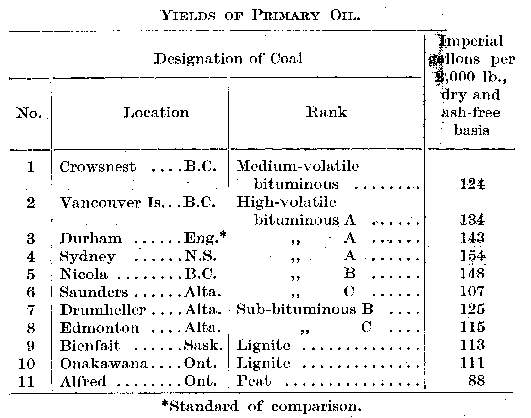
On the dry and ash-free basis all the coals, excepting the peat, yielded more than 100 gallons of primary oil per short ton. The highest yield was 154 gallons per ton, and the lowest 107 gallons. It should be noted, however, that the dry basis favours the low-rank coals, which would be handicapped commercially by the expense of drying. The ash-free basis favours the coals high in ash, and especially those having a high content of inherent ash. These would have the added expense of washing before the liquefaction process, or be subject to a considerable loss and expense in removing ash from the primary liquid product.
It will be noticed that two of the Canadian coals, from the Sydney district in Nova Scotia and the Nicola district in British Columbia respectively, gave higher yields of oil than the standard English coal. The sample of Sydney coal tested was particularly well suited for the process because of its low inherent ash.
 |
 |
| Names mentioned in this article | |
 |
 |
| Name | Age | Occupation | Notes |
|---|---|---|---|
| Bowles, K. W. | |||
| Haanel, P. F. | Chief of the Division of Fuels | ||
| Warren, T. E. |




 Contains public sector information licensed under the

