


| Newspaper Articles |

|
Newspaper Articles |
 |
 |
10th August 1940, Page: 33, Column: 1
Notes On Safety Organisation
These notes are based on the Mines Inspectors' Reports for 1938. The price of each Report is 1s. net. Copies are Obtainable through H.M. Stationery office.
Widespread Campaign Advocated.
The present-day widespread consciousness of the need for safety planning on the community principle provides an obvious lesson on the moral obligation of the individual who, being compelled to reflect on the problem, realises that he is protecting himself more surely in this way than he would be doing by directing his plans and operations without consideration for others who live and work with him. This lesson has often been taught in mining, and among mining men the community idea in establishing and maintaining safety is or should be an accepted principle. Indeed, it should not be necessary to emphasise this point, and the hope may be expressed that when the dawn comes again, as it most surely will do, there will be a hundred per cent. enthusiasm for community consciousness in safety planning in and about the mines. Having learnt the lesson to-day in the ordering of social life, it should be good enough to apply to the peace operations of to-morrow, that is, in the combat with the forces of Nature, so that she may yield up her coal for the good of all men.
Successful Fife Campaign.
The campaign for greater safety should be encouraged at every mine. Its exact form may vary from pit to pit according to the conditions and circumstances prevailing, but whatever the form or the means adopted the ultimate object should be the same, namely, the elimination of the weak link that spells disaster to the whole machine or mine.
In the past individual mines and companies have encouraged the movement. For instance, as noted by Mr. T. Ashley in his report for Scotland, in the last decade there has been in existence a campaign to secure greater safety at the mines belonging to the Fife Coal Co., Ltd. As briefly stated, under the general works manager there is a central safety committee which meets monthly and, in conjunction with a safety engineer, this committee controls 11 safety inspectors and 13 colliery committees, one at each mine, the manager acting as chairman. The colliery committee consists of the officials and representatives of the workmen from the various districts and occupations. The safety inspector reports to the central committee on the work done.
A considerable amount of propaganda work is carried on which aims at cultivating a spirit of emulation between the collieries. Bulletin boards and posters are exhibited on the surface, and notices giving particulars as regards the number of accidents are posted at the entrances to the various sections.
In a paper describing the nature of the campaign Dr. William Reid says that the study of their individual safety problems by the mine officials has resulted in improvements in such matters as roadhead supports, shot-firing, lighting, and in the application of haulage safety appliances, and that the campaign has resulted in a gradual reduction in the accident rate.
Safety Officers Make Good.
Turning to the Northern Division report by Mr. W. J. Charlton, it is there recalled that at the collieries in the Lambton, Hetton and Silksworth groups of the Lambton, Hetton and Joicey Collieries, Limited, Durham, a bid to increase safety was inaugurated in April, 1937. Mr. P. S. Blunden, the holder of a first class certificate, was appointed to co-ordinate safety activities and additional safety officers have since been appointed to assist him. The Inspector summarises the activities thus :—
Central and individual pit safety committees;
Suggestion boxes at collieries ;
Monthly safety magazine — with accident league tables ;
Shield for inter-colliery annual competition ;
Bonus system of monetary rewards for safe working ;
Safety literature, including instructional booklets, posters from Safety First Association, slogans printed on pay tickets ;
Educational work, in conjunction with the county authority, which comprises classes in safety principles for boys, deputies' and shot-firers' preparation classes, and first-aid classes. The colliery company pay class fees and travelling expenses for those wishing to further their technical education ;
Lectures on subjects connected with safety in mines ;
Popularising the use of protective equipment.
The accident rate on the basis of shifts actually worked at the collieries was seven per cent. less in 1938 than in 1937.
Special campaigns were instituted in 1937 at two collieries in the group where accident rates were highest. Comparing periods of 12 months before and after the commencement of the campaigns there were reductions of 29 and 32 per cent. at the respective collieries, in the accident rates on the basis of manshifts worked.
A reduction in accident rates to boys, calculated per 1,000 boys employed, is particularly satisfactory. Comparing 1938 with 1937, the average rate for the ten collieries showed a reduction of 30 per cent.
Safety Propaganda Effective.
The effectiveness of the safety propaganda method of attack upon the question of safety in mines is becoming increasingly realised, but Mr. Charlton observes that the movement is, as yet, only in its infancy. He says the method adopted for educating officials and workmen at the collieries owned by the Ashington Coal Company, Ltd., is commendable. Photographs enlarged to a size of 1 foot 3 inches by 10½ inches taken to illustrate a particular point in connection with accident prevention, are posted at the pitheads. They are changed frequently, and while they are posted the officials devote particular attention to the points illustrated. Examples include correct methods of: (a) spragging on machine-cut conveyor faces ; (b) timbering on machine-cut conveyor faces ; (c) supporting the roof on each side of a web of undercut coal before completing the stripping of the undercut coal.
Only correct or safe methods are shown — never the incorrect or unsafe. The photographs have a personal interest and should tend to raise the standard of workmanship, which the Inspector considers is of vital importance in accident prevention.
Mr. H. J. Humphrys, of the Yorkshire Division, reports that the safety committees of Messrs. Newton, Chambers and Co., Ltd., had another successful year. He records with gratification that the figures presented to their annual general meeting show that the accident rate (accidents disabling for more than three days) for 1937 was 48 per 100,000 man-shifts worked against a figure of 71 for all Yorkshire. It showed a 50 per cent. reduction compared with 1931, the year in which the safety committees started. These figures are given by the Inspector in the hope that others may be thereby encouraged to set up safety committees on these lines. The first requirement is a capable and enthusiastic safety officer.
Pit Committee's Useful Purpose.
Whilst only a few pit committees are in operation in the North Midland Division Mr. G. Cook says that at those mines where committees are established they continue to hold regular meetings for discussion of accidents which have taken place with a view to finding remedies and their adoption for preventing similar occurrences. A greater safety consciousness is shown at these mines and he IS of opinion that if more committees were established they would result in a decrease in the number of avoidable accidents at collieries. Safety officers have been appointed at two further groups of mines with beneficial results. The Inspector is pleased to find that workmen, both old and young, now appear to appreciate the advice given by safety officers on the safest methods of carrying out their work.
Reference is made by Mr. E. H. Frazer of the North Western Division to the fact that each producing mine of Manchester Collieries, Ltd., has a pit committee established. It is constituted of representatives of the management, firemen, miners, surface officials, surface workers and a safety officer. Its functions are purely advisory and consultative. Every accident is considered and the fundamental cause determined, when possible. It has been found that the majority of accidents can be prevented by the injured persons themselves exercising more care and thought in the execution of their duties. The head safety officer's opinion is that these committees serve a useful purpose, and that the representation of the workers should be increased so that more of them will be present when accidents are discussed individually. In another Division the same object is attained by limiting the period of service on such committees so that the personnel is changed frequently.
Creation of Safety Consciousness.
In the view of Mr. E. Rowley of the Midland and Southern Division the true accident position at individual collieries cannot be obtained unless a detailed analysis is made, and the figures interpreted with due regard to their origin and associated factors. In order to present some idea of the position, particulars of accidents have been obtained from eight representative collieries in the Division and a "safety rate" worked out for the purpose of comparison.
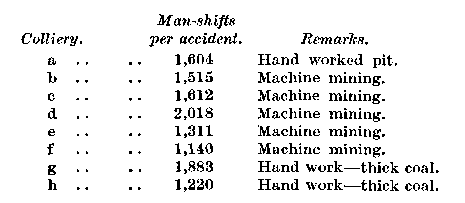
The figures clearly indicate a great field for improvement in the accident position at many of the collieries, and the Inspector suggests much useful information would be obtained if more comprehensive records of accidents were kept, and an improvement in the general position forthcoming if the resulting conclusions were applied. The value of the figures, for instance, could be increased by taking account of accident severity.
It is generally accepted that a considerable proportion of the accidents which occur in mines may be attributed to what is widely known as a "Failure of the Human Element," and there has been a tendency to accept the results as something inseparable from the winning of coal. Mr. Rowley, however, affirms that an analysis of the type of accident referred to will show that the mystic phrase can be expressed in such ordinary terms as inexperience, indiscipline, haste, carelessness, procrastination, etc. — all of which may be made to yield to treatment of the right kind. The elements of that treatment, he adds, are education, and the creation of "safety-consciousness" among officials, and men from the highest to the lowest.
It is recognised that good safety officers are not plentiful, and that to obtain men with the necessary combination of tact, character, technical knowledge, organising ability and enthusiasm, a substantial salary must be paid ; but Mr. Rowley feels sure that men of this type would more than justify themselves and, putting it at the lowest plane, would at large collieries probably save their salaries by a reduction in insurance premiums.
A competent safety officer will, of course, draw up his own programme to suit the needs of his own colliery, but the Inspector considers it may not be out of place to put forward a few essentials of the job :—
(1) A study of accident records and reports. The records should be worked out for each separate district under the various classifications, and haulage accidents should include comparisons on a ton-mile basis of the different types of haulage. Reports of accidents should be studied with the object of devising means to prevent a recurrence.
(2) Safety inspection and actual investigation of accidents.
(3) Organisation of safety committees.
(4) Training of boys.
(5) Promotion of the use of protective equipment.
(6) First-aid training.
(7) Propaganda.
(8) Training of adults by film displays and by study on the spot of methods of work, the mistakes made, and instruction in better methods. Interest may be stimulated by getting the men themselves to give talks on how they do their work.
 |
 |
| Names mentioned in this article | |
 |
 |
| Name | Age | Occupation | Notes |
|---|---|---|---|
| Ashley, Theodore | H.M. Divisional Inspector of Mines | Whos Who Page | |
| Blunden, Philip Sidney | Safety Officer | Whos Who Page | |
| Charlton, William John | H.M. Divisional Inspector of Mines | Whos Who Page | |
| Cook, George | H.M. Divisional Inspector of Mines | Whos Who Page | |
| Frazer, Edgar Hamilton | H.M. Divisional Inspector of Mines | Whos Who Page | |
| Humphrys, Herbert John | H.M. Divisional Inspector of Mines | Whos Who Page | |
| Reid, William, Dr. | Whos Who Page | ||
| Rowley, Elijah | H.M. Divisional Inspector of Mines | Whos Who Page |
 |
 |
| Related Articles | |
|
|
| Pub. Date | Article (Newspaper) |
|---|---|
| 13 Jul 1940 | Accidents And Their Prevention (The Science and Art of Mining) |
| 27 Jul 1940 | Accidents And Their Prevention (The Science and Art of Mining) |
| 10 Aug 1940 | Notes On Safety Organisation (The Science and Art of Mining) |
| 24 Aug 1940 | Notes On Safety Organisation. — II (The Science and Art of Mining) |
| 07 Sep 1940 | Training Boys In Safety Principles (The Science and Art of Mining) |
| 21 Sep 1940 | Health, Welfare And Education (The Science and Art of Mining) |



 Contains public sector information licensed under the

