


| Newspaper Articles |

|
Newspaper Articles |
 |
 |
13th July 1940, Page: 8, Column: 2
By Products From Coal
By B. Wilson Haigh, M.L.A.(Bihar), M.I.Chem.E., M.M.G.I.
[Note. — In a recent issue of The Science and Art of Mining (page 388) some notes on systems of carbonisation were culled from a paper on "Coal Carbonisation and some of its Byproducts," which was read before the Mining, Geological and Metallurgical Institute of India. Appended are extracts from the section of the paper dealing with by-products derivable from coal.]
Coal Tar.
Coal, the raw material of the carbonisation industry, is by no means a simple material but a mixture of many variable substances that have their own peculiarities when subjected to destructive distillation. The problem is a very complicated one, and vast sums reaching into millions of pounds have been spent on experiment and research. In coal we find various compounds of carbon, hydrogen, oxygen, nitrogen and sulphur combined in many forms, and these are so affected by processes of distillation as to be an ideal source for the synthesis of thousands of organic compounds.
Coal tar is a complex mixture about which comparatively little is known even to-day, but most people know that it is the source of many valuable compounds. Its definition by the British Standards Institution is as follows :—
"Tar is a bituminous product, viscous or liquid, resulting from the destructive distillation of organic materials. The word 'Tar' must always be preceded by the name of the material from which it is produced : Coal, shale, wood, peat, etc. Its mode of production should also be indicated."
The amount of coal tar varies according to the amount of volatile matter in the coal from which it is produced and also the temperature of carbonisation. In coke oven and gasworks practice in England, an average of about 5½ per cent. (10 gallons per ton) is recovered. In India, about half that quantity is recovered, say 5 gallons per ton of coal.
Coal tar comes away with the gas when the coal is heated, and when the gas is cooled the tar condenses out with some water vapour and settles out from the water by virtue of its higher specific gravity. There are plants where it is necessary to remove the bulk of tar before the gas is cooled ; as in the indirect recovery process, it can be done by mechanical means.
The most modern method of tar extraction is by electric precipitation.
Coal tar is the most important and interesting raw material from the chemical manufacturers' point of view. The number of products that are derived from it is legion, and the story of their manufacture is one of the most fascinating in the history of science. It provides the raw material for road binding material, wood preservatives, sheep dips, washes for the destruction of pests for horticultural crops, antiseptics and disinfectants, dyes, perfumes, flavours, sweetening materials, important medicinal substances and raw materials for the plastics industry. Naphthalene is also extracted from coal tar and it in its turn is the raw material for deodorants, insecticides, dyes including synthetic indigo, solvents for varnishes, etc.
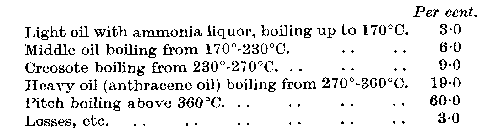
Tar, when distilled, yields light oil and creosotes of various boiling points and specific gravities, all with their own characteristics. A typical distillation result is shown below :—
Colour has a very definite place in the scheme of the Universe, but the tinctorial art of to-day is very different from that of the ancients and stands upon an entirely different structure, the foundation stone of which was laid in 1856 when a brilliant young chemist, W. H. Perkin, discovered mauve, the first aniline dye. These so-called aniline dyes are synthetic organic compounds not extracted from, but derived by a series of chemical reactions, many of them very complicated, from coal tar.
In 1913, only about 9 million pounds of British dyes were sold, as against 63 million pounds in 1937. Foreign dyes dropped from 32½ million pounds in 1913 to 5 million pounds in 1931 ; the figures for 1937 are not available, but would probably be about 6 million pounds. The present war will greatly affect the export of German dyes, and nobody can foretell what will happen afterwards ; but the figures quoted give some idea of the magnitude of the industry.
Naphthalene is an important constituent of coal tar. In 1936, over 200,000 tons were produced. It may constitute as high a proportion as 10 per cent. of coal tar, but is generally less than that. The melting point of the pure product is 80.25°C. and its boiling point is 218°C. It crystallises out of the tar oil coming over between 190° and 230°C. Drained or whizzed naphthalene is a standard article of commerce.
Ammonia.
Up to a few years ago, the chief source of supply of ammonia and its products was coal; but that situation has been completely changed since the advent of synthetic ammonia from the nitrogen of the atmosphere.
To-day, there is little profit to be made from ammonia as a by-product from coal, so little that more than one works in India which formerly manufactured ammonium sulphate have now ceased to do so. Three different processes are in use for the manufacture of sulphate of ammonia where coal is carbonised : (1) The Indirect process, practised at most gasworks and at some coke plants. (2) The Semi-direct process, in which the crude gas is cooled below the dew point, thus removing the tar and the water to a large extent. (3) The Direct process, in which the crude gas is freed from tar in its hot state either mechanically in a rotary tar extractor or by the electrical precipitation method.
Benzole.
There is a general idea that benzole is recovered from coal tar. That is only true to a very limited degree and certainly not in India. Practically all the benzole is recovered from coal gas. Taking the volume of recoverable crude benzole in coal gas as about 2 gallons per 10,000 cubic feet and the volume of 1 gallon of crude benzole as vapour to be 35 cubic feet, it will be seen that the extraction of the benzole from the gas will reduce the volume of the gas by something less than 1 per cent. The calorific value of the benzole is about 150,000 B.Th.U. per gallon, and the removal of 2 gallons will thus reduce the calorific value of the gas by 30 B.Th.U. per cubic foot.
If a vapour such as benzene is brought into intimate contact with an oil such as creosote, the molecules of benzene vapour will impinge on the surface of the oil and be held there by the attraction of the molecules of the oil. At any temperature, if the pressure of the vapour above the oil is constant, the number of vapour molecules entering and leaving the oil in a given time will be the same. Equilibrium is then established and the oil is said to be saturated with benzene. Under these conditions, the concentration of the benzene in the oil is constant and can only be altered by altering the temperature or the pressure of the benzene vapour above the oil. As the temperature decreases, the molecules of benzene in the oil will have less energy and so have less tendency to leave the solution ; or in other words, the cooler the oil the more benzene vapour it will absorb and, conversely, the hotter the oil the less benzene it can absorb. This of course explains why it is more difficult to recover benzene or other hydrocarbon vapours in a tropical climate than in a temperate one.
The first process in the refining of benzole is known as "washing." The object of washing is to remove certain impurities such as thiophene, etc. It is generally done in a vertical cylinder of cast-iron with a conical bottom and fitted with a mechanical agitator. The size varies according to the capacity of the still — it is often arranged that one charge of the washer makes one charge for the still and that may be anything from 1,000 to 7,000 gallons. The benzole is washed with the smallest quantity of 95 per cent, sulphuric acid required to remove the impurities, then with water and afterwards with caustic soda to ensure that no acid remains to corrode the rectification still. After settling, the washed benzole is run into the final or rectification still, which comprises a horizontal steel cylinder. The heating is carried out by means of steam in closed coils, of which there are various designs, and the inlet of the coil is connected to the steam supply and the outlet to a steam trap. "Open" steam is available from a perforated pipe running along the still bottom. The still is surmounted by a fractionating column through which the vapours pass, and between the fractionating column and the condenser there is often a dephlegmator or analyser which is in effect a water-cooled reflux condenser, the severity of the condensation being controlled by varying the water supply.
Toluol is one of the products of crude benzole, and Indian benzoles are rich in this substance because it is less volatile than benzole and less escapes with gas. Toluol is the basic material from which the high explosive T.N.T. (tri-nitro-toluol) is manufactured, and it has been proved on a commercial scale that toluol of the very high grade of purity required for the manufacture of this high explosive can be produced in India.
Coal Gas.
When the by-products have been recovered from the crude gas, there still remains the coal gas itself, part of which may be regarded as a by-product. The gas evolved may amount to 10,000 cubic feet per ton of coal with a calorific value of 450-500 B.Th.U. per cubic foot, so that it represents enormous heating value and, as it can be piped any distance, it forms a valuable heating medium always "on tap" for any purpose for which gas can be used.
Fifty per cent. or more is required for heating the ovens and maintaining the walls at suitable coking temperature. Old ovens of the waste heat type, not fitted with regenerators for pre-heating the air, require more gas than the modern regenerative type ; but whatever gas is to spare after that requirement is satisfied, is known as "surplus" gas. For this there are many uses, such as lighting and heating, either domestic or commercial, in highly populated areas where there is a constant demand.
Where coke plants are associated with steel works there are many uses for the gas, as in open hearth, re-heating and smelting furnaces. At other plants it is used for steam-raising, heating tar stills or other chemical plant and for gas engines. New uses are developing such as the Fischer-Tropsch process, which is a synthetic process coming under the same category as the Bergius hydrogenation process, the object of both being the conversion of coal into oil without the production of solid by-products other than waxes. The process consists in the conversion of so-called "synthesis gas" — a mixture of 1 volume of carbon monoxide and 2 volumes of hydrogen — into an oil product. The starting material may be coal or coke. The coke is converted into water gas, which is then converted to "synthesis gas" and the spare coke oven gas is also decomposed to provide more "synthesis gas." After removing impurities, this gas is taken at atmospheric pressure through reaction chambers containing a catalyst. The reaction temperature of the synthesis is between 180° and 210°C. and it has to be controlled within narrow limits. The product first obtained is known as the primary product and consists of gaseous, liquid and solid hydrocarbons. This primary product has to be further treated to obtain commercial products.
 |
 |
| Names mentioned in this article | |
 |
 |
| Name | Age | Occupation | Notes |
|---|---|---|---|
| Haigh, B. Wilson | |||
| Perkin, W. H. | Chemist |




 Contains public sector information licensed under the

