


| Newspaper Articles |

|
Newspaper Articles |
 |
 |
15th June 1940, Page: 391, Column: 1
Gas And Dust Experiments
By E. T. John.
From paper on "A Method of Clearing Gas and Allaying Dust in the Track of a Coal Cutter Jib," read before the Manchester Geological and Mining Society.
Experiments were prompted by observations of the large quantity of gas given off while arc walling in the Parkgate Seam, also reports of ignitions which had taken place in the cut at various collieries and the ever-present coal dust problem. The experiments were carried out in the above-mentioned seam, which is 5' 3" thick between a rock roof and a hard fireclay floor and at a depth of approximately 600 yards. The method of working is to head out pillars with the Anderson Boyes arcwall machine and to retreat these pillars by normal hand-got methods. The place in which we worked was ventilated by brattice sheets from the intake airway.
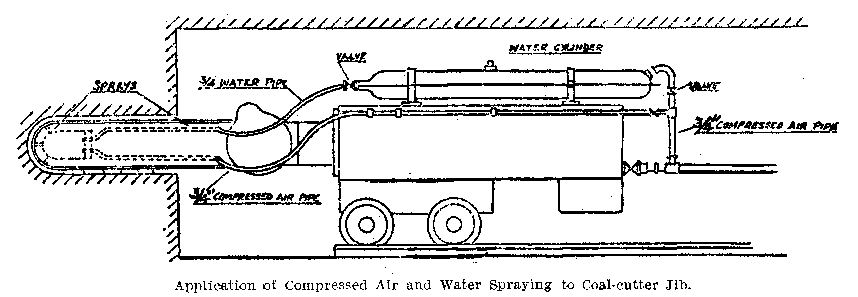
A number of air samples taken in the cut showed that high percentages of CH4 were present even hours after the cutting had been finished, and while there was no gas present before cutting certain percentages were present along the heading immediately after cutting commenced. Therefore, it was decided to attempt to clear the gas by passing compressed air into the back of the cut through the jib. Certain mechanical difficulties were encountered in arranging pipes through the body of the jib, but these were eventually successfully overcome. The compressed air was by-passed from the main supply to the machine through piping and a control valve.
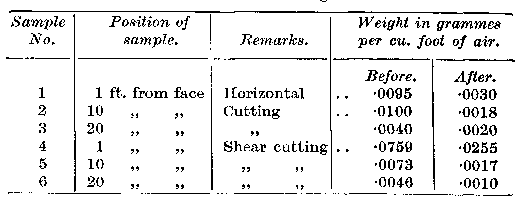
Air samples were taken in the horizontal cut, the vertical cut, and at intervals of 10 feet along the heading while injecting air into the back of the cut and also without injection.
The methods of sampling were as follows :—
(1) In the heading the samples were taken simultaneously in certain positions by emptying water from an ordinary sample bottle. This was done when the jib was halfway through the cut, by a man stationed at each of these points.
(2) The samples taken from the horizontal and shear were obtained by drawing the air through a thin metal tube by means of a rubber aspirator pump. The air was pumped into an ordinary sample bottle. It was found necessary to turn back the end of the metal pipe and to secure a piece of muslin over the end to prevent coal dust from getting into the pipe when pushing it into the cut. When taking these samples cutting was stopped at the points at which the samples were taken and the compressed air was cut off from the jib.
The pressure of compressed air at the machine is approximately 60lb. per square inch, and estimating the quantity of air used by the size of the apertures in the chain track through which the air passes into the cut I estimate that about 100/150 cubic feet of air per minute passed through the jib. The quantity of air used can be regulated by means of the separate control valve. I consider that these experiments show that gas can be easily cleared from the cut by this method, making conditions much safer for shot-firing.
While the compressed air undoubtedly cleared the gas and had a considerable cooling effect I do not claim that it would be infallible in preventing an ignition, and there was also the problem of dealing with the coal dust. It was, therefore, decided to attempt to use atomised water in conjunction with the compressed air.
Samples were obtained to show the amount of dust being produced during normal cutting without using the compressed air or water and further samples were taken during cutting operations with the compressed air and atomised water in use. These results are shown in the following table :—
The water reservoir is constructed from an ordinary oxygen cylinder of nine gallons capacity. It is 6 feet long by 8 inches diameter and capable of withstanding a pressure up to 1,800 lb. per square inch and weighs 2 cwts. when empty. The water is forced from this reservoir to the atomiser.
The nine gallons of water is sufficient to cut a horizontal and shear cut in four headings. In each heading this works out at approximately 40 square feet per gallon. The application of this apparatus to a longwall face is in my opinion quite practicable where the circumstances are such as to require steps to be taken to prevent ignitions, and where there is an excessive amount of coal dust being made.
It has not been possible to make actual experiments on a longwall face, but for the benefit of those who might be interested I would like to submit the following information arising out of my own experience with this apparatus in headings.
The chief problem is the quantity of water to be carried on the machine. The total area of cutting done with the nine gallons carried on this machine was 360 square feet. On a longwall face 100 yards long with a 4 feet 6 inches cut, you would have a cutting area of 1,350 square feet, so that on this basis you would require approximately 34 gallons to complete the face. Perhaps, however, the quantity of water required will depend to a large extent upon the cutting speed.
In these experiments it took one hour and twenty minutes of actual cutting to use nine gallons. This is approximately one gallon in every nine minutes of cutting. Therefore, if you take six hours to cut a face and continuously inject water during this time you will require 40 gallons of water. This is when the full air pressure of 60 lb. per square inch is being used to force the water through the atomisers. However, if the water is only used when actually cutting and the cutting speed is 5 to 6 feet per minute, then nine gallons of water would be sufficient to cover a face 100 yards long. The actual cutting time at 5 feet per minute would be one hour for a face 100 yards long.
It is not claimed that this apparatus is mechanically perfect or that it is a final solution of any problem, but I trust that the results will be helpful to those who might be considering similar experiments.
 |
 |
| Names mentioned in this article | |
 |
 |
| Name | Age | Occupation | Notes |
|---|---|---|---|
| John, E. T. |




 Contains public sector information licensed under the

