


| Newspaper Articles |

|
Newspaper Articles |
 |
 |
18th May 1940, Page: 360, Column: 2
Endless Rope Haulage
Working to the Dip
By E. H. Browne, B.A.Cantab.
From paper on "Endless Rope Haulage: Large Installations Working to the Dip," presented at the April meeting of the Manchester Geological and Mining Society. Concluded from page 341.
Features of the Haulage Gear.
(a) Automatic Control. — Automatic control of the haulage, however large, is desirable. There is some prejudice against working a large unit without a person wholly employed in control. This is illogical. If an automatic braking device is sufficient for a 20 h.p. unit why should it not be so for any size ? Indeed, the human element may be counted a danger. The haulage should therefore be controlled by one of the hands working at the top of the brow, whilst provision for at least three push-stop switches will enable any of those working at the bankhead to stop the rope with ease and within close range of any position in which they may be.
As soon as the current is cut off the brakes should be applied automatically, gently, but with sufficient force to bring the rope to rest within 10' of travel and without any run-back whatsoever, except of course that caused by stretch of the rope in the lower parts of the brow.
The pawl wheel method of self-acting brake is adequate for small gears, but wear of the brake-wheel is likely to produce heavy starting torques to release the tightened pawl. A further objection is that a slight reversal is necessary in order to operate the brake. Far better is an electrically controlled brake.
It is not generally agreed whether the brakes should be on the slow or intermediate shaft. On the latter braking is more easily effected and equipment is less bulky and more readily adjusted. There remains the fear of consequence of a failure of the gears, shafts or keyways of the last reduction; a very remote possibility, but one which must exercise the minds of those who prefer to have heavy post brakes on the slow speed shafts.
(b) Emergency Run-back Device. — Every haulage should be fitted with an emergency run-back device. The essential feature should be that it does not operate under normal circumstances when stopping, and this eliminates an ordinary pawl working on a toothed wheel. It is also desirable to have facilities for suspending the operation of the device when required, although proper disciplinary action should be taken to see that this is not done during normal running.
(c) Driving Wheel. — Reference to this part of the gear earlier assumes the use of the surge wheel, but there are the alternatives of a rope-gripping pulley or the loop drive system with an additional idle pulley.
The plucking of the rope due to bad surging is the bugbear of the first system. The subject still retains much of its mystery and requires further research. Driving pulleys which grip the rope have not achieved popularity owing to heavy rope wear, except possibly the Karlik pulley, but the loop drive system is interesting and would appear to merit examination.
Electrical Equipment.
(a) Starting. — Two methods may be considered for the operation of the haulage : (1) A clutch device may be used to remove the burden of picking up the load from the electrical equipment. In this case a squirrel cage motor will be used and will be allowed to remain running, the rope being started and stopped by the clutch ; (2) Direct operation of the rope by electrical equipment controlling a slipring motor.
Method (1) may take various forms. An externally or internally operated clutch may be used or a variable speed fluid coupling. Good design is essential to avoid fierce operation with consequent pluck on the rope, and to give swift action in emergency. Although improvements have been effected, and maintenance costs are less than in the past, the use of clutches is limited, and preference is felt for Method (2) except where intermittent running is anticipated.
With a slipring motor a rheostatic controller can be used, but above 100 h.p. the liquid type is desirable. In good practice the whole electrical equipment is interlocked. The first movement of the control lever from the "off" position closes contacts in the master switch that in turn closes the stator switch. At this point the current is allowed to flow in the rotor circuit, but through all the liquid resistance. Further movement operates the moving electrodes of the controller and the full load is picked up slowly.
(b) Automatic Braking. — Braking must be positive, by dead weight held off by current flow, and should come into operation when the circuit is broken, but with a certain time lag to suit individual cases. A solenoid device has been used with great success and reliability, but cannot be obtained F.L.P. Buxton certificated in the larger sizes. For this reason, and for additional improved operation, the "Thrustor" has been embodied in design for brake control. A suitable type giving a dead weight pull of 500 lb. and a stroke of 5" is available. Power consumption is low, a necessary feature if the thrustor is to be supplied from an F.L.P. transformer which is obtained only up to 3 K.V.A. (for polyphase) or 5 K.V.A. (for single phase). The thrustor will work with equal efficiency in either direction. The power must be sufficient to hold off the brake and release must be gradual. To this end a time-lag device can be fitted in the form of internal flow controls adjustable externally.
The Track.
For all permanent haulages expenditure on the track will be well repaid. All tracks should be flshplated and spiked or nailed to sleepers, the rails being bored for this purpose. They should be of adequate weight on the following lines :—
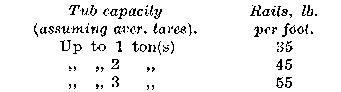
The habit of using rails in too short lengths persists. Thirty-foot rails are suitable for use in permanent roads if they can be handled at shaft mouthings and roadway bends. If not, half-length rails are necessary. Standardisation of this kind is highly desirable ; it is also required for rail sections. The use of tie bars is limited in this country although general in America.
The gauge is probably dictated, but this presents no real difficulty. Small gauges have been made to accommodate large tubs, although sacrifice was made of ease of handling.
Sleepers should be of sound larch. A prejudice against steel for this purpose must be confessed. In dip workings the danger of slipping is sufficient objection, but in the worse designs, where the steel sleeper cannot be fixed at rail joints as it fouls the fishplates, it becomes a positive menace. It may be significant that the main line railways have made little progress in conversion to steel sleepers.
The track should be ballasted to the top of sleeper level with suitable material, imported if necessary. Fine dirt or ashes should be used to top up the travelling way of permanent roadways.
The installation of good track is one thing and the maintenance in moving ground, particularly with floor lifts, is another. Needless to say the latter is equally essential and frequently a far bigger problem.
Running Operation.
The personnel required on the haulage should be studied before and after it is working. The number of persons employed will indicate whether the layout is good or bad. At the bankhead two or three men are sufficient for large outputs if automatic control is provided. The starter controller is situated near the working position of one hand whilst all have push-stop switches within reach.
Excessive stopping and starting must be avoided. With a point to point haulage, where all coal is put on at the bottom position, running should be continuous. Where there are several points of attachment complications may occur and stops become unavoidable, but they must be limited or overheating of the controller and wear of contacts will ensue. If the haulage is above its duty spacing should be increased to suit. Reversing should be discouraged. Too often laziness is the cause and other means can be found to overcome difficulties. There is a danger of loss of control. In any case reversing is limited to the length of the chain.
Backstays can be used on every set except where the rope stretch at the bottom of the roadway is so great that, when stopping, a considerable run-back occurs. It is frequently contended that backstays are unnecessary on endless rope haulage, but a prejudice in favour of them is understandable provided they are designed to be effective in operation. A recent S.M.R.B. Paper indicates how frequently they are not so.
Protection above the bottom landing, above junctions and below the bankhead, must be provided. Overspread axle catches, if correctly designed for the tub in use, will serve on full and empty sides.
The spacing between sets must be followed rigidly. A bell or other device can be operated by the previous set to indicate when the next should be attached. With a point to point haulage perfect spacing can be maintained, but where there are intermediate feeders the judgment of the haulage hands is called upon and full sets may be a little irregular, but empties are set to gauge as before. Accumulation of spare chains or clips should not be allowed, as they induce irregular loading.
The Rope.
(a) Maintenance. — Rollers must, of course, be provided if the rope touches the floor at any points. The rope should be kept in a properly lubricated condition. Ordinary rope oil is too thick to penetrate and only tends to collect dirt. Light engine oil has a chance to effect some penetration and certainly prolongs the life of the "C" wheel segments, assists surging, and increases rope life. The best method of application is by means of a drip can situated before the surge wheel.
(b) Splicings. — In cases where ropes have actually broken the failure has been invariably at a splicing. The number of splicings should be reduced to a minimum. Recently a piece of 1¼" rope, 3,200 yards long and weighing 12½ tons, was successfully carried underground and installed in one piece with a single splicing, in spite of various obstacles including an airlock. Much greater lengths can be dealt with similarly. Where the rope is to be taken underground coiled on drums the maximum length which can be handled should be ordered.
In many pits splicing practice is bad and far too short lengths are taken. Thirty yards is the minimum length desirable for 1" and 1 1/8" ropes, and a few extra feet may be allowed for larger diameters.
The ends of strands replacing the central hemp core must be lapped throughout with some material, such as cotton rope, to avoid a reduction in diameter. There is a good deal of craftsmanship in the job, and technique is passed on rather than imparted through text-books. The practice of splicing in pieces of new rope in place of worn lengths is dangerous. The splicing itself may not be effective. Furthermore, the life of the rope as a whole will drag on, like a railway wagon, with the worst parts renewed. A weak link may then exist which is difficult to detect. On all major haulages the entire length should be changed at the same time.
Where the haulage extends in length extra pieces of rope will have to be spliced in, but these short lengths should be eliminated by longer lengths as and when practicable. As soon as the haulage reaches its final or semi-permanent position, one or two pieces of rope should replace the whole.
(c) Records. — A full and detailed book record of all ropes should be kept. The lengths referred to can easily be identified by a good ropeman.
(d) Length of Service. — The life will depend directly upon the layout and upon the effectiveness of lubrication. Under ideal conditions a good flattened strand rope should last for five to ten years, average running one shift per day. Ill-designed layout (inadequate pulley diameters and heavy frictional wear) accounts for short lives.
Method of Attachment. — The lashing chain is a clumsy arrangement to enjoy such universal employment. A chain is not really suited to the forming of a knot. The use of manganese steel chains is held up during the war, but mild steel may prove preferable to iron. The use of clips of various types is general with under-rope haulage, but limited with over-rope. On larger installations the increase in rope tension and consequent reduction in diameter towards the top of the haulage may necessitate the tightening of clips whilst in motion.
The perfect means of attachment remains to be designed. Perhaps the use of short ropes capped at each end may hold the secret, although this suggestion begs the question of attachment to the rope. These remarks are, however, intended to be provocative in the hope that someone will investigate the problem on more original lines than have yet been attempted.
 |
 |
| Names mentioned in this article | |
 |
 |
| Name | Age | Occupation | Notes |
|---|---|---|---|
| Browne, E. H. | Whos Who Page |
 |
 |
| Related Articles | |
|
|
| Pub. Date | Article (Newspaper) |
|---|---|
| 04 May 1940 | Endless Rope Haulage, Working to the Dip (The Science and Art of Mining) |
| 18 May 1940 | Endless Rope Haulage, Working to the Dip (The Science and Art of Mining) |



 Contains public sector information licensed under the

