


| Newspaper Articles |

|
Newspaper Articles |
 |
 |
6th April 1940
Some Dust Problems Of Coal Mines
By John Smellie, Ph.D., A.R.T.C.
From paper presented at the March meeting of the Past and Present Mining Students' Association — Wigan Mining and Technical College.
The dust problem of coal mines may be divided into two main parts: (1) The problem of air-borne dust and its physiological effect on workers; and (2) The problem of deposited coal dust, its dangers and treatments to render it innocuous. A great deal of time and money in research and experiment has been devoted to these problems recently, and much really good work has been done. Many very important questions, however, still remain doubtful or unsolved altogether.
Physiological Hazard.
From the physiological standpoint the great amount of dust of all kinds produced in mining operations must be kept to the lowest possible limit. When the dust concentration of the atmosphere is dangerous and cannot be improved hy alteration of the machine or method, and where trapping of the dust is impracticable, then protection must be afforded to the worker.
The dread disease due to dust inhalation is, of course, silicosis. It is defined as a pathological condition of the lungs, due to the breathing of small particles of silicon dioxide, and has long been known in the gold mining industry of South Africa. The high incidence of the disease among men in this country, who cannot claim to have been exposed to dusts containing a high percentage of free silica, is still a matter of great controversy among mining and medical men.
From a review of recent literature on silicosis in this country, several important points emerge, and these are :—
(1) Silicosis is a difficult disease to diagnose. Other diseases such as phthisis, tuberculosis and bronchitis complicate matters. X-ray photographs are necessary.
(2) A "work-history," or a history of exposure to dangerous silica dust, is necessary for a complete and proper diagnosis.
(3) Most of our cases come from the South Wales coalfield, and particularly the anthracite region.
(4) No stone-dusting is done in those collieries with a high incidence of silicosis.
(5) Geological evidence shows that the silica content of the rocks associated with the anthracite seams is insufficient to account for the high rates compared with other collieries. It would appear therefore that in the majority of the silicosis cases in this country there is a cause not yet fully understood.
Remedial Measures.
The greatest danger of silicosis in coal mines is to those workers employed in hard headings, tunnels, sinkings and rippings in hard rock with a high free silica content. Methods of reduction of the fine dust produced in the occupations mentioned are :—
(1) The use of rotary drills, where practicable. In very hard stone, of course, these drills are unsuitable. Drillings are coarser than those made by percussive drills, and there is a better opportunity of catching the borings at the mouth of the hole and preventing their dissemination later.
(2) The dust traps are designed for use with compressed air percussive drills, and a typical example is the pyrene trap. A practical trial in a rise heading in rock gave the following results :—
Weight of dust collected from 10½ feet of hole = 16 lb. 10 ozs., which is about 60 per cent. of the theoretical weight. The remainder must escape at the start of the hole and during drilling via the suction hood.
About 50 per cent. of the weight collected is less than 240 mesh, and would constitute a dangerous atmosphere, especially when it is known that the free silica content is 66 per cent.
Wet drilling is another method of reducing the dust produced by drilling, but for several reasons it is not very effective.
Foam has been tried as an alternative to water, but modern opinion is inclined to favour the dry dust trap.
(3) Many lectures have been given on the use of the mist projector, a device intended to be used to settle the dust and fumes quickly in dead ends. There is no doubt that it is effective, and the worse the ventilation the more effective it will be. The use of this device in any of its forms, either with or without the addition of soluble oil, is to be recommended as a means of quickly settling large quantities of dust suspended in the air after shot-firing.
(4) Ventilation is often cited as being a cure for the problem of air-borne dust. It is true that in a brisk ventilation heavy concentrations of dust are swept away rapidly, and at the face in dead ends a good ventilation is necessary. Dust in circumstances like these should be treated like a gas. Too much ventilation, however, aggravates the dust problem in other ways.
For tunnel work there is the alternative of exhaust or forcing ventilation. Forcing ventilation is best for the face as face workers are in a clear atmosphere, and the fumes and dust from shots are more quickly cleared away. Outbye workers are generally more able to wear respirators than face workers.
(5) Apart from the remedies enumerated for reducing the amount of dust, there is still left the respirator for those who cannot avoid a dusty atmosphere. The new Mark IV respirator is the most efficient design, and should be used where any risk of dangerous dust exists in addition to the remedies already mentioned, and not as an alternative.
Respirators are a boon to many of the underground workers such as coal-cutters, loaders, etc., but two rather practical points arise here.
Firstly, there is a natural antipathy on the part of workmen to wearing the respirator. In many cases it is slung around the neck and not worn over the mouth. This happens because the average workman is not aware of the type of disease he is being protected from. Symptoms are not immediate — like excessive heat or humidity; the time-lag may be about five years or more.
Secondly, there is the question of servicing the respirators. For efficient operation and hygiene the respirators should be brought out of the pit daily. The lamp cabin is a convenient place for handling. There the respirator can be washed, brushed and disinfected and the valves put in order each day, and re-issued with the man's lamp,
At some collieries this system. is in operation, and the men have got into the habit of bringing them out daily. A fuller realisation on their part of the danger of silicosis and its kindred diseases would result in a greater use being made of the Mark IV respirator.
Instruments for measuring dust concentration have developed much in recent years, and their necessity will be appreciated when one considers that the dangerous dust which penetrates the inner recesses of the lungs is invisible to the naked eye. Few, if any, colliery companies have an equipment of modern dust sampling instruments or laboratory facilities for dealing with the samples. For the proper measurement of improvement or alteration in dust concentration after installation of a dust trap or other dust reducing device, a Konimeter or similar instrument is required for routine work. Such an instrument might profitably be included among the ventilation instruments of a coal company.
Dust Suppression at Source.
The problem of coal dust as an explosive agent has long been with us — roughly 40 years — and to-day it is as bad as it has ever been, We have certain remedies, it is true, but recent events and recent findings of research have cast some doubts on the effectiveness of these remedies.
It is evident that the reduction of coal dust at its source is the surest and most economical way of reducing the menace. Considering the amount of work that is done in roadway enlargement and in the improvement in ventilation systems to deal with gas, the amount of thought and experiment expended on dust suppression is negligible. By "dust suppression" is meant the reduction of dust formation at its source, and this must not he confused with dust control, or the controlling of dusty atmospheres outbye from the coal face.
It will be agreed that the hulk of the fine dust is produced at the coal face by the operations or coal-cutting, shot-firing, and filling out of coal, and it is in this sphere that I feel there is much room for improvement.
Although much fine dust is produced while cutting, the greatest amount is possibly liberated while the coal is being filled out on to conveyers.
Coal-cutting.
In several papers on the subject of dust I have read that sharp picks will reduce the amount of fine dust produced. In order to find out to what extent this was so, I had several tests made, and the results are shown in the accompanying tables (Tables 1 and 2).
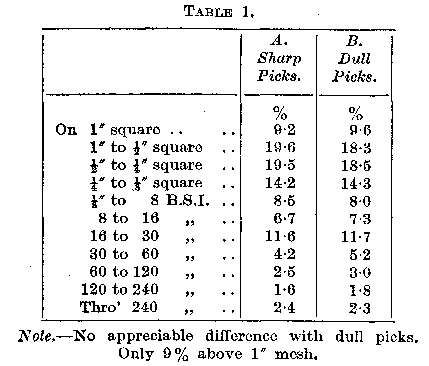
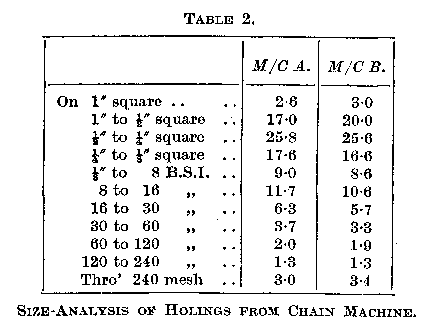
Chain speed, haulage speed, and pick sharpness and spacing, do not appear to have such a great effect. The aim, of course, is to have as few picks as possible, the minimum chain speed and the maximum haulage speed.
Tests taken with and without gummers nearly always show a reduction in the amount of -¼" coal, and it is safe to assume a reduction of fine dust also. The atmosphere behind the cutter is generally clearer too. Now that the "gummer" has proved its worth, the time has come for further and mere earnest efforts to wet the kirvings as they are made with water or other wetting agent. The spiral gummer provides an excellent place for such a start to be made. The Americans, it may be noted, have persevered with water on the jibs for many years.
Where coal is reduced to fines as in coal-cutting, dust will always be produced in quantity, and the laying of this dust and its attachment to the larger pieces is a matter which will strike at the root of the whole problem of coal dust suppression and collection.
Shot-firing is another operation which reduces coal and produces fine dust. Much dust in the vicinity is always raised by the concussion.
Other less violent means of bringing down coal and stone such as hydrox, cardox, or coal-bursters produce less dust, but their use is generally governed by more important considerations than dust production.
Dust Control in Atmosphere.
This is a large problem in itself and has been given much consideration recently.
Return Airways. — Filtering the return air has been suggested, but this is hardly a practical solution.
The system of spray-barrages is the best method available at the moment when used in an airway of large area.
At Loading Points. — Prevention of access of air-currents to the stream of coal at a transfer point is remarkably efficient, and is the simplest method of dust control. At loading points this principle can be applied in conjunction with any of the many dust traps now on the market, whether of the wet or dry type. Very dusty atmospheres exist around a loading point when large tonnages are dealt with, and much still remains to be done in the design of efficient hoods which will allow tubs to be filled properly and safely and yet allow the dispersed dust to be sucked into the deposition chamber or apparatus.
My own personal view is that, while water mists are effective up to a point, a dry filler trap will be the ultimate perfect solution when fitted with a strong fan and large cyclone or labyrinth.
Much of the responsibility in the matter of dust at gate belt ends and gate end loaders should be placed on the owners. Electrical manufacturers can make motors dust-proof, drip-proof, flame-proof, etc., and why not gate end leaders? Much of the work done to date in the application of hoods and filters to these machines has been done by colliery managers.
Intake Airways. — In constricted intakes there is a continual deposition of dust blown from tubs. Even where the tubs are steel and dust-proof the amount of coal dust blown off the tubs is considerable. I have experimented with tub covers of steel, but these were found to be impracticable on account of the irregularity of the tubs and the peculiar conditions of some of the ever-rope haulages.
The best solutions, to my mind, are the provision of large intakes or parallel intakes to reduce air velocity, the elimination of constrictions as far as possible, and the wetting of the tub tops before they start on the main haulage.
The recommendations of the Royal Commission refer to this point, and a reversion to the old system is advocated.
Whether or not a stable foam could be used to cover the coal tubs is a question mainly of cost.
Function of Incombustible Dust.
Despite our efforts to reduce the formation of coal dust and our efforts to prevent its dispersion, a certain amount will still be deposited in the roadways, and we are obliged by Statute to treat it in some way to render it innocuous. The use of incombustible dust is a case of an evil used to fight an evil, but it is the method generally adopted. Other methods such as consolidation of the dust to prevent its dispersion by chemicals, mud or cement, are only capable of limited application.
Although some roadway dust mixtures may comply with the regulations in regard to percentage of incombustible matter, this is not always a criterion of safety. It is the percentage or proportions of the various dusts which rise and form a cloud in an explosion which is the all-important feature. The condition and intimacy of mixture of the dusts are of great importance.
The formation of a cloud in intimate mixture with the coal dust is the action expected from an incombustible dust and, therefore, apart from its heat-absorbing capacity it must be capable of rising and dispersing easily and intimately with coal dust under the same disturbing forces. That stone dust did fail to rise was the important fact that emerged from the enquiry held into the causes and circumstances attending the explosion at Haigh Pit, Whitehaven, 29th January, 1931. The finding was that "The explosion was spread throughout the district because of the dampness causing the limestone dust to hind and not rise and intermingle with the fine coal dust which lay upon it."
Factors Affecting Incombustible Dust Efficiency.
Any stone dust can become inefficient for the purpose originally intended if it is not given proper treatment, or is not of the proper type. The "efficiency" of the dust comprises such properties as specific gravity, fineness, dispersability, moisture content and chemical composition; all these factors have a hearing on the "efficiency" of the dust. A dust may become inefficient because of its hailing up or caking, or because it has absorbed a high percentage of moisture. All dusts absorb moisture, and the amount absorbed varies from dust to dust, depending on their composition. The amount varies with the temperature and humidity of the atmosphere, but tests show that the amount absorbed from a mine atmosphere is not of any consequence and does not unduly affect the dispersing power of the dust.
Caking. — It is in the case of a dust being thrown on wet strata and then drying out that the greatest danger lies. Samples would show this dust to be dry, yet it would not be dispersable.
Balling. — A phenomenon (physical) apparent in all finely ground powders is the tendency for the dust to form spherical aggregates. It is due to the size-grading of the dust, and can be eliminated as a rule by the introduction of a proportion of larger particles. Its practical effect on dispersion is small.
The new Regulations now prescribe a slightly coarser dust than formerly.
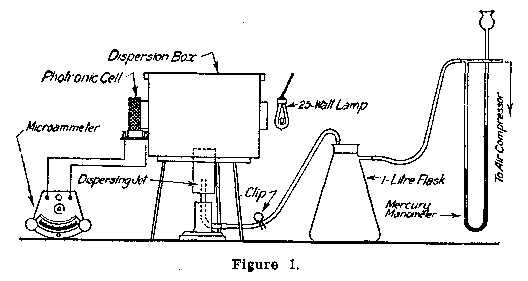
Dispersion Test. — This test shows clearly the effect of fineness and moisture in the "cloud density" produced under standard test conditions. It shows clearly that, for dust mixtures which cannot be sieved owing to their wetness, an analysis is practically valueless.
Bearing in mind also that water has a selective action on stone dust, and hardly affects coal dust, the combined use of stone dust and water should not be practised. The stone dust must be dry to be of any use. The dispersion apparatus is shown in FIGURE 1.
Movement of Dust Layers. — Dispersion values only tell half the story in the matter of cloud formation, as in actual practice the dusts have to be swept up from a layer and not blown out of a tube. Tests have shown that (1) Coarse dust is more easily moved than fine dust; (2) Coal dust is swept off the top of stone dust; (3) When stone dust is on top the coal dust is prevented from being raised; (4) In a very thick layer of stone dust only the top layers are swept off; (5) A rough dust surface is best for dust removal.
The recent Coal Dust Regulations have embodied some of the findings of research into the efficiency of stone dusts and particularly in the matter of size of the incombustible dust, the dispersion test and the depth of sampling.
It might be argued that stone dust, being twice as heavy as coal dust, cannot dilute coal dust or intermingle with it under the forces of an explosion. For in a 50/50 shale coal mixture the surfaces of the particles (assuming equal fineness) are about in the ratio of 2 : 1, or 2,000 square feet per lb. as against 1,000 square feet roughly. However, up till now, no more suitable substance has been found. Allowing for the many factors which tend to affect the incombustible dust, the policy should be to have at all times an excess of incombustible matter with the stone dust on top.
It is in the region of the coal face where coal dust is being continually deposited that the danger lies. Also, it is in this area that there is the greatest risk of the inception of an explosion, and where the explosion would possibly be in a weak or unstable condition and would tend to disturb the surface layers only. A lighter dust in this vulnerable area would be an advantage if one could be found.
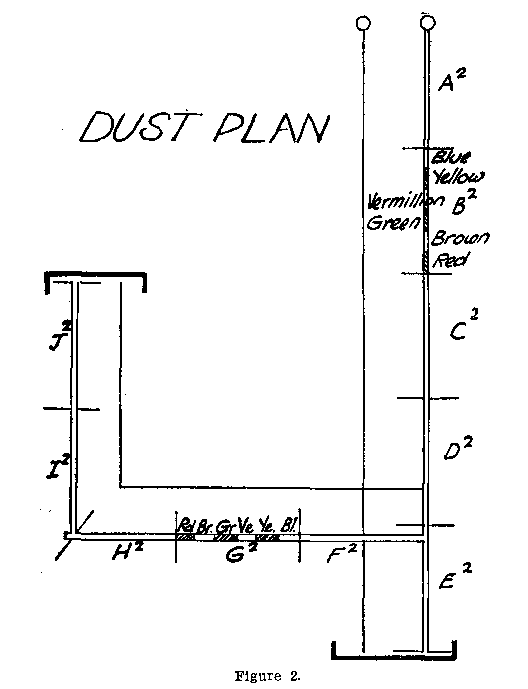
Systematic Treatment. — To follow a regular routine in sampling and treatment is essential, and proper plans are a necessity so that a true check can be kept.
FIGURE 2 shows a typical stone dust zone plan (350 yards) to comply with the 10 samples per mile requirement. The zones are divided into six equal parts and coloured according to the system indicated on the plan.
In summing up, we are relying more and more on the stone dust remedy, although we have recently experienced several failures. A higher standard of stone-dusting is being attained with the use of greater quantities of dust. The mine atmosphere will become more dusty and conditions will not improve unless we get down to the prevention of dust formation at the coal face.
 |
 |
| Names mentioned in this article | |
 |
 |
| Name | Age | Occupation | Notes |
|---|---|---|---|
| Smellie, John |




 Contains public sector information licensed under the

