


| Newspaper Articles |

|
Newspaper Articles |
 |
 |
24th February 1940, Page: 260, Column: 1
Mine Supports During War Time
By A. M. Bryan, M. A. Hogan, and J A. S. Ritson.
From paper presented at annual general meeting of the Institute of Mining Engineers.
In order to obtain the maximum output, and to minimise transport and distribution problems, it is desirable to limit the range of sizes in which supports are produced. By agreeing on a reasonable number of standard sizes, more regular production is ensured. For example, in the case of timber props, lengths below 4 feet may be standardised in 3-inch steps, and over 4 feet, in 6-inch steps. Similar standardisation might well be effected for steel supports.
Saving Timber.
So far as making the best use of the timber is concerned, this can only be done by taking proper steps to prevent losses and wastage due to carelessness and inefficient or bad mining practice, bearing in mind that the efficiency of a method of working must now be judged in the light of existing conditions as to shortage of certain materials and increased prices, and not on normal pro-war standards. Several pits have achieved excellent results by employing for the time being salvage squads whose job it is to explore all accessible roadways and workings, old and new, with a view to recovering supports carelessly left behind and restoring them to such a condition that they can be returned to stock.
The losses and wastage of timber due to inefficient mining practice raise bigger and more controversial questions. We propose to confine our remarks to a brief summary of the main points, with a few observations thereon.
Premature damage and losses of timber supports may arise from overloading or bad usage due to :—
(a) The method of working employed. (b) Defective roof control. (c) Use of supports that are not strong enough for the loads to be carried. (d) Failure to set sufficient supports, e.g., timbering distances too great. (e) Wrong methods of setting, e.g., setting props without a lid. (f) Failure to effect timely withdrawal. (g) Use of wrong tools in withdrawal, e.g., using an axe to hack props. (h) Faulty system or lack of system of withdrawal. (i) Friction of moving parts, e.g., setting props too near conveyors on conveyor faces, or ropes or tubs on roadways. (j) The rotting action of pit atmospheres or fungal growths.
Of these, by far the most important are (a), (b), and (f), especially (b).
As regards (a), there can be little doubt that some methods of working necessitate much higher consumptions of timber than others. Those which entail a high consumption, whilst they may have been beyond question in pro-war days, must now be reviewed in the light of the changed circumstances. For example, it may now be advisable to change from a bord-and-pillar system to longwall, to take out pillars by longwall methods, to work a retreating longwall rather than an advancing system, or to employ machines to effect concentration and obtain larger outputs from smaller areas.
As to (b), in ordinary longwall the main factor in roof control is the packing system. To be most effective, well-built packs of adequate width, suitably disposed, should be erected as soon as possible and advanced as close to the face as is practicable with the minimum of delay after the coal is stripped. In this way the load on the other supports is reduced so that props are less liable to be damaged and more easily withdrawn. If good quality packing is not available on the spot the quality can be improved by transporting good stone from out-bye, or by using debris-filled bags or wire-netting. The cycle of operations should be such as will ensure timely erection of packs. it is important also to ensure that the length of span of the working-space between the coal face and the packs or waste edge is maintained within reasonable limits.
Items (f), (g), and (h) may be considered together. No prop should be allowed to remain in position in faces or on roadways any longer than is necessary. In actual withdrawal operations there can be no doubt that many god props are destroyed or lost. Too frequently the axe is used to cut out a weighted prop or to weaken it sufficiently to enable it t be displaced by a hammer, when a withdrawal device, such as the sylvester, with or without a twisting device attached, would enable the prop to be withdrawn in a condition fit to be used again. Again, so far as the whole withdrawal operation for the supports on a face is concerned, there is generally a proper sequence for a given set of conditions which, when determined, should be followed to ensure withdrawal with least danger and losses. Once this sequence has been determined for a given face, supervision should be strict enough to ensure that it is rigidly carried out.
Consideration should also be given to the possible uses of withdrawal devices even with timber props, especially in thick seams with high convergence, to enable the props to be safely withdrawn without damage under load.
Timber props must be regarded as rigid supports, and unless sufficient yield is provided by a compressible lid or a soft floor it may be necessary to provide additional yield in other ways. This can be done by suitable tapering, a method which experience has proved to result in a marked saving in timber. Burred ends can be sawn off and the prop used again in a thinner seam.
All damaged timber no longer of service for props in a particular seam should, if fresh, be recovered and reconditioned for use as props for thin seams in the same colliery or in other collieries for lids or headtrees, lagging or sprags, or for use in the building of chocks.
In roadways all reasonable precautions should be taken to effect every possible economy. These precautions include the tapering of props and crowns or balks, resort to the old device of reinforcing bars by wire ropes, and the protection of the timber by special preservation treatment in places where timber is liable to rot.
Quantity of Timber for Props.
In discussing the use and replacement of timber supports it is desirable to consider the relative supporting value of different classes of timber, and the effect of seasoning on the properties of timber. The Baltic props used in normal times have an average crushing strength of 3,600 lb. per square inch and weigh about 30 lb. per cubic foot when thoroughly seasoned. In an unseasoned condition the average crushing strength of Baltic timber is about 2,400 lb. per square inch, and the weight up to 50 lb. per cubic foot or more. Thus the strength of a seasoned prop is half as much again as that of an unseasoned one, and the weight is little more than half.
For practical purposes it can be taken that home timber grown under proper conditions is equal in strength to Baltic provided it is peeled and seasoned before use. The presence of the bark is objectionable in the forest because it prevents or delays the seasoning of the timber and acts as a starting-point for fungal decay. And, as the bark adds nothing to the strength it is clearly wasteful to transport unbarked props to the mine. One ton of fully-seasoned props is equivalent in supporting value to 2.88 tons of unseasoned props with the bark left on.
The presence of knots has a weakening effect on prop timber, and where there are large knots or where the cross-section of the timber is irregular the crushing strength may be only two-thirds of the values mentioned above.
Substitutes for Timber.
With most substitutes, especially at the working face where they are most needed, it would be impracticable and dangerous to attempt a sharp change-over from timber; there must necessarily be a period of transition which in some cases may last for several months. Possible substitutes are steel, reinforced concrete, brick, masonry, pit debris, and suitable combinations of these as intermediate packs, chocks, or cogs.
At present steel is undoubtedly the most satisfactory and handy substitute for timber for the support of roads and faces, but it will show by far the greatest saving when used to replace timber at the working-face where the consumption is much greater than in roadways and other parts of the mine. The average life of a timber prop in pre-war days was probably 3 or 4 days. The steel prop should certainly last as many months, and it is estimated that assuming 3 days as the life of a wood prop and a loss of 2 per cent. per week on steel, an annual consumption of 500,000 tons of timber in the form of 4-foot props could be replaced by 16,000 tons of steel for the initial change-over, and the addition of the same amount of steel annually thereafter to make up for wastage.
There is a definite though limited field for the use of reinforced concrete, brickwork, or masonry on main roadways where the ground is settled. Unfortunately in many cases the process of substitution is not generally a direct one except where roadways are actually under repair after the main subsidence has occurred. The new roadway supports are required at or near the road-head in longwall as the working face advances, and in this unsettled and green ground timber, or preferably steel, is necessary because other substitutes, generally, would be unsafe. Substitution by brickwork, reinforced concrete, etc., can therefore for the greater part only be effected by withdrawing timber or steel supports from settled ground for use in green ground. This operation would involve additional expense and labour and possibly also interfere with production at a time when labour is scarce and output is vital.
Economy in the consumption of timber at the working face may also be effected by a considerable extension in the use of chocks or pillars of various kinds. Hard wood for chock pieces is not so scarce as timber for pit props. Where hardwood chocks are used they should be erected in such manner as will ensure early and effective resistance and should also incorporate a release device to ensure easy withdrawal and recovery of the wood. Setting chocks on loose dirt may facilitate withdrawal but it reduces the efficiency by preventing the chock from offering early resistance. Disposing one member of the chock "to form a trip" does not always prove successful, and, generally, a mechanical trip device gives the best results. In a few pits, however, a special type of brick is inserted between members at the four corners of the chock, and release is obtained by chipping out the bricks. Chocks consisting of reconditioned parts of scrap arch-girders are being successfully used in one or two longwall faces in Scotland to the entire exclusion of props. The time is opportune for the reconsideration of the design and use of a more permanent type of chock of steel or reinforced concrete and bard wood in suitable combination, incorporating a release device and mounted on skids to enable it to be pulled forward as the face advances.
Apart from its more efficient use in the normal packing systems, there is undoubtedly a limited field for a more extended use of pit debris for building stone pillars and dirt chocks to replace props and bars at the working face. Small stone packs could easily be built along the face where there is a supply of good building stone readily available. Where only small material is at hand it could be used successfully as a filling for chocks with a skeleton of old timber. If old timber is scarce debris-filled bags could be used for the walls or even for building the complete chock.
The Economical Use of Steel.
Steel materials not in actual use should not be allowed to lie and deteriorate or get lost in different parts of the mine, but should be collected, cleaned, reconditioned if necessary, and put into stock, or, if unfit for further use, returned to the steelworks as scrap. Since the tonnage of steel used on the roadways is far greater than that required on the working-face, economies in the use of steel on roadways ought eventually to release a sufficient tonnage of steel to make a substantial contribution towards the provision of additional steel for use at the working face. Attention to the following matters would go a long way towards providing that contribution :—
1. Immediate withdrawal of steel arches from disused roadways.
2. Efficient lagging or strutting of arches to increase resistance, minimise distortion, and possibly increase also the spacing of arches,
3. Use of efficient yielding devices to prevent or minimise distortion of arches in the moving zone.
4. Improvement of packing system to reduce convergence, including consideration of the "double-packing" system.
5. Close study of conditions with a view to reducing the tonnage of coal required by setting arches on top of road-side packs, or by the use of cambered or straight girders.
6. Provision of reconditioning plant at each colliery and immediate reconditioning of distorted arches for re-use as arches or for cutting into props, chock pieces, sprags, sleepers, etc., the material for which no further use can be found at the pits to be returned immediately as scrap.
7. Use of, or replacement of steel by, other forms of support, such as brickwork, masonry or reinforced concrete in roadways in more or less settled ground.
Reinforced Concrete.
Reinforced concrete pit props were used in the various coalfields in 1914-18 with a moderate degree of success. These props were mainly used on roadways, but some were used at the coal-face.
Concrete is a relatively brittle material, and high-strength concrete is liable to fail suddenly and explosively under load unless suitably reinforced. The reinforcing steel supplies the tensile strength which the concrete lacks, with the result that reinforced concrete is capable of a certain amount of deformation and crumbles rather than collapses violently. At the same time, it must be recognised that reinforced concrete is not capable of withstanding repeated severe shocks, and this circumstance mitigates against the use of reinforced concrete props at the coal face unless special precautions can be taken for setting and withdrawal.
The relative weights and strengths of props of different materials for a seam 4 feet thick are as follows :—
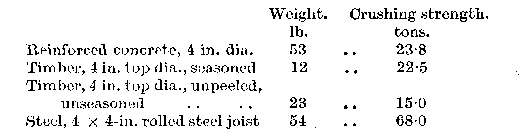
Thus a reinforced concrete prop is no heavier than the equivalent steel prop, and is equal in strength to a seasoned timber prop.
 |
 |
| Names mentioned in this article | |
 |
 |
| Name | Age | Occupation | Notes |
|---|---|---|---|
| Bryan, Andrew Meikle | Whos Who Page | ||
| Hogan, A. M. | Whos Who Page | ||
| Ritson, John Anthony Sydney | Whos Who Page |




 Contains public sector information licensed under the

