


| Newspaper Articles |

|
Newspaper Articles |
 |
 |
27th January 1940, Page: 234, Column: 1
Fires In Mines
By Chas. W. Brown.
From paper on "Some Causes of Mine Fires — Their Prevention and Methods of Combating," read before the North Staffordshire Colliery Undermanagers' Association. Continued from page 218.
Sealing Worked Out Areas.
Proceeding to deal with what the writer considers the best means of "sealing" or "isolation" of worked out areas, let us assume an area worked out as shown in FIGURE 1, which at the time of finishing would be to a boundary, or it may be to a fault; on the coal rib side of each road leading to the face an adequate amount of pack should have been carried during the working to ensure the complete isolation of the next working panel from any of the roads in the worked-out area adjacent. At the boundary ends of the roadways the spaces X and X, that is, main and return ends of old face, should be packed off as shown, only leaving sufficient space for the passage of ventilation necessary for the complete "stripping " of the district of all supports and other working material to points back to some 30 or 40 yards at the outbye ends of the roadways, at which points sealing should begin at A and B respectively, the packs at XX having been put in. In the "stripping" precedence should be given to the "return" side, the work proceeding without delay in all three shifts on account of the gradual accumulation of gas content in the ventilation, consistent with the dimunition of air consequent upon the withdrawal of face roadway supports, thus constituting what may be termed a race with nature and time. Should the work of stripping be retarded it may require further time and the expense of providing a means of "dead" end ventilation, such as the introduction of air-pipes and small fans for the purpose for which installations, in the case of old roads, there is limited space.
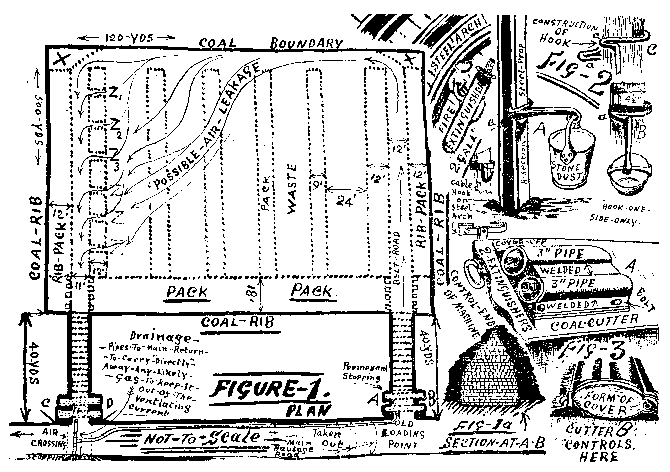
Having withdrawn all supports in both roads back to the packing points, packing is proceeded with by the importation of suitable debris, such as fireclay or beating up dirt, all wood being excluded. In most mines there is choice of dirt for such purposes, which should be taken advantage of for sealing purposes in order to obtain a "close" seal. In the first place the smallest area of space should be chosen to begin the seal pack. All wood, boards, etc., should be taken out of the sides, leaving for the time being the supports overhead, and the sides packed up in V-form to minimise the opening of the adjacent strata as much as possible; then the roof is gradually stripped and packed tightly with a mixture of fine dirt, sand, stone dust, or cleanings of the roadways, which latter make good sealing material. Any spaces — no matter how high or wide — are completely packed up, time and expense in this case being considered a secondary item.
In order to guarantee perfect packing, the packs are put on in 6-foot sections up to about half the height of the road; where middle packs are run up at each yard, thus ensuring the back ends being tightly packed, which may not be possible in 6-foot lengths, the packs may be left open. It is obvious that a large amount of building material is required with so many walls. This is supplied from various points of the colliery, and when such material is not procurable bag packing is resorted to, the bags being filled with incombustible material.
There is a point here in relation to the building of the walls. Large stones should not be used as they tend to produce "open" walls, whereas small boulders or stones make the walls closer while the small material has a tendency to embed itself better. This proceeding is carried on back to about 4 yards from the outbye ends of the roadways, or — and here is another important point — an inspection is made of the surrounding strata for breaks in roof, floor and sides, which may vary in extent and distance along roads leading off other roads in accordance with the amount of pressure.
Having decided upon the point for the purpose, a trench is made in the floor ensuring that the base is below any breaks which may have been caused by creep; the sides are also cut back well into the solid. A permanent stopping is then proceeded with by way of bags of concrete (ready mixed) on the surface and sent in loads of 10 in a wet state, about 50 per day. This method may not be practicable in all cases on account of long distance transit, in which event the concrete would "set" in the bags before reaching its destination, so that another method may be adopted, that is, erect a 9-inch wall with a 2-foot or 3-foot space or the thickness desired behind it ; then the concrete is sent in the dry state and mixed in situ and filled in behind the brick wall. In the case of bags they are placed in "endwise." that is, the wall is the thickness of the length of bags (about 2' 6") and filled in behind with sand and liquid cement. The finishing of roof and aides is the most difficult, consequently ripping is proceeded with as the stopping advances until all breaks have been passed through and filled with cement, baits of small concrete being thrown in forcibly by hand where necessary to produce a reliable finish to the stopping. In some cases, in order to make doubly sure, another similar stopping is added with a small space filled in with sand and liquid cement between.
Thus it will be seen that we have a seal of some 30 yards of strictly supervised packing which would in itself constitute a good seal, with the addition of good substantially built stoppings as a finish, so that one may with safety state "We shall have no trouble from that area."
There is another source of danger which may present itself during the working out of areas, that is when the practice of leaving "vent" holes on the return aide of faces through the packs is used to drain away gas, as shown at Z1 and Z2 and Z3 in FIGURE 1. These are about 30 yards apart and are left unsealed. The practice is in the writer's opinion a very good one, since it tends to drain away from the face at the point where the gas collected from the whole of the wastes. Undrained the collected gas may result in sudden emissions consequent upon the falling in of any one of the wastes which may be acting as a gas-holder, and if the whole ventilation and gas be forced round the top corner of the face the working of coal-cutters would be stopped, that is if the men had sufficient initiative to do so, or they may go on cutting with the danger of ignition from possible electrical or other "sparking."
By the introduction of the practice of leaving "vent" holes the danger of gas (or some of it) is in some degree eliminated, but there is the danger of these "vent" roads being left in an "unsealed" condition whereby a condition of "heating" or "spontaneous combustion" may be caused by a small amount of air being drawn through the waste to the return. It should be the general practice that, when one "vent" is left open, the one further back should be "properly" sealed; that is, although the road may have partially closed by pressure, it should be made possible to get to the "waste" end of it, and from thence all supports should systematically be withdrawn and the road be securely packed with proper sealing material such as small dirt, stone dust and sand in successive packs, as previously mentioned, in order to ensure a tight seal. In some cases these roads have "grown up" by pressure so that some persons have simply had the entrance filled up with a few shovelfuls of dirt, and the point hidden with boards behind the roadway supporting rings; at a later date the same has had to be opened out again and properly sealed.
The writer may here state that one of the largest fires in his experience, affecting an area of some 360 yards by 60 yards, had to be sealed owing to the presence of a number of "ribbon" roads, that is roads in all directions between the main intake road and the face, their necessity being for the negotiation of a number of small faults intervening during the general working. None of the roads had been packed off, hence the result as stated. Relative to the latter there is another point to consider, namely, the possibility of change in conditions subsequent upon the changing of the direction of the ventilating current of any particular area; this, in the writer's opinion, may have had some accelerating effect upon the gob-fire mentioned, inasmuch as, previous to turning the ventilating current from its previous pulling away from the face to the opposite by a short cut-through nearer the upcast from the face in question, there was no sign of heating, which afterwards developed in very speedy manner. This, then, should tend to warn us to duly consider many possibilities before turning the direction of the ventilating current of any particular area.
(To be continued.)
 |
 |
| Names mentioned in this article | |
 |
 |
| Name | Age | Occupation | Notes |
|---|---|---|---|
| Brown, Charles W. |
 |
 |
| Related Articles | |
|
|
| Pub. Date | Article (Newspaper) |
|---|---|
| 13 Jan 1940 | Fires In Mines, Some Common Causes (The Science and Art of Mining) |
| 27 Jan 1940 | Fires In Mines (The Science and Art of Mining) |
| 10 Feb 1940 | Fires In Mines (The Science and Art of Mining) |



 Contains public sector information licensed under the

