


| Newspaper Articles |

|
Newspaper Articles |
 |
 |
30th December 1939, Page: 193, Column: 1
Specific-Gravity Coal Washing
By C. W. H. Holmes, M.Met.
Extracts from paper on "Notes on Specific-gravity Coal Washing with special reference to the Tromp Process," presented on 9th December at a general meeting of the North of England Institute of Mining and Mechanical Engineers.
The conditions which must be fulfilled by any specific-gravity process for coal washing before it can expect to be either economically or technically successful are: (1) The loss of the medium used to float the coal must be so small that its cost does not exceed a fraction of a penny per ton of coal washed. (2) The viscosity of the specific-gravity bath must be low enough to permit of quick stratification of the particles and should remain so over the useful range, that is, between 1.30 and 1.90 sp. gr. (3) Vertical currents should not be employed, as they impair the sharpness of the separation and limit the range of size that can be treated in one bath. (4) Mechanical agitation should not be employed, due to risk of floating up middlings or flat shale with the washed coal. (5) The medium employed should be capable of being readily removed from the separated products, and should also be capable of being easily recovered from the swill water in a concentrated form for re-use. (6) The density of separation must be maintained within narrow limits without difficulty. (7) The medium used must be such that it can easily be purged of coal and shale shines.
The specific-gravity processes for coal washing can be divided into two main groups — those employing a high-density liquid and those in which a suspension of heavy finely-divided material in water is employed. At the present time the use of true liquids or solutions for the specific-gravity washing of coal is extremely limited, and we must turn to the second group to find processes which have found wider industrial application.
It has been recognised in metallurgy for many years that a mass of finely-divided particles either settling in water or, alternatively, suspended in water, behaves in many ways like a liquid having a specific gravity greater than unity. For example, the differences between "free" and "hindered" settling ratios are due to this phenomenon, which in this and in other instances is turned to practical advantage. On the other hand, it is this same phenomenon that limits the efficiency of classifiers and sometimes interferes with the operation of ball-mills.
The suspensions that can be used for industrial coal washing maybe considered in two main groups, (1) Stable and (2) Unstable.
Stability may be obtained in several ways, for example: (a) By the selection of a solid medium which is naturally stable over a useful range of specific gravity (e.g., Loess, Wuench) ; (b) By means of rising currents (e.g., Chance) ; (c) By mechanical agitation; (d) By the addition of some stabilising agent that will procure the desired stability without at the same time raising the viscosity to such an extent as to prohibit its use (e.g., clay in the De Vooys Process).
So far as group (2) is concerned, it will be obvious from the foregoing that no special means need be adopted to obtain an unstable suspension ; if, however, suspensions are prepared having a predetermined degree of instability and this lack of stability is made to help instead of to hinder, then it may fairly he said that one of the major problems associated with specific-gravity coal washing has been overcome.
Stable Suspensions.
(a) Loess, which is a natural product of no commercial value and which can, in localities where it is found, be had for the mere cost of getting and freight. Loess is what one would call geologically a "Silt," that is to say, it is finer than sand (which would be too coarse to stay unaided in suspension) and coarser than clay (which gives suspensions that are in general too viscous to be useful). It is unlikely that all deposits of Loess have the same physical characteristics as regards distribution of particle size.
The only other natural medium that has been, to my knowledge, employed in coal washing is clay in connection with the Wuench process. The clay slip is agitated mechanically by means of horizontal blades on a vertical shaft and the viscosity of the pulp is kept within limits by taking a tapping off to a flotation cell and removing the accumulated coal climes. This process has been worked at a strip mine in Kansas, the clay underlying the coal seam being used to make up the suspension.
(b) Rising currents are employed in the Chance and De Vooys processes ; in the former case the suspension of sand in water is definitely unstable and an upward current is employed to stabilise it, whilst in the latter the suspension is stable and the upward current is used for another purpose, namely, to prevent "crowding" — that is to say, an accumulation of middlings very close to the separating density in the suspension. The only practical consequence of this current is that the effective density of the separation is slightly above that of the suspension itself; thus, using a pulp of 1.40 density the "effective" density of the separation would be nearer 1.45. It might have a somewhat limiting effect if a wide range of sizes were treated in the bath, but the results obtained under industrial conditions indicate that normally this slow upward current has no serious effect on the separation.
(c) Mechanical agitation as a means of stabilising a suspension can only be effective, and at the same time have no limiting effect upon the accuracy of the separation, if it has practically no work to do in achieving its end. The aim of every gravity process is to approach as closely as possible to the static conditions obtaining in a float-and-sink test carried out in the laboratory, and if the agitation is at all violent these ideal conditions are not fulfilled, with the result that eddy currents will upset the distribution of the near density particles into their correct products.
(d) The retarding effect which clay has upon the settlement of fine suspended solids has long been known in metallurgy, its influence upon the separations effected in classifiers and upon the rate of settlement in thickeners being a common source of trouble. Indeed, in coal washing itself it is found that clay is the main cause of inefficient settlement in slurry cones. Additions of clay therefore provide another means for stabilising suspensions of finely divided solids in water, and it is by this means that the suspensions of barytes employed in the De Vooys process are prevented from settling out too rapidly to permit of their use in that process, which, of course, demands a high degree of stability in the suspension, as any appreciable settlement in the separating bath would cause an accumulation of middlings at intermediate levels in the bath.
Unstable Suspensions.
In regard to the use of unstable suspensions, the very fact that a suspension is unstable postulates higher densities in the lower than in the upper layers, which, in turn, means that particles of intermediate density must accumulate in the suspension unless they are continuously removed, and for the moment it must be assumed that this is the case.
The Tromp process is the only one that purposely employs an unstable suspension, and the solid media that have been used are magnetite and burnt pyrites, although tests have shown that a number of other cheap ferruginous materials are equally suitable.
There is no magic in the use of iron-bearing minerals ; other materials may be used, provided that they are sufficiently dense to give the desired density at the bottom of the bath without so high a solid content as to impair the fluidity. Quartz could be used, provided that the density of the suspension at the bottom of the bath did not exceed about 1 1.40. Materials with densities of 3.0 and 4.0 could be used in cases where the maximum densities required in the suspension did not greatly exceed 1.55 and 1.65, respectively.
The rate at which the magnetite settles depends on the average size of particle, and this forms the initial means of controlling the range of specific gravity from the top of the bath to the bottom. Some means must be provided for removing middlings from the intermediate levels in the bath so as to prevent any accumulation.
The Tromp Bath.
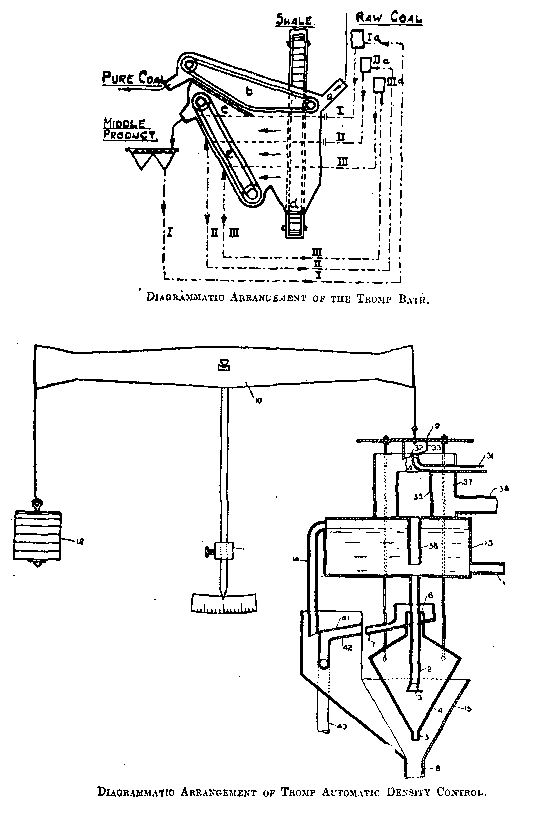
The accompanying illustration shows a diagrammatic arrangement of the Tromp bath. The raw coal is fed to the bath at a and falls beneath the surface of the suspension, the clean coal floats up to the surface and is continuously removed by the push-plate scraper b over an inclined slot screen c ; the refuse sinking right through the suspension is extracted by means of the draining elevator d. Particles of intermediate density are continuously moved across the bath by means of slow horizontal currents of suspension I., II. and III., and are finally extracted by means of scraper e, together with a certain amount of the suspension.
The circulation of the streams of the heavy medium is effected by means of compressed air lifts, and arrangements are made so that circulations I. and II., or II. and III., can be mixed in any proportions in order to obtain the requisite densities at the clean coal-middlings and middlings-refuse separating levels.
A certain amount of magnetite, together with such small quantity of coal and clay shines as are formed, adhere to the separated products, and it is therefore necessary to spray them, first, as regards the clean coal to improve its appearance, secondly, to recover the magnetite, and, thirdly, to prevent any accumulation of slimes in the system which would, of course, ultimately increase the viscosity. All the separated products are sprayed with process water, that is to say, water that has been clarified in the plant itself, and the clean coal is given a final spray with clean make-up water.
The catch tray under the middlings screen is divided so that the suspension flowing over with the middlings is returned directly to the Tromp bath, the balance of the suspension being sprayed off at the end of this screen.
The underflow from the end of the middlings screen and from the clean coal and shale screens, consisting of a very dilute suspension of magnetite, is fed to a slurry sieve where any gritty material coarser than the particles of magnetite is removed. The dilute underflow from the slurry sieve is pumped up to the clarifying tank, where the initial rate of settlement of the magnetite is high and, in consequence, clarified water can be obtained without difficulty. As the magnetite falls to the bottom of this cone its rate of settlement naturally decreases, but there is no difficulty in thickening it up to densities in excess of those required in the process.
Automatic-control Gear.
In the plant as originally installed, there was no difficulty in maintaining a constant density in the suspension at the two separating levels, but it was necessary for the plant operator to check from time to time the density of the three circulations in order to make sure that no variation had occurred. In order to overcome this possible objection, automatic-control gear has been devised and has been in successful operation for some months with a view to maintaining a constant density in the thickened pulp returned from the clarifying cone. This arrangement is shown diagrammatically. It consists essentially of a balance by means of which the flow of pulp from the cone back to the process is continually weighed. The moving parts of this balance are shown in heavy lines, whilst the various pipes and vessels which are involved are shown in light lines.
The operation of the mechanism is as follows : The thickened pulp from the clarifying cone enters by pipe 1, at such a rate that it is continuously overflowing through pipe 14. It enters the weighing vessel, 4, from which it flows continuously from the bottom outlet, 5, as well as from the top, 6. The restricted outlet, 5, is necessary in order to prevent the fine magnetite settling out in the vessel, and this portion is returned to the clarifying cone. The overflow from the weighing vessel passes between the partitions 41 and 42 when the suspension is of the correct density and is returned to the process. If, however, the suspension is too light, the balance-weight, 12, will lift the vessel, 4, which will discharge its top liquid over the partition, 41, whence it will be taken back to the bottom of the-clarifying cone for further concentration.
If, on the other hand, the suspension has too high a density, the weighing vessel, 4, will sink and pipe 33 will force some of the clarified water flowing continuously through pipe 31 into the vessel, 13, in sufficient quantity to counteract the rise in density. Under these conditions the high-density suspension cannot go back to the process because the chute, 7, will then be below partition 42 and the pulp will go back to the clarifying cone.
The medium having correct density passes down pipe 43 into the surge tank before being returned to the process. This tank is float-controlled so that, when the necessary store of medium of the correct density has been accumulated, the valve feeding the automatic density-control device is shut off and does not reopen until the level of suspension in the surge tank has fallen to a certain extent.
At the end of the washing shift the raw feed is shut off and the plant is kept in operation for a few minutes in order to give the slowly-moving middlings time to cross the bath and to be extracted by the middlings scraper. After this has been done the whole of the medium is drawn from the separating bath into a storage tank immediately below it.
At the beginning of the shift the suspension is pumped back into the system by means of a specially-designed pump, and this is, in fact, the only time that a concentrated suspension of magnetite is handled by a pump, all the handling during the operation of the plant being effected by means of compressed air lifts so as to avoid wear and tear. The only pumps in continuous operation are those handling the swill and spray water.
Some Benefits Claimed.
Regarding benefits derived from the greatly increased accuracy of separation that can be obtained with this modern washing process, when compared with jigs, for example: In the first place a higher yield of washed coal for an equivalent ash-content is obtained, because specific-gravity washing enables the heavy high ash sinks that were formerly found in the clean coal to be exchanged for a larger. quantity of lower ash material which formerly went away with the refuse, and the higher the percentage of middlings in the raw coal the greater will be the increased yield of clean coal for a similar ash-content.
Secondly, the ash-content of the washed products will be more uniform in fact, and will appear to be even more so because there will be an entire absence of pieces of high ash material, which with normal washing and small samples are the most fertile source of complaint.
Thirdly, there will be an increased yield of screened sizes due to decreased breakage during washing, and this has been the subject of careful and continual checks at Domaniale where, as the result of changing over from the old system to the new one, the increase in the recovery of 80-15 mm. nuts has amounted to 11 per cent.
Finally, the absence of degradation is reflected in the appearance of the washed coal, which is not only free from unsightly pieces of middling and flat shale but the nuts retain their corners and look much more attractive than the normal Baum-washed coal.
 |
 |
| Names mentioned in this article | |
 |
 |
| Name | Age | Occupation | Notes |
|---|---|---|---|
| Holmes, C. W. H. |




 Contains public sector information licensed under the

