


| Newspaper Articles |

|
Newspaper Articles |
 |
 |
26th August 1939, Page: 60, Column: 1
Small Scale Faulting
A paper by Mr. Arthur Bray, M.Sc., A.I.M.M., issued by the Institution of Mining and Metallurgy and published in the BULLETIN of the Institution, deals with "Small Scale Faulting." Mr. Bray, who is a lecturer on geology at the Wigan Mining and Technical College, carried out his investigations in the Pemberton Rock exposed above the Pemberton Five-Foot seam in the No. 8 district of No. 2 pit at Bickershaw Colliery in Lancashire. lie expresses the view that "Small scale faulting is probably more common than is generally realised, but it may not be noticeable unless brought out by the dislocation of coloured bands in the rock. It is of interest as showing the possible course of faulting in depth, and shows how comparatively small forces may produce results similar to those formed on a larger scale."
In the area described by Mr. Bray the rock shows evidence of contemporaneous disturbance, in that whisps of coal are embedded in the sandstone at all angles. They begin and end abruptly, and where they are abundant there is frequently a thin layer of ironstone conglomerate which is very irregular in thickness and continuity. These bands or ironstone and coal do not appear to have been affected differently from the rest of the rock during faulting.
The Pemberton Rock in the fresh condition is very light in colour. The bedding is shown by layers of black sand and red ironstone bands at vertical intervals varying from 2 mm. to several centimetres. The sudden ending of these black layers against the tiny faults makes the faulting pattern fairly easy to follow. Where the bands of black sand are absent the faults are difficult to follow unless they have a filling of crushed rock or pyrites.
The faults are seen in section, and on that account are of considerable interest; they simulate larger faults. The faults shown were measured, and are drawn to scale. In some specimens the pattern is so complicated that the full structure cannot be distinguished. Many of the faults bade at an angle of 30° from the vertical, but this is by no means the rule. The hade frequently changes, and in one specimen the upper portion of the fault is normal, whilst in depth it becomes reversed, at still greater depth continuing its former normal course. In some instances the faults are curved or sigmoidal in shape. Normal, so-called tension faults, occur in juxtaposition with reversed faults of about the same throw. The same forces, either tension or pressure (but probably pressure), must have acted in each case. Reduction of horizontal distance shown by reversed faults in one part of a specimen is compensated by increase in distance by normal faulting in another part.
In mining bedded deposits cut by faults it cannot, therefore, be assured that a fault will be met at a predicted position in a lower seam, by projection from a bade which has been determined at a higher level. A fault may also become reversed in depth.
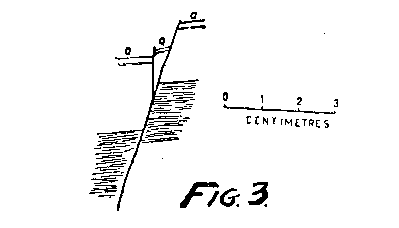
The throw of the fault varies from about 1 mm. up to three or more centimetres. In the fault shown in FIGURE 3 the throw in the lower levels is about 1 cm. Higher up, however, the fault divides into two, one of them having a throw of 2½ mm. and the other branch fault carrying the total throw to that of the single fault in depth. Faults of small and large throws are mixed indiscriminately. In one or two cases a small drag is present (FIGURE 1). In specimens such as these the faults must be of the same age, and their behaviour where they meet is of interest. Some run together for part of their course, only to diverge again at greater depth. A very common form of meeting is for one fault to end and finish abruptly against another, especially if the angle of junction approaches 45°. Occasionally one fault may cross another without there being any apparent shift of one fault by the other. It is rare to find in these specimens one fault moved by another. This is, perhaps, to be expected if they are all of the same age. Some of the smaller faults can be seen to die out both when followed upwards and in depth (FIGURE 1).
Plans of faults taken on horizontal planes at different levels in the same specimen can be seen to differ widely from each other. This is perhaps an important point to remember when conclusions as to what may happen in depth have to be deduced from surface geological plans. Some specimens show shatter belts on a small scale. A large number of faults are localised in a width of about 2 inches, within which the seams of black sand are broken up and lie at all angles within the fault zone. The bedding on either side is comparatively undisturbed.
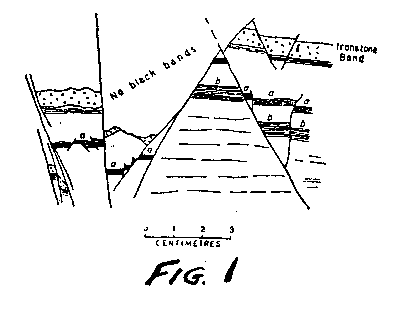
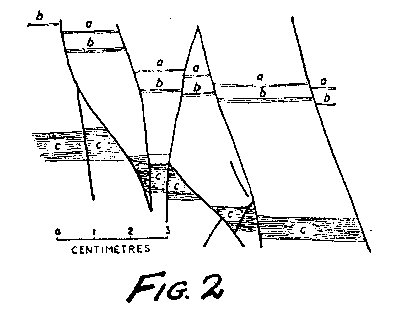
The width of the fault fissures is very small, but in some instances there is an occasional widening, due either to the splitting up of a fault into a number of very closely spaced fractures, or to a filling of crushed rock. The surfaces of the fault planes are blackened and dusty, and occasionally there is evidence of striae. Some of the faults, although small, are mineralised. The mineral is pyrites, which occurs as a row of minute crystals down a length of the fissure. A single crystal often fills the whole width of the fault. The unfaulted Pemberton Rock in the area from which the specimens were collected, and the sandstone between the faults, are free from pyrites, so that the mineral probably entered the fissures in solution, although the cracks are of extreme fineness. Only portions of the faults are mineralised, both in depth and along the strike of the fractures, thus forming miniature ore-shoots.
 |
 |
| Names mentioned in this article | |
 |
 |
| Name | Age | Occupation | Notes |
|---|---|---|---|
| Bray, Arthur |




 Contains public sector information licensed under the

