


| Newspaper Articles |

|
Newspaper Articles |
 |
 |
12th August 1939, Page: 42, Column: 1
Mine Ventilation
By R. Clive, Prof. D. Hay, M.C., B.Sc., and Prof. I. C. F. Statham, M.Eng.
Excerpts from "Mine Ventilation: a Review of Present Theory and Practice (Tenth Report of the Midland Institute Committee) on Mine Ventilation," presented at the general meeting of the Institution of Mining Engineers. Continued from page 27.
Practical Considerations of Air-distribution.
Splitting the Air. — The impossibility of providing adequate ventilation by coursing the air in a single current throughout the whole mine was recognised in the North of England about the fourth decade of the nineteenth century. It was found that this method gave rise to high resistance and sluggish flow and that the total resistance was decreased with consequent increase in quantity by providing parallel paths for the air-currents. The advantages of splitting the air in this manner were stressed by Atkinson and gradually the method of providing a number of separate splits was adopted, but its importance and advantages are not always fully realised even to-day. Thus by the connection of n equal airways in parallel the quantity would be increased n times for the expenditure of n times the power, whereas if the airways were in series this increase in quantity would require n3 times the power. Apart from economy of power, splitting yields several concomitant advantages, e.g., it allows of the adjustment of the quantity circulating in the various districts in accordance with their individual requirements and allows of air-velocities being kept within reasonable limits.
The ideal arrangement for mine-ventilation systems would be as follows :—
(1) The mine should be divided into districts of approximately equal resistance, or of resistances appropriate to their requirements, each ventilated by its own split or current.
(2) The beginning and end of each split should be as near the shafts as possible.
(3) The number of splits should not be too small or too large. If the number is too small, the total resistance of the mine will be high and the length of face per split may be too large, whereas if the number is too large, although the total quantity in the mine is increased, the velocity of the air on the faces may be inadequate.
It is seldom possible to adopt this ideal scheme, especially in so far as providing splits of equal or appropriate resistance. The distribution of the air to meet conditions usually found necessitates either (a) the regulation of one or more splits or (b) the installation of auxiliary fans to boost up the pressure in certain splits.
The advent of mechanised mining has necessitated more careful attention to splitting the air. Whereas with hand-getting and filling into tubs it was usual practice to ventilate more than one face with the same split, with machine-cutting and conveying producing large outputs and increased quantities of gas from rapidly-moving faces, the ventilation of more than one face with the same split is not to be recommended in seams making a large quantity of gas. Bearing this in mind it is therefore very necessary to plan the position and size of intakes, returns, and air-crossings in conjunction with the development lay-out of the district.
Regulators are almost invariably employed where the surface fan is of adequate capacity to allow of their insertion and where the pressures required in the various districts are not widely different. The selection of the position of a regulator is especially important in mines liable to spontaneous combustion, on account of local pressure differences set up by its erection. The choice between regulators and auxiliary fans is, however, influenced by local conditions and economic considerations which involve balancing the cost of power lost at the regulator against the capital and overhead charges and power costs of the fan.
Auxiliary Fans or Boosters installed below ground and working in series with the main fan may be employed in cases where the resistance of a district is very great in comparison with that of other districts, in such cases dependence upon the main fan would involve running this at a high speed giving increased pressure throughout the mine and necessitating the extensive use of regulators, with consequent dissipation of energy in the low-resistance splits. Auxiliary fans are frequently found useful in hot and deep mines where the working conditions may be improved by speeding up and increasing the cooling power of otherwise sluggish air-currents. Great care is necessary in fixing the position of auxiliary fans, otherwise the redistribution of pressure resulting from their action may result in leakage from return to intake and local re-circulation of air with attendant danger and little or no improvement in conditions.
While in certain cases the use of auxiliary fans may be justified, it is advisable wherever economically possible to increase the size and number of airways rather than to resort to their use. Auxiliary fans afford ready means for the ventilation of headings, especially where the pressure is insufficient to allow of the provision of adequate air without seriously crippling the ventilation in the rest of the district. They are also useful for ventilating roadways during "drawing-off" after the collapse of the roof has blocked the normal air course. A point worthy of mention is the importance of providing, for use with such fans, air-pipes of sufficient diameter and having airtight joints with welded and bolted flanges and rubber washers. The necessity of earthing such pipes to avoid the possibility of electrostatic discharges should not be overlooked.
Leakage.
Investigation shows that at many mines insufficient attention is paid to the question of uncontrolled leakage. It is obviously of little advantage to install efficient plant at the surface for the production of air-currents if short-circuiting of the air occurs due to leakage before the workings are reached. Variations in conditions, in practice, and in the distance which the air has to travel make it difficult to lay down any rule regarding the proportion of air passing in the fan which should reach the working faces, but in practice the figure has been found to vary from as low as 16 per cent. with mines of high resistance in which the problem of leakage is neglected to as high as 70 per cent. or more under the host conditions. Leakage may be considered under the two headings, (a) surface leakage and (b) underground leakage.
(a) Surface Leakage: Air-locks. — Considerable loss of leakage frequently occurs at the upcast pit-top due to faulty air-lock arrangements. Excessive leakage is liable to arise where coal is wound at the upcast shaft, and instances have been observed where leakage at the upcast pit-top amounted to 30-40 per cent. of the air passing the fan. It is obvious that apart altogether from the effects on the adequacy of the underground ventilation arising from such leakage, the economic aspect is often of importance. With suitably-designed automatic air-locks such as are to be found at many modern mines, leakage at the upcast pit-top can be reduced to negligible proportions.
(b) Underground Leakage : Pit-bottom. — Faulty pit-bottom arrangements frequently give rise to considerable losses by leakage, especially where coal winding is done from both shafts. Attention to the design and maintenance of separation doors and the avoidance or sealing of useless roads in the vicinity of the shafts is essential, as otherwise much of the air passing down the shafts never passes beyond the pit bottom.
Between Intakes and Returns. — Leakage of considerable magnitude from intakes to returns frequently arises from various causes, e.g., through doors, stoppings, overcasts, and broken ground or unconsolidated and defective packs.
Doors between intakes and returns are a substantial source of leakage and require special attention to their number, design, and maintenance, especially where haulage operations occur through them. The use of properly-mounted steel doors in permanent and important situations is worthy of consideration.
Stoppings between intakes and returns do not always receive the attention they merit, If they are properly constructed leakage is slight, especially if non-porous material is used and a masonry wall is built on the intake side. In many cases, however, advantage accrues from recessing the wall into the roof, floor, and sides of the cross-cut.
Overcasts also frequently constitute sources of leakage and demand special care where considerable differences of pressure exist between the intake and return. Concrete construction is to be recommended. Alternatively, natural air-crossings with ample ground between the lower and upper reads afford the best solution in suitable ground. A fault often found in air-crossings is excessive resistance due to inadequate size of the return portion and to abrupt changes of direction of air-flow.
Leakage through broken ground may arise from insufficient distance between intakes and returns, a feature to which attention should be paid during the lay-out of ventilation systems. Its detection and prevention are often difficult, but "guniting," i.e., cement spraying, the sides is sometimes found to be effective. Similar considerations apply to leakage through unconsolidated and defective packs. Every effort should be made to ensure specially tight packing between roadways which are subsequently to serve as airways.
The existence of leakage is readily detectable from measurements at each end of intakes and returns, and, when the leakage is considerable, systematic measurements along the length of the roadway should be resorted to in order to detect the actual site of leakage.
The Design of Mine Roadways.
The Influence of Size. — The importance of maintaining roadways of large cross-sectional area consistent with the strength of the strata and with economic considerations is not always appreciated.
From the Atkinson formula it will be seen that, other things
remaining constant,  Thus an increase in area of
50 per cent., other factors remaining unchanged, will yield an
increase of 84 per cent. in quantity, while doubling the area results
in an increase of 183 per cent. in quantity. In practice, however,
changes in cross-sectional area are accompanied by changes in
perimeter or rubbing surface.
For equal rates of flow in any airway —
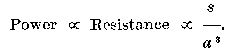
Considering a square airway within sides of length L and given length we have

Thus to pass a given quantity of air through a roadway 4 feet square requires 32 times the power to pass the same quantity through a similar roadway 8 feet square.
Although in normal practice the differences in size of airway and power consumed are not so marked, the influence of size is important. Thus, if we take two airways (a) 5 x 6 feet and (b) 6 x 10 feet in which the area is doubled, we find that the ratio of power required is 5.5 to 1. It is obvious that the question resolves itself into balancing the cost of the construction and maintenance of the larger roadway within the saving in cost of power. Since conditions vary so widely in this respect, no general rule can be given and every case must be considered separately in this manner.
Influence of Shape of Section. — The influence of shape of section is indicated in the Atkinson formula, which shows that for different shapes the resistance is governed by the relationship of the perimeter to the area. Considering an area of 100 square feet the ratio of the pressures required to pass a given quantity through airways of similar type but of different shapes is shown in the following table :—
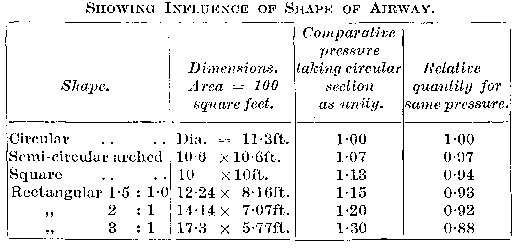
It will be seen that the shape of section affects the pressure requirements and the quantity which will flow for a given pressure, the influence being more marked as the shape departs from the symmetrical proportions of a circle or square.
Character of Lining. — The character of the lining employed in mine roadways has a marked effect upon the value of the coefficient of friction. In practice, the average value of K expressed in inches of water-gauge per square foot of rubbing surface for a velocity of 1,000 feet. per minute may range from about 0.00040 for a smooth-lined roadway to 0.00161 for a timbered roadway, representing a ratio of 1 to 3.5 between these values.
Other things remaining constant, the pressure required to pass
a given quantity of air through an airway varies directly as the
value of K and the quantity of air that will flow with a given
pressure varies as  Hence the pressure required under
mine conditions to pass a given volume of air him a roadway lined
with timber may be 3.5 times as high as that required to pass
the same volume through a smooth concrete-lined roadway.
Furthermore, for the same pressure the quantity passing through
a smooth-lined roadway will be about 1.87 times that passing
in a timbered roadway.
It cannot be too strongly emphasised that the degree of alignment of successive supports has an important effect upon the value of K under practical mining conditions, and in a timbered or arch-girdered roadway faulty alignment of the timbers or arches may give rise to 50 per cent. or greater increase in the resistance. The most convenient way of assessing the effect of various factors is to express the resistance in atkinsons per 1,000 feet of roadway.
Influence of Restrictions.
Bends. — The question of air-flow at bends has received considerable attention. Any deviation from flow in a straight line results in additional resistance, the magnitude of which depends upon the extent and abruptness of the change in direction. Briefly, it may be stated that sudden changes of direction should be avoided. Thus the substitution of a properly-constructed bend for an elbow or the reminding of corners at junctions of roadways materially reduces the resistance to air-flow and is usually profitable. In this way the pressure loss at a right-angle bend may be reduced to about one-half.
Crooked and Sinuous Roadways. — The malalignment of roadways, resulting in even slight changes of direction comparable to continuous curves should be avoided, as a slightly-curved roadway offers appreciably higher resistance than a straight and uniform roadway. In one case it was observed that a 340-foot length of arched roadway, including a 16° hand, had a coefficient of friction 160 per cent. higher than the adjacent straight portions of this roadway.
Changes of Cross-section. — Considerable resistance arises in mine ventilation systems doe to changes in cross-sectional area of roadways such as occur at ripping lips. For small lips and low velocities the resistance at the change of cross-section is small and negligible, but for hips where the difference in velocities in the two sections of roadway is greater than 6 feet per second, the loss may be so material as to warrant consideration of tapering the lip.
Tubs. — The effect of the presence of tubs in mine roadways is not always appreciated and allowed for when deciding upon the size of roadways required for given conditions. Investigations show that the resistance due to mine tubs may be divided into end resistance and side resistance, the relative importance of each depending upon the number and disposition of the tubs. The resistance also varies with the relative size of tub and mine roadway. Two examples of measurements made underground may be cited. In one case it was shown that the resistance caused by tubs may increase the coefficient of friction for a particular roadway by as much as 100 per cent. In the other case similar results were obtained, and it was found that the presence of tubs on an endless-rope haulage in a Yorkshire colliery increased the resistance by 109 per cent. as compared with an unrestricted roadway. It is interesting to record that check measurements on a scale model in the laboratory gave the increased resistance as 116 per cent.
Miscellaneous Obstructions. — Care should be devoted to the avoidance of unnecessary restrictions in airways in the form of abandoned door frames and disused plant. When the velocity ms small the effect of these obstructions may ho negligible, but when they exist in airways with high-velocity currents it is desirable that they should be removed.
Resistance of the Working-face. — The resistance offered to the passage of air along a coal face depends upon a number of factors, e.g., thickness of seam, length of face, system of packing, and the method of working which influences the nature of obstructions in the shape of tubs, conveyers, coal-cutters, gumming, etc. Furthermore, the resistance of a single face varies considerably over the cycle of operations involved in normal mining practice. It will be at a maximum at the beginning of the stripping shift when the packs are nearest the face, and will thereafter decrease gradually to a minimum at the end of the stripping shift. Few reliable figures are available regarding the actual resistance of working faces. Measurements in the mine and in the laboratory show that the maximum resistance may be three to four times the minimum resistance. Fortunately, however, the resistance of the face usually represents but a small proportion of the total resistance of the air-circuit, so that variations in face resistance alone do not result in proportionate variations of air-flow in the circuit.
Measurements underground indicate that fluctuations in air quantity at the face over a complete cycle, expressed in terms of the maximum, may range from 90 per cent. or less on a short face in a thick seam to more than 60 per cent. on a long face in a thin seam. More data are required before face resistance can be evaluated with certainty.
The provision of adequate ventilation on long faces in thin gassy seams sometimes gives rise to difficulty on account of the high air-velocity required, and in certain cases the length of face may have to be limited to that which can be adequately ventilated at reasonable velocities. Attention should also be given to the cycle of work to ensure, if practicable, that the most dangerous operations are not performed when the air is most restricted.
 |
 |
| Names mentioned in this article | |
 |
 |
| Name | Age | Occupation | Notes |
|---|---|---|---|
| Clive, R. | |||
| Hay, Douglas, Prof. | Whos Who Page | ||
| Statham, Ira Cyril Frank, Prof. | Whos Who Page |
 |
 |
| Related Articles | |
|
|
| Pub. Date | Article (Newspaper) |
|---|---|
| 29 Jul 1939 | Mine Ventilation (The Science and Art of Mining) |
| 12 Aug 1939 | Mine Ventilation (The Science and Art of Mining) |
| 26 Aug 1939 | Mine Ventilation (The Science and Art of Mining) |
| 09 Sep 1939 | Mine Ventilation (The Science and Art of Mining) |



 Contains public sector information licensed under the

