


| Newspaper Articles |

|
Newspaper Articles |
 |
 |
29th July 1939, Page: 26, Column: 1
Mine Ventilation
By R. Clive, Prof. D. Hay, M.C., B.Sc., and Prof. I. C. F. Statham, M.Eng.
Excerpts from "Mine Ventilation a Review of Present Theory and Practice (Tenth Report of the Midland Institute Committee) on Mine Ventilation," presented at the general meeting of the Institution of Mining Engineers.
The Objects of Mine Ventilation.
The objects of providing ventilation in coal mines may be summarised as follows :—
(1) To dilute, render harmless, and carry away all noxious and inflammable gases which are produced in the mine. (Coal Mines Act, 1911, Section 29 (i).)
(2) To provide air for the respiration of men and animals.
(3) In deep, hot mines, to cool the working places and to render the atmospheric conditions healthy and suitable for the performance of work.
(4) To keep the dust concentration in the air within required limits by carrying away the dust produced, in the working faces and other parts of the mine, as a result of the getting of minerals and constructing and maintaining the requisite roadways.
Standards of Ventilation.
The maintenance of a standard of purity of the atmosphere in mines necessary for health and safety is demanded by Section 29 (1) of the Coal Mines Act, 1911, which reads as follows: "An adequate amount of ventilation shall be constantly produced in every mine to dilute and render harmless inflammable and noxious gases to such an extent that all shafts, roads, levels, stables, and workings of the mine shall be in a fit state for working and passing therein, and in particular that the intake airways up to within one hundred yards of the first working place at the working face which the air enters shall be normally kept free from inflammable gas."
Section 29 (3) sets up definite standards respecting the permissible limits of pollution so far as deficiency of oxygen and the percentage of carbon dioxide are concerned, and defines the term "normally free from inflammable gas." According to this sub-section — "A place shall rot be deemed to be in a fit state for working or passing therein if the air contains either less than 19 per cent. of oxygen or more than 1¼ per cent. of carbon dioxide, and an intake airway shall not be deemed to be normally kept free from inflammable gas if the average percentage of inflammable gas found in six samples of air taken by an inspector in the air-current in that airway at intervals of not less than a fortnight exceeds one-quarter."
Mines liable to spontaneous combustion may be exempted from the provisions relating to oxygen and carbon dioxide by order of the Secretary of State. As a further safeguard against the risk of explosions it is laid down (Section 67 (2)) that men must be withdrawn from mines in which safety-lamps are required to be used when the percentage of inflammable gas present in the general body of the air is 2½ and in naked light mines when the percentage is 1¼. Section 60 (2) requires that electric current shall be switched off when the percentage of inflammable gas in the general body is 1¼, and Section 32 calls for the use of safety-lamps under prescribed conditions. Under normal circumstances these statutory requirements are met without difficulty and allow ample margin as regards both safety and health.
The Production of Ventilation.
Natural Ventilation. — Although insufficient in itself to meet the ventilation needs of coal mines, natural ventilation frequently plays an important part, especially in deep, hot mines. Natural ventilation results from a difference in density of the air in the upcast and downcast shafts and in returns and intakes of steep workings, due to differences in temperature brought about by natural agencies.
The quantity of ventilation so produced depends upon the difference between these air densities and upon the resistance, The temperature and the density of the air in upcast shafts remain more or less uniform, but the temperature and density of the downcast air are influenced by changes of the surface atmospheric temperature. For this reason the quantity of natural ventilation in a mine varies considerably and may be nil or may assist or retard the nominal direction of flow.
It may be pointed out that the air descending the downcast shaft undergoes a rise of temperature of about 1°F. per 182 feet as a result of auto-compression, and conversely, the air ascending the upcast undergoes auto-decompression at the same rate. If no conduction of heat takes place in the shafts, the air will, under certain conditions, be at the same temperature at the bottom of both the downcast and upcast shafts. Such a condition arises only when the geothermic gradient of the strata is 1°F. per 182 feet, in which case no natural ventilation would occur. If the geothermic gradient is greater than 1°F. per 182 feet the temperature of the air entering the upcast will be lower than that at the bottom of the downcast, resulting in natural-ventilation effects opposing mechanical ventilation.
The influence of natural ventilation has attracted considerable attention. Clive gives detailed information of measurements made at Bentley Colliery, in Yorkshire, with shafts 1,900 feet deep. He found that the average downcast temperature fell, on a hot summer day, as much as 17½°F. in 15 hours, corresponding to a range of 1.3 in. of water-gauge effect and to an increase in quantity of 34 per cent. It was also noted that during a summer week the natural ventilation had a retarding effect only for a few hours. During the winter the variation of the average day and night temperature of the downcast shaft amounted to 20.3°F., corresponding to a range of 15 in. of water-gauge effect and an increase of 25 per cent. in the total quantity produced. Variations between the lowest point in summer to the highest point in winter amounted to 65 per cent. The value of the mine resistance independent of the temperature effect was 0.72 atkinson, but changes of temperature resulted in an "apparent resistance" of 0.89 atkinson in summer and 0.39 atkinson in winter with the result that the h.p. in the air dealt with by the fan varied from 182 in summer to 80 in winter.
Mechanical Ventilation: Main Fans. — Owing largely to the danger of underground fans being destroyed or damaged by explosion, fire, or other cause, the Coal Mines Act, 1911, Section 31 (2), requires the maintenance at the surface of a complete ventilating appliance, capable of producing sufficient ventilation, immediately available for use in the case of accident, kept in effective condition and used once a week. For this reason underground fans are not need for main ventilation purposes in this country. In certain cases the installation of main fans underground offers advantages both on the score of efficiency and convenience. Thus, where several seams, in different stages of development, requiring different quantities and pressures are worked from a pair of shafts, the installation of separate fans in each seam avoids the heavy losses which normally occur at regulators and gives greater general flexibility. This method has been adopted at various mines, particularly on the Continent, but the advantages and disadvantages of underground fans require careful consideration in each individual case.
Centrifugal Fans. — For many years and until comparatively recently mechanical ventilation at coal mines was effected almost exclusively by the use of centrifugal fans. The early forms were of large diameter and ran at slow speeds, but evolution in fan design led to the introduction of higher speeds and smaller diameters and to the development of multi-vane types. Progress in the design of blades, inlets, casings, and evasee chimneys has led to increased efficiencies and to-day good results are obtainable from fans built by any reputable manufacturer providing the appropriate data are submitted by the colliery company.
Screw of Axial-flow Fans. — The screw or axial-flow fan differs from the centrifugal fan in that, as its name implies, it discharges the air axially instead of tangentially. Such fans comprise a rotor carrying the air-screw or blades which revolve in a cylindrical or tunnel-shaped casing. Recent developments in the design of axial-flow fans have led to their more extensive use in British mines, and modern designs are giving good service. It is claimed that the axial-flow fan possesses the following advantages: (1) Flexibility. Its performance may be varied to suit changing conditions by altering (i) the speed, (ii) the number, (iii) the pitch, of the blades in the rotor, or (iv) the number of rotors. Thus variations can be catered for. (2) Simplicity both of fan and housing. (3) Suitability for direct drive from motor or turbine, due to high speed of rotation. (4) Ease of reversal of ventilation, which is affected by reversing direction of rotation of the blades. (5) High efficiency, due to low internal resistance of the fan itself.
Fan Efficiencies and Selection of Fan.
Much discussion has raged around the highly controversial question of fan efficiency which has been approached in various ways depending largely upon whether the efficiency is related to the fan alone or to the complete ventilating equipment. Thus, four efficiencies may be recognised, namely, the aerodynamical efficiency, fan efficiency, mechanical efficiency, and over-all efficiency.
The Aerodynamical Efficiency furnishes a measure of the fan's capability to produce useful depression, and is important since it indicates the extent to which the total pressure produced by the fan is absorbed within the fan itself owing to its internal resistance.
The Fan Efficiency includes not only losses due to the internal resistance of the fan but also those due to windage and friction at the fan-shaft bearings. It is difficult to evaluate these losses separately and they are usually assessed by determination of the ratio of the horse-power in the air to the horse-power applied to the fan shaft.

The Mechanical Efficiency is the efficiency of the driving unit up to the fan shaft and includes losses in belt, chain, or gearing and in the driving engine or motor.
The Over-all Efficiency is the combined efficiency of the fan, drive, and engine or motor and is the product of the fan efficiency and mechanical efficiency. Thus E0 = Ef x Em, where E0 = over-all efficiency, Ef = fan efficiency, Em = mechanical efficiency.
The Selection of a Fan of appropriate design and size involves difficulty on account of the varying resistance of the mine. It is known that maximum efficiency of working for any given fan depends upon the
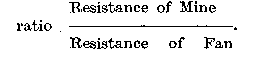
Some idea of the variations of mine resistance are given by one of us who found that the resistance of a certain South Yorkshire mine varied during the first eleven years of its life from 55 atkinsons at the commencement to 0.4 atkinson when the colliery was fully developed. The corresponding variation in equivalent orifice was from between 7 and 10 square feet in the early stages to between 70 and 84 square feet when fully developed. Unfortunately, no single fan exhibits characteristics which enable it to work at a high efficiency over so wide a change of resistance. In practice, the difficulty may be overcome by installing a fan suited to the mine during development and replacing this by another fan when the mine is developed. This practice is particularly applicable with axial-flow fan when only the rotor need be replaced. Such a procedure may prove economical by avoiding the heavy cost of running a fan for long periods at a low efficiency.
Compound Running of Fans. — Alternatively, two fans may be operated in parallel or in series. Thus, if the mine resistance decreases to such an extent that the original fan no longer gives a reasonable efficiency, a second fan may, in some circumstances, be installed to work in parallel with the first. This procedure was adopted by Bentley Colliery where two fans have run in parallel for many years. If, on the other hand, the resistance of the mine increases, demanding a higher water-gauge for the same quantity, improvement might be secured by running a second fan in series with the first.
Fan Drives. — Mine fans are driven both electrically and by steam, the choice of drive depending upon conditions, but in certain cases the effect of natural ventilation may necessitate varying the speed of the fan if a constant ventilation is to be maintained throughout the year. Such variations of fan speed are more readily effected with steam-driven than with electrically driven fans, unless expensive electrical equipment is installed.
 |
 |
| Names mentioned in this article | |
 |
 |
| Name | Age | Occupation | Notes |
|---|---|---|---|
| Clive, R. | |||
| Hay, Douglas, Prof. | Whos Who Page | ||
| Statham, Ira Cyril Frank, Prof. | Whos Who Page |
 |
 |
| Related Articles | |
|
|
| Pub. Date | Article (Newspaper) |
|---|---|
| 29 Jul 1939 | Mine Ventilation (The Science and Art of Mining) |
| 12 Aug 1939 | Mine Ventilation (The Science and Art of Mining) |
| 26 Aug 1939 | Mine Ventilation (The Science and Art of Mining) |
| 09 Sep 1939 | Mine Ventilation (The Science and Art of Mining) |



 Contains public sector information licensed under the

