


| Newspaper Articles |

|
Newspaper Articles |
 |
 |
15th July 1939, Page: 11, Column: 1
Selection And Purchase Of Coal
Technical Bulletin No. 11 issued by the Coal Utilisation Council deals with "The Selection and Purchase of Coal and Coke for Central Heating and Steam Raising Purposes." it is an abridged version of a paper read in January before the Institution of Engineers-in-Charge by Mr. H. L. Pirie, M.I.Mech.E., the chief engineer of the C.U.C. The paper is divided into sections dealing respectively with selection, purchase and service, and in his introductory remarks Mr. Pirie says :--
Definition of Coal. — "Coal" is an omnibus word. It is used indiscriminately to denote, both individually and collectively, each and every variety of a highly complex organic rock of very variable chemical composition ranking from anthracite to lignite, and also one or more of the multitude of sizes into which each class is divided either naturally or by screening.
These various coals possess widely different properties. Hardly any two are exactly alike in chemical composition and physical characteristics. They consequently behave differently to a greater or lesser degree under the influence of heat, and each requires special conditions if the best combustion results are to be obtained from it.
In a general way it may be said that practically all coals can be burned with some degree of success in every appliance; but although manufacturers are continually improving their apparatus with the object of increasing the range of coals which can be burned thereon, there is no single design which will give commercial satisfaction with every variety of solid fuel.
Relation between Fuel cad Equipment. — The relation between fuel and equipment has, therefore, a close bearing on efficiency. The best coal in the world can be rendered well nigh worthless if it is used with unsuitable or unsatisfactory equipment.
Figure of Merit. — Assuming adequate draught and faultless operation, the combined efficiency of the combustion process may be expressed in the form of an equation thus :—
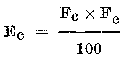
Where Ec is the combined efficiency of the fuel and appliance Fc the "figure of merit" of the coal or coke; and Fe the "figure of merit" of the equipment on which the fuel is to be burned.
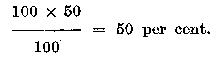
These figures of merit can be assessed by evaluating the coal to the appliance or vice versa, but the relative importance of the desirable qualities varies in each according to conditions of use. Supposing "best steam coal" having a figure of merit of 100 is supplied to a grate, half the bars of which have fallen into the ash pit, the combined efficiency of the process will be :—
In much the same way, from a study of the relationship between ash and boiler efficiency, we know that with coals having a basic ash content of 10 per cent., and up to 20 per cent., the efficiency of certain types of boilers will be decreased by approximately one-third of 1 per cent. for each 1 per cent. increase in the ash content. Hence, even in a perfect plant, the ultimate efficiency of combustion with a high-ash coal would be low. In fact, it has been stated that, with coal containing over 40 per cent. of ash, it is almost impossible to raise steam. In other words, the efficiency of the process is zero, because the combustible portion of the coal is so embedded in the ash and clinker that, no matter what type of appliance is used, the oxygen in the air cannot get in contact with the fuel, and no heat is generated.
In their instructions to those tendering for the supply of coal and coke, the Metropolitan Water Board state — "Subject to suitability, absence of excessive smoke and clinker-producing properties, calorific value per penny of cost will be regarded as a principal factor in the selection of steam coal."
To arrive at a final conclusion for awarding the contract, a figure of merit derived from actual experiments is used when multiplying the B.Th.U. offered per penny by the expected efficiency of the coals. The Board know from experience the efficiency likely to be obtained when the coal submitted is burned on particular grates. It follows, therefore, that the fuel and the combustion equipment must be considered together. For best results each should meet the requirements of the other.
 |
 |
| Names mentioned in this article | |
 |
 |
| Name | Age | Occupation | Notes |
|---|---|---|---|
| Pirie, H. L. | Chief Engineer |




 Contains public sector information licensed under the

