


| Newspaper Articles |

|
Newspaper Articles |
 |
 |
9th June 1939, Page: 1012, Column: 2
Pit Ponies On Show
Colliery companies which employ ponies or horses underground, and take the greatest pains to see that they are well treated and cared for, naturally resent the efforts made from time to time to induce consumers to stipulate that their supplies of coal shall be drawn from pits using nothing but mechanical haulage. The suggestion is both unfair and unreasonable; first, because colliery animals as a class are certainly better treated and probably more lightly worked than the general run of horses employed on commercial work on the surface; and secondly, because although conditions underground may render complete mechanisation eminently practicable at one colliery, the problems and conditions may be entirely different at another colliery in the same district, and pony haulage may, therefore be necessary. Many collieries, of course, employ both methods. Propagandist societies and their well-meaning supporters may think that what is possible and even obvious, at one pit or throughout one district must necessarily be equally possible for all pits and all districts; but, as any practical mining man knows, that is a complete delusion-one of the many relating to the coal industry that are unfortunately only too common.
Unscrupulous Propaganda.
It is to be feared, too, that the societies are not always very scrupulous in their propaganda; as for example the implication, in a recent statement in the Press, that cruelty to animals is inseparable from their employment underground. This is not only utterly untrue but a gross libel on the men who drive and tend the ponies.
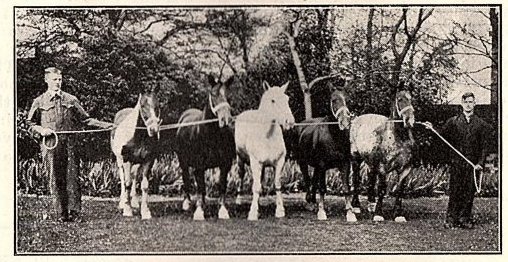
Five ponies from New Sharlston Collieries, Ltd., West Yorkshire
"Link," "Drummer," "Pat," "Jack," and "Captain."
It is not very often that coal consumers, and members of the public generally, have an opportunity of seeing colliery animals and forming their own opinion about their appearance and condition. Such an opportunity however, is provided by the exhibition of pit ponies and colliery horses organised by the Mining Association of Great Britain at the Royal Agricultural Society's Centenary Show at Windsor from July 4 to 8. There will be nearly 90 animals in all, drawn from Northumberland, Durham, Yorkshire, Nottinghamshire, Derbyshire, Cannock Chase, the Forest of Dean and South Wales; and the colliery companies exhibiting horses or ponies include Ashington and Bedlington (Northumberland); Horden, South Derwent, Stella, Lambton, Hetton and Joicey, Bearpark, Londonderry, Ryhope, South Pelaw, Washington, and Harton (Durham); Granville, Grassmoor, Netherseal, Stanton Ironworks, New Hucknall, Bolsover, Staveley, Butterley, Sheepbridge Coal and Iron, and Shipley (Notts and Derby); West Cannock, Cannock Chase, Cannock and Rugeley, T. A. Hawkins and Sons, and William Harrison (Cannock Chase) ; Manvers Main, Amalgamated Denaby, Dalton Main, Doncaster Amalgamated, Newton Chambers. Wharncliffe Silkstone, and Wath Main (South Yorkshire); Pope and Pearson, Henry Briggs and Son, New Sharlston, Ackton Halt and Airedale (West Yorkshire); Cannop (Forest of Dean); Ocean, Tredegar Iron and Coal, Fernhill, Lancasters Steam, and Powell Duffryn Associated (South Wales).
A Thoroughly Representative Selection.
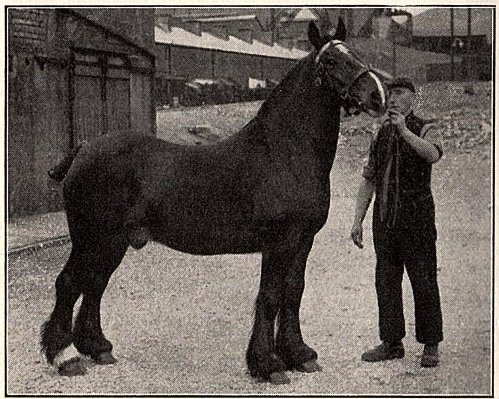
"Tinker"
A 21 year old horse habing 17 years service underground,
owned by Powell Duffryn Associated Collieries.
The entries are fully representative, ranging from ponies of nine hands to horses standing 15.2; in age from 5 to 27 ; and in length of service underground from six months to 23 years. The animals illustrated herewith are typical of those which will take part in the exhibition, and it is a condition of entry that they shall have been working regularly underground until 14 days before the show. It is very much to be hoped that all those who take an interest in the welfare of pit ponies, including the supporters of the aforesaid societies, will go and make the personal acquaintance of the animals and of the men in charge of them.
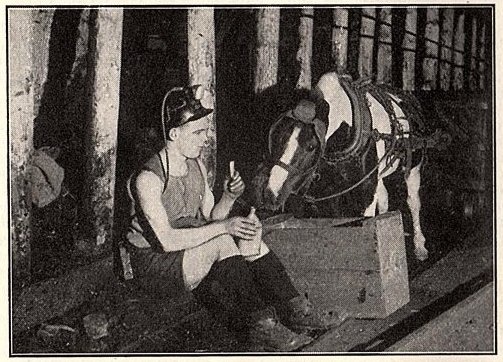
"King"
A 7-year old horse of the Ashington Coal Co.
The arrangements for the exhibition are now practically complete. They have been in the hands of a committee consisting of: Sir J. Beynon and Mr. I. Williams (South Wales), Mr. H. J. Weeks (Northumberland), Mr. Austin Kirkup (Durham), Mr. H. O. Bishop (Midland Counties), Mr. B. H. Pickering (South Yorkshire), Major C. H. Stringer (West Yorkshire), Mr. C. J. Hale (Forest of Dean) and Mr. Philip Gee; with whom Mr. Fred Sweet and Mr. Robert Clive, the secretaries of the Northumberland and Durham and South Yorkshire Colliery Owners' Associations respectively have actively co-operated. While at Windsor the animals will be under the charge of Mr. W. D. Rees, the veterinary surgeon of the Powell Duffryn group of collieries; and the committee hopes that as many colliery owners as possible from the various districts exhibiting will make a point of being present in order to assist in entertaining visitors, answering questions and contributing to the success of the show.
A special illustrated booklet on pit ponies and colliery horses is being prepared in connection with the exhibition, to which Sir Frederick Hobday, honorary veterinary surgeon to the King and president of the University of London Animal Welfare Association has contributed a foreword.
 |
 |
| Names mentioned in this article | |
 |
 |
| Name | Age | Occupation | Notes |
|---|---|---|---|
| Beynon, J., Sir | South Wales | ||
| Bishop, Hubert Ormond | Midland, Whos Who Page | ||
| Clive, Robert | |||
| Gee, Philip | |||
| Hale, C. J. | Forest of Dean | ||
| Hobday, Frederick, Sir | |||
| Kirkup, Austin | Durham, Whos Who Page | ||
| Pickering, Basil Henry | South Yorkshire, Whos Who Page | ||
| Rees, W. D. | Ventinary Surgeon | ||
| Stringer, Clifford H., Major | West Yorkshire, Whos Who Page | ||
| Sweet, Fred | |||
| Weeks, H. J. | Northumberland | ||
| Williams, I. | South Wales |




 Contains public sector information licensed under the

