


| Newspaper Articles |

|
Newspaper Articles |
 |
 |
9th June 1939, Page: 1037, Column: 2
Mining Examinations
Report Of The Board For 1938
We make the following extract from the report of the Board for Mining Examinations upon their proceedings during the year 1938.
The death of Mr. Herbert Smith on June 16, 1938, was an irreparable loss. Mr. Smith was appointed a member in 1924 and in later years was elected a vice-chairman, a post which he held up to the date of his death. His loss will be felt keenly, both by the Board and the workmen whom he represented. During the year, Sir Henry Walker, the Chief Inspector of Mines, retired from the public service, thus bringing to a close a long association with the activities of the Board, and the Rt. Hon. James Brown, M.P., retired after 17 years of valuable service. Mr. W. Lawther felt obliged to sever his connection owing to pressure of other duties. The vacancies have been filled by the appointment of Mr. Alf. Smith, Mr. F. H. Wynne, Chief Inspector of Mines, Mr. Andrew B. Clarke, and Mr. James Bowman.
Four meetings of the Board were held, one before each examination, to authorise all arrangements therefore, and one after each examination to consider results. The Doubtful Cases Committee appointed by the Board and consisting of 15 members, met in accordance with custom before each examination to consider the applications of candidates, particularly with a view to ascertaining in cases of doubt whether a candidate's experience conformed to requirements.
Examinations for Certificates of Competency.
Examinations for certificates of competency were held at Edinburgh, Newcastle-on-Tyne, Sheffield, Wigan, Cardiff and Birmingham. The written parts of the examinations took place on May 25 and 26, and on November 23 and 24. The oral tests were taken about six weeks later and were attended only by candidates who qualified in the written examinations. The Board again have pleasure in recording an increase in the number of candidates presenting themselves for examination, the total (including re-examinees) being 654, compared with 560 in 1937. The number of candidates entering for first class certificates increased by 48 to 287, and the number of candidates for second class certificates by 46 to 367.
There was again an increase in the number of successful candidates for first class certificates — the figure of 31 per cent, being better than for many years past, but the successes in the under-managers' examination fell from 35.8 per cent. to 28 per cent.
During the year 15 unsuccessful candidates obtained a sufficient number of marks to enable them to take advantage of the concessions in regard to re-examination in not more than two written papers or the oral test. In May, five candidates earned the right to attend in November and four qualified. In November, 10 candidates qualified for re-examination in 1939.
In the second examination of the year, the new system of identifying candidates by number was adopted, and logarithmic tables were supplied for the use of candidates at the written examination. Both innovations operated satisfactorily.
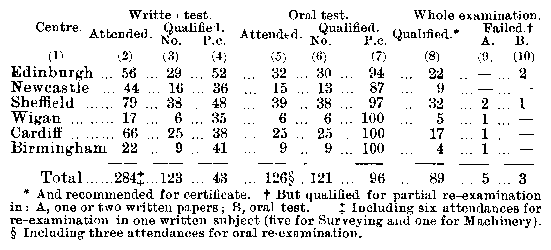
Examinations for First Class (Managers') Certificates.
One hundred and twelve candidates attended the examinations for the first time and 32 were successful. Sixty-six candidates out of 212, holding either second class or surveyors' certificates, qualified. Inability to qualify in the surveying paper and failure to attain the required aggregate marks were the major causes of failure of the unsuccessful candidates.
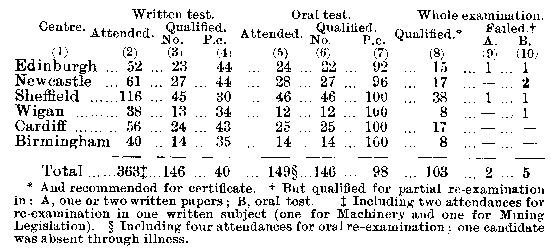
Examinations for Second Class (Under-Managers') Certificates.
One hundred and sixty candidates attended the examinations for the first time and 40 were successful. Inability to qualify in Paper No. 2 (ventilation), No. 5 (surveying) and failure to attain the required aggregate marks were the chief causes of failure of the unsuccessful candidates.
Examinations for Mine Surveyors' Certificates.
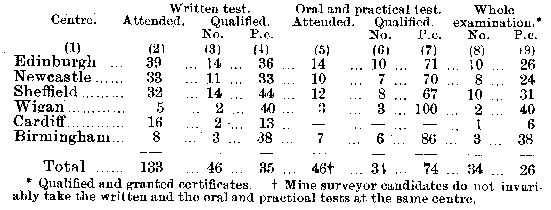
Written examinations were held at the same centres as the examinations for certificates of competency on May 26 and November 24. The oral and practical tests were held subsequently on three successive days at specified collieries, and were attended only by those candidates who qualified in the written examinations. The Board are still concerned at the reduction during the last few years in the number of candidates presenting themselves for examination. In 1934 there were 219 entrants, and in the year under review 133. Unless attendances improve, the Board will have to give further consideration to the possibility of holding one examination per annum. The Doubtful Cases Committee, whose functions have already been referred to, undertakes similar duties in regard to applications from candidates for mine surveyors' certificates. The Qualifications and Examinations (Mine Surveyors') Committee — comprising 11 members of the Board — meets twice a year to supervise all matters in connection with the surveyors' examinations.
The oral and practical tests were held at pits owned by the following companies. The Board wish to record their thanks to those companies for the facilities which they have so kindly given to the examiners. Ackton Hall Colliery Co., Ltd., Henry Briggs, Son and Co., Ltd., Charlaw and Sacriston Collieries Co., Ltd.. Londonderry Collieries, Ltd.. Lothian Coal Co., Ltd., Manchester Collieries, Ltd., Morris and Shaw, Ltd., The New Monckton Collieries, Ltd., New Sharlston Collieries Co., Ltd., James Nimmo and Co., Ltd., The Powell Duffryn Associated Collieries, Ltd., and Wemyss Coal Co., Ltd.
Eleven candidates out of 36 qualified at their first attempt. 10 candidates who had passed an approved surveying course or who held an approved degree or diploma entered for the examinations and two qualified.
 |
 |
| Names mentioned in this article | |
 |
 |
| Name | Age | Occupation | Notes |
|---|---|---|---|
| Bowman, James | Whos Who Page | ||
| Brown, James, Rt. Hon. | |||
| Clarke, Andrew B. | Whos Who Page | ||
| Lawther, Will | Whos Who Page | ||
| Smith, Alf. | |||
| Smith, Herbert | Whos Who Page | ||
| Walker, Henry, Sir | Whos Who Page | ||
| Wynne, Frederick Horton | H.M. Chief Inspector of Mines | Whos Who Page |




 Contains public sector information licensed under the

