


| Newspaper Articles |

|
Newspaper Articles |
 |
 |
11th March 1939, Page: 278, Column: 2
Casualties-Occurrence And Prevention
Psychological Aspect of Question
By C. H. Leeds, M.I.M.E.
From paper read at the February meeting of the North of England Institute of Mining and Mechanical Engineers. The paper discusses the features presented on four graphs prepared for the occasion.
A definite distinction should be made in the classification of avoidable and unavoidable accidents, and as a first step towards recognition of the greater importance of preventive measures in the former case, avoidable accidents should be placed in a class by themselves as "casualties." It is in this category of casualties that improvement can be most easily effected. On the presumption that the occurrence of casualties is directly influenced by the interference of the human element, it becomes necessary inter alia to trace the relationship between the varying number and the respective times at which they occur during the working shift. The material factor is not so much the seriousness of any one casuality as compared with the insignificance of another, as the tendency to casualty of any kind: (a) on the part of any particular individual; (b) in any special class of work; (c) under particular conditions of work; (d) under particular climatic conditions; (e) under personal influences.
(a) "Accidents proneness," or the abnormal liability of some individuals to injury of one kind or another, is not uncommon. Records of such cases are already being kept by certain large colliery concerns such as The Fife Coal Co., and such remedies applied as the removal of the workman concerned to some other class of work. The practice of keeping such records should be general throughout the industry. It would probably be found that the above remedy was effective in the majority of apparently chronic cases. Cases, on the other hand, which showed no improvement irrespective of surrounding circumstances, should be considered incurable, and the workman removed from the mine as a menace to himself, his fellow workmen, and the accident rate.
(b) There are undoubtedly certain classes of occupation in which liability to injury is more pronounced than in others. Obviously therefore it is in these occupations that the greatest care should be taken in the selection of the workers, and where, as in the transit of coal, boys are largely employed, special supervision and, so far as possible, special training and instruction should be given in the particular work to be undertaken. If it should be found that the tale of injuries showed no sign of improve- ment in spite of these precautions, and assuming that everything possible has already been done to make the transit conditions perfect, then the fault must lie in the transit system itself, and it may even be necessary to adopt some other in which liability to injury has been proved to be less.
(c) This category is concerned less with the manifold diverse conditions existing in all mines than with such special conditions as may be the corollary to the introduction of some peculiar method of working or type of machinery, where the possession of comparative data may serve as a warning or otherwise. As for example, shot-firing with permitted explosives or substitutes. Such records are often kept by managers for their own purposes, and the broadcasting of their experiences would be of much value to others.
(d) The influence of extremes of heat and cold on man's physical condition — and consequently on his mental alertness — is well known, and it is not unreasonable to suppose that the more ordinary fluctuations of temperature and pressure may have a corresponding effect in a less marked degree. There are periods in the day and in the calendar year at which vitality is lower than at others, and it follows that there is a variation in the activity of the brain. We cannot as yet control the elements, and must therefore be content to counteract them to the best of our ability by a process of substitution.
(e) There is probably nothing more disconcerting to the ordinary member of a family than some domestic trouble. Sickness, debt, a quarrel, or one of a dozen worries may prey on his mind during the whole of his absence from home, and so distract his attention as to render him more liable at any moment to injury.
Colliery 3-year Record.
The following notes have been compiled at a colliery over a period of three complete years, during which time every underground accident and/or casualty, however slight, has been recorded. Many of the latter were mere scratches, causing little or no interference with the work of the individual concerned after the application of a simple dressing. The workmen concerned have been divided into six classes. The total number of calendar days worked was 900. The total number of accidents and casualties was 2,128, or 298 per 100,000 tons of coal drawn. The number of injuries disabling for more than three days was 320, approximately 15 per cent. only of all the injuries sustained, or slightly over 45 per 100,000 tons. The liability to injury in the respective classes is shown in the table :—
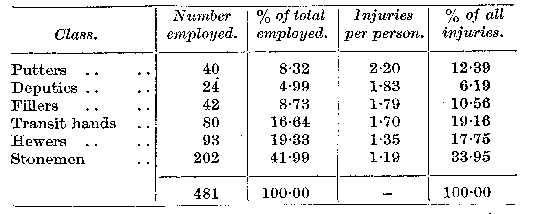
It will be noticed that there is no particularly outstanding evidence of special liability to injury amongst any one class as such, the liability varying consistently (with the exception of deputies) in inverse proportion to the numbers employed; or in other words, a small number of injuries amongst a small number of employees tending to give a greater percentage than a much larger number amongst a large number of employees.
The greatest travelling distance for the bulk of the workmen in the case under review was less than a mile, and the travelling was on the whole good, so that no abnormal expenditure of energy was necessitated in getting to the working face. It can scarcely be supposed that the ensuing 2½ to 3 hours' work out of a normal working shift of about 6½ hours was the cause of such excessive fatigue as to result in pronounced carelessness on the part of the workmen in each of the very diverse occupations shown on the upper portion of the first graph exhibited, more particularly as the lower portion showed no such 4th hour peak in the case of pneumatic-pick hewers or deputies, whose work is at least as strenuous if not more so than that of any of the other classes.
Again, there was a recrudescence of injuries in the case of the majority of the workmen between the 5th and 6th hour. Here fatigue may be more reasonably blamed, even the deputy class, although not actually at peak in the 6th hour, showing a decided tendency to increased liability to injury during the latter part of their shift.
Putters and fillers are inconsistent with the above suggestion. Putters may possibly be going less hard about this time as a result of the slackening off of tired hewers. Fillers are probably engaged in shovelling up the last few remaining coals from a practically cleared face, the heavier part of their work arising more often than not in the earlier hours of their shift. In both cases the numbers are so small that a few accidents one way or another makes a considerable deviation in the curve.
It is, I think, probable that fatigue and lack of concentration both play a part in the 6th hour peak, when workmen are beginning to count the minutes before knocking off. From a purely economical standpoint it would be out of the question at the present day to reduce the hours of underground labour to a point at which fatigue of any significance would be entirely eliminated. Moreover, the evil of distraction and reduced concentration towards knocking-off time must still remain. It appears that improvement must be looked for through the education of the workmen, together with increased supervision at these critical periods. They should be made familiar with these critical hours of the shift by graphic lectures at which the necessity would be impressed upon them of keeping their minds on their work whilst at work.
The second graph submitted was of interest as showing that the majority of injuries disabling for more than three days occur in the 6th hour.
There is another aspect to this question of periodicity in the occurrence of accidents, namely, its relation to the respective months of the year, and the third graph showed the occurrence of the 2,128 injuries sustained by an average of 481 workmen over a complete period of 3 years.
In February, which is recognised as the month in which vitality is at its lowest ebb, the peak — considered in relation to shifts worked — was outstandingly high, whilst in July it dropped by nearly 30 per cent. There was a fall from October to November, which it is difficult to account for since a rise might more naturally be looked for as the winter advanced. A marked fall from November to December calls for some special explanation. I can only suggest that it must be due in part at least to the well-known fact that the miners work with extra effort in preparation for Christmas; and although it might be expected that this would result in more superficial cuts and bruises, it does entail greater concentration and a more cheerful and therefore less distracted mental outlook. It is also possible that, in spite of orders to the contrary, there is a tendency to ignore slight injuries which at any other time would be reported for treatment.
The fourth graph gave a classification of the injuries which disabled for more than three days. The number of such injuries was definitely greater in the winter months than in the summer. Falls follow approximately the same type of curve. Haulage and machinery injuries as might be expected are less consistent, but the better period during the summer months was maintained.
I do not think that we can neglect the inference that the better position during the summer months is due to a more alert mentality in a stronger and healthier body, and if this is so, the remedy would appear to lie in making up as far as possible any artificial means during the winter months for the lack of those life-giving properties which Nature distributes during the spring.
This is no Utopian idea. The conditions under which miners live and work have been improved out of all recognition during the last half-century and it is not beyond man's ingenuity to improve them further. Good travelling roads, continuously lighted, face-lighting, ample bait times without rush or hurry, sympathetic attention to all genuine complaints, will go a long way to render one of the most strenuous and not too pleasant of occupations less fatiguing to mind and body. Comfortable homes, interesting diversions and above all wages sufficient to provide, at all times and more particularly during the winter months, good sustaining food, may go further than we know to improve the outlook, the mentality and the efficiency of the workmen and prove a first-class investment from every point of view.
 |
 |
| Names mentioned in this article | |
 |
 |
| Name | Age | Occupation | Notes |
|---|---|---|---|
| Leeds, Charles Herbert | Whos Who Page |




 Contains public sector information licensed under the

