


| Newspaper Articles |

|
Newspaper Articles |
 |
 |
22nd October 1938, Page: 113, Column: 1
Coal Mining In 1937
Report of Secretary for Mines
The Seventeenth Report of the Secretary for Mines, and the Thirteenth Annual Report of H.M. Chief Inspector of Mines, jointly contain a vast amount of detail statistical information, and as usual has been published through H.M. Stationery Office at 4s. net. The Reports are in one volume of 250 pages and both relate to the year 1937.
The Report of the Secretary for Mines contains a general review of the coal mining industry and other mining and quarrying industries, including an account of the negotiations leading up to the introduction of the Coal Bill and the passing of the Coal (Registration of Ownership) Act, 1937. A review of the schemes in force under Part I. of the Coal Mines Act, 1930, is also included.
The Report of the Chief Inspector of Mines reviews the mining accidents which occurred during the year and discusses generally the progress made in preventive measures, the need for further progress, and the lines along which it can be made. Other subjects discussed are protective equipment, explosives and roof supports on roadways and at the working face.
World Coal Output.
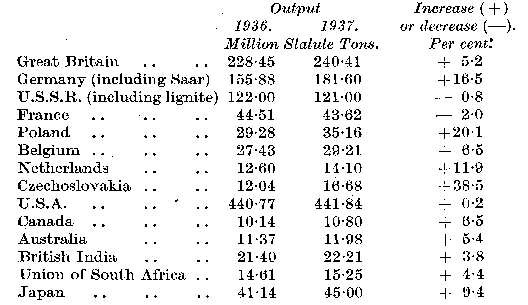
In 1937 there was a general increase in industrial activity and an increase of 22 million tons (18 per cent.) in world coal exports. Bearing these points in mind the Secretary for Mines says it is surprising to find that the world coal output was only about 5 per cent. greater than in the previous year. Almost the whole of the increase took place in the European coalfields. In Germany (including the Saar) the output increased by 25¾ million tons, in Great Britain by 12 million tons, in Poland by nearly 6 million tons and in Czechoslovakia by about 4 2/3 million tons. Increases of nearly 1¾ million tons and 1½ million tons were registered in the output of Belgium and the Netherlands respectively, while in France and the U.S.S.R. output declined by about 1 million tons each. The total output in the whole of Europe, exclusive of the U.S.S.R. and Spain, for which countries information is not available, increased by 51 million tons to 565 million tons.
In the U.S.A. in contrast to the year 1936, when the increase was greater than for any other individual country, the output in 1937 increased by only 1 million tons, to 442 million tons. The production in Japan for 1937 is not yet available, but is estimated at about 45 millions.
The following table shows the output (provisional) during the last two years in the chief European and other important producing countries for which information is available :—
So far as information is available, it is estimated that in 1929 stocks of coal and coke at European coal mines (excluding U.S.S.R.) amounted to nearly 10 million tons. At the end of 1931 they had increased to about 33 million tons but have since decreased to less than 12 million tons at the end of 1937 when they were about 20 per cent. less than at the end of the previous year.
As regards coal and bunker coal shipments of the chief exporting countries it is shown that Great Britain's shipments rose from 46.5 to 52 million tons, those of Germany from 282 to 38 million tons, those of the U.S.A. from 12.5 to 15.1 million tons, Poland's increase being from 8.2 to 10.8 million tons. These are the principal increases, the fifteen exporting countries listed showing total exports of 120 million tons in 1936 and 142 million tons last year, of which Great Britain's contribution was 52 million tons or 36.6 per cent.
The total quantity of British coal exported (including the coal equivalent of the coke and manufactured fuel), which had fallen to 50 1/3 million tons in 1936, rose last year to 56 1/3 million tons, an increase of 12 per cent.
World coal exports increased by 18 per cent. in 1937 as compared with 1936. Although British exports increased by about 6 million tons during the same period, the Great Britain share of the world coal export trade showed a decrease of 2 per cent.
The average declared value per ton f.o.b. of all British coal exported, which had declined from 16s. 8d. in 1930 to 16s. 1d. in 1933 and 1934, improved slightly in 1935, while there was a marked increase to 17s. in 1936. The upward tendency was accentuated by the change in market conditions in 1937, when the figure reached 18s. 8d. per ton.
British Coal Output.
The raising of 240½ million tons at the mines in Great Britain last year represented an increase of 12 million tons over 1936 and 33 1/3 million tons over 1933, but total production was 3 1/3 million tons below that of 1930. For the last few years production has been increasing despite a decrease in the volume of foreign shipments, but in 1937 it is satisfactory to be able to record an increase in output in practically all exporting districts as well as in those producing mainly for home consumption.
The output in the chief exporting districts in 1937 amounted to 117¾ million tons as compared with 111 2/3 million tons in 1936 and 103 2/3 million tons in 1933 the figure for 1930 was 125¾ million tons. The greatest recovery was in South Wales with an increase of nearly 4 million tons over 1936 and in Durham with an increase of nearly 2¼ million tons; in both districts, however, output was well below the 1930 level.
In the remaining districts, which produce mainly for the home market, output increased from 103½ million tons in 1933 to 116¾ million tons in 1936 and 122 2/3 million tons in 1937 moreover the 1937 figure was 4½ million tons greater than in 1930. As compared with 1936, practically the whole of the increase of 6 million tons was almost equally shared by Yorkshire and the district of Derby, Nottingham and Leicester.
World production in 1937 increased by 70 million tons as compared with 1936, and was 96 million tons more than in 1913. Production in Great Britain in 1937 showed an increase of 12 million tons over 1936 hut was 47 million tons less than in 1913. The quantity of coal available for consumption for all purposes in Great Britain amounted to 181¾ million tons, which was nearly 6 million tons more than during the previous year and 8¼ million tons more than in 1929. The figure had declined steadily from 173½ million tons in 1929 to 148 1/3 million tons in 1933. Since then the recovery has been rapid and continuous.
The steady increase during recent years in the quantity of coal consumed at gas and electricity undertakings is particularly striking. The combined figure for 1933 was 26¾ million tons; by 1937 it had risen to 33 million tons, an increase of 6 million tons of which electricity undertakings accounted for 4 million tons. The progressive recovery since 1932 in the iron and steel trades was maintained in 1937, the consumption of coal having increased by 2¼ million tons or over 10 per cent. as compared with 1936.
Employment Conditions.
There was a steady increase in employment at the mines in Great Britain throughout the year, the number of persons employed rising from 771,200 at the end of 1936 to 802,100 at the end of 1937, an increase of 30,900. The average number of persons employed during 1937 was 791,700 or about 24,600 more than in the previous year, but 139,600 less than in 1930. The manshifts worked per person numbered 270 or 8 more than in 1936.
The improvement in the regularity of work, which has been continuous over the past few years, was maintained during 1937. The average number of days on which coal was wound at the pits was 268, or 13½ days more than in 1936, and 23 days more than in 1930.
The total volume of employment in 1937 was nearly 9 per cent. greater than in 1936, but 7 per cent. less than in 1930.
Use of Machinery.
Mechanical mining at coal mines in this country has developed rapidly during the last ten years and particularly during the last half of the decade. Greater advance has been made during the period in the mechanical conveyance of coal than in the cutting of coal by machinery, but the former is a more recent development of mechanical mining and has, therefore, had the opportunity of making quicker progress.
The number of mechanical conveyors in use has been increased from 2,856 in 1928 to 7,300 in 1937 the figure for 1936 was 6,727. There has been a great increase in the proportion of machines driven by electricity; 43 per cent. of the total number of machines were electrically driven in 1928 and 58 per cent. in 1937. The total quantity of coal conveyed in 1928 was 28 million tons, in 1936 it was 109 million tons, rising in 1937 to 123 million tons; the proportion conveyed of the total saleable output rose from 12 per cent. in the former year to 51 per cent. in the latter; in 1936 the figure was 48 per cent.
The number of coal-cutting machines in use has increased since 1928 from 7,131 to 7,600 in 1936 and to 7,781 in 1937; here again electricity has supplanted compressed air, the proportion driven by electricity of the total number of machines in use having increased from 50 per cent. in 1928 to 64 per cent. in 1937. The quantity of coal cut by machinery in 1928 was 61 million tons or 26 per cent. of the total saleable output; the comparable figures for 1936 were 125½ million tons and 55 per cent. and they increased to 137 million tons and 57 per cent. In 1937.
The quantity of mineral dealt with per machine both by mechanical conveyors and coal-cutting machines has been greatly increased, and as regards the latter, has been more than doubled. The quantity of coal conveyed per machine has risen from 9,800 tons in 1928 to 16,800 tons in 1937, and the quantity of coal cut per coal-cutting machine from 8,600 tons to 17,600 tons.
As previously mentioned, the expansion of mechanical conveying and loading below ground at coal mines in the past few years has been rapid; this applies particularly to the tonnage dealt with by face and gate conveyors worked together. The total tonnage mechanically conveyed increased from 109 million tons in 1936 to 123 million tons in 1937, of which nearly 80 million tons were carried by face and gate conveyors as compared with 67 million tons in 1936; the figures for face conveyors only, being 43 million tons and 42 million tons respectively. It will be seen that there has been a decline in the proportion of coal dealt with by face conveyors only, from 38 per cent. in 1936 to 35 per cent. in 1937, while the output of coal dealt with by face and gate conveyors together has increased from 62 per cent. to 65 per cent. in 1937.
Pneumatic Picks.
The progressive increase in the use of pneumatic picks which has been shown over a number of years was continued in the year under review. The number in use for ripping and similar work has increased from 3,450 in 1936 to 3,824 in 1937, in which year it was nearly three times as many as in 1928, while picks used for coal-cutting have increased from 6,464 in 1936 to 7,621 in 1937, or eight times as many as in 1928. Of the 7,621 pneumatic picks in use in 1937 for getting down coal 1,281 were used in conjunction with coal-cutting machines, an increase of 90 over the previous year. The quantity of coal dealt with by these picks has risen from little more than one million tons in 1928 to 11¾ million tons in 1936 and to 13¾ million tons in 1937.
The Durham, Lancashire and Cheshire, Yorkshire and South Wales and Monmouthshire districts accounted for 90 per cent. of all the coal dealt with by this means and a similar percentage of the total number of picks in use for all purposes.
Steady progress has also been made in the use of drills for boring shot-holes, the number having increased from 5,504 in 1928 to 6,857 in 1935.
CHIEF INSPECTOR'S REPORT.
Passing on to the Report of the Chief Inspector of Mines it has to be noted that in view of the retirement of Sir Henry Walker the preparation of the work fell upon the shoulders of his successor. Sir Henry joined the Inspectorate in 1902, and in 1915 he was appointed Divisional Inspector in Scotland. He became Deputy Chief Inspector in 1921 and three years later he was elevated to the post of "chief." Sir Henry on his retirement carried with him the affection and good wishes of his colleagues.
There were 2,120 mines at work in 1937, an increase of 40, and on the average 177,479 persons were employed at the surface and 625,880 persons underground. The number of persons killed by accident was 859 and 3,363 were seriously injured. Those who were injured and disabled for more than three days numbered 140,645.
The death-rate per thousand workers above and below ground was 1.07, as compared with 1.02 in 1936 and 1.10 in 1935. The killed and seriously injured rate was 5.26 as against 5.02 in 1936 and 5.28 in 1935. Calculated per 100,000 man-shifts the death-rates for these three years were 0.40, 0.39 and 0.43 respectively; killed and seriously injured 1.96, 1.92 and 2.06.
Of the 3,838 persons killed and seriously injured underground during the year, 1,952, or 51 per cent., were due to falls of ground; 982, or 26 per cent., by haulage accidents; 122, or 3 per cent., by explosions; 71, or 2 per cent., by shaft Accidents; and 711, or 18 per cent., by various miscellaneous causes.
Falls of Ground.
Four hundred and thirty-six persons were killed by falls of ground and 1,516 seriously injured from the same cause during the year. Compared with the year 1936, there were increases of 56 in the number killed and 167 in the number seriously injured. The total number of persons disabled for more than three days, including those reported to the Divisional Inspectors as having been seriously injured, was 48,269, an increase of 734 compared with the corresponding figure for 1936.
Accidents from falls of ground accounting for 51 per cent. of all the serious accidents occurring underground, the problem of preventing them is still, as it so long has been, the most important and pressing one which confronts all connected with the practical side of the industry. Many of the accidents are avoidable by ordinary caution, being due to lack of care and foresight. The research that is now being carried on in all the coalfields on the general problems of roof control should result in time in fewer falls, and as a corollary, fewer accidents therefrom, but it is not likely to affect the proportion of accidents which are avoidable by ordinary caution. These can only be reduced by intensive and persistent propaganda, coupled with closer supervision and strict discipline in order to see that what should be obviously necessary precautions are not neglected.
A large number of the accidents falling to be included in the category of "avoidable" are those caused by falls of side at the face, especially where the coal is worked by machinery.
Suggested Haulage Precautions.
The accidents due to underground haulage involved the loss of 982 lives, 75 more than in 1936. The separate accidents represented 27 per cent. of all the reportable accidents which occurred underground. Workpersons disabled for more than three days numbered 33,668. The killed and seriously injured rate per 100,000 man-shifts in the various Divisions varied widely from the average (0.60) for the whole country, the highest rate (0.86) being for the Swansea Division and the lowest (0.46) for the Cardiff and Forest of Dean Division. Roughly, the variations remain more or less constant from year to year, which would appear to indicate that the incidence of accidents from this cause (haulage) is dependent upon several constant factors, e.g., the physical conditions underground, haulage practice, and, possibly also to some extent, local customs. For these reasons comparison of the rates as between district and district is somewhat invidious, since it is impossible accurately to assess the value of each of the factors mentioned above. For instance, the Swansea Division has the unenviable distinction of the highest rate from year to year over a considerable period, but in extenuation of this it must be remembered that the physical conditions there are unfavourable — inclinations are often high, the measures are much disturbed, resulting in difficulty in keeping roadways straight and also in maintaining in first class order such roadways as there are.
In spite, however, of these variations, there are great possibilities for a general reduction of accidents from this cause for, in whichever district they occur, the Chief Inspector, Mr. F. H. Wynne, C.B.E., B.Sc., says a large majority of them might be prevented by the following precautions (a) greater care and caution on the part of those engaged in the haulage operations; (b) making the conditions in the roadways more favourable by affording plenty of room and by better lighting; (c) the provision of more and better safety devices, and seeing that they are properly maintained and always used; and (d) keeping persons not engaged in the actual haulage operations away from the roadways while the haulage is in motion.
Miscellaneous Accidents.
Eighty-two persons were killed and 629 reported as having been injured from various miscellaneous causes during the year.
Thirteen persons were killed and 213 injured by accidents connected with the use of explosives. Upwards of 75 per cent. of both the fatal and non-fatal accidents caused by explosives were due to blows from stone or coal projected by shots when the persons killed or injured had not taken proper shelter. Whilst the number of deaths and persons injured from this cause are not great they are by no means negligible, especially since, almost without exception, the accidents causing the death or injury should not have occurred.
In eight accidents due to suffocation by natural gases, 13 persons were killed during the year. In five of the accidents, eight persons lost their lives because for various reasons — generally to get a tool or material, but sometimes unaccountably — they went through fences into abandoned workings where either firedamp or blackdamp had accumulated. Short of putting in stoppings at the entrances to all abandoned districts or roadways, the Inspector says, it is difficult to suggest a remedy for these occurrences, for in some of these cases a fence could not have been passed inadvertently, access beyond being impossible without the deliberate removal of part of the fence.
During the year five lives were lost and 15 persons were injured in three accidents as a result of suffocation by fumes from underground fires. In addition to these, two lives were lost purely as a result of the fire preceding the explosion at Holditch Colliery.
Two persons were killed in two separate accidents due to electric shock. There were 44 non-fatal cases during the year.
Twenty-three persons were killed and 106 seriously injured by accidents in connection with the use of machinery during the year. These figures show a slight improvement on the previous year, when they were respectively 28 and 111. Of the 23 deaths, 12 resulted from accidents in connection with the working of coal-cutting machines. Perusal of the details of these accidents confirms the view that most of them would not have occurred if the persons involved had been more alive to danger.
Practically half of the serious machinery accidents were due to conveyers, and it is a fairly general observation by the Inspectors that the inherent danger of the rollers at the tension ends of belt conveyers is not fully appreciated. To prevent intentional or accidental contact with the rollers complete boxing-in is essential, and cleaning of the belts, other than automatical mechanical cleaning, should be done only when the belt is at rest. With the belt in motion any manual cleaning is bound, sooner or later, to result in accident.
In other miscellaneous accidents 26 persons lost their lives and 249 were seriously injured, compared with 36 and 247 respectively in the previous year. Of the fatalities eight were due to blood poisoning following such slight injuries that the persons concerned did not think First Aid treatment necessary, or, in several cases, even report the injury; at least four would most probably have been prevented if bard hats, and two if gloves, had been worn.
Explosions.
Thirty-five accidents by explosions of firedamp occurred during the year. In thirteen of them 63 persons were killed and 21 injured; in the remaining twenty-two cases 38 persons were injured, some slightly and some seriously.
The most serious accident during the year occurred at Holditch Colliery, on 2nd July, causing the loss of 30 lives. The explosion was caused by a fire in a longwall face when preparations were being made to erect stoppings to isolate the fire.
Two explosions were caused by open sparking at electrical apparatus. One of them occurred at Markham Colliery, Derbyshire, on 21st January, and resulted in the deaths of nine persons and injury to five others.
Firedamp was ignited by arcing inside an electrically driven coal-cutting machine, apparently at the switch, when the current was switched off. Flame was transmitted to the outside atmosphere through a gap between the door or cover plate and the flanged face of the controller box or compartment. In replacing the cover plate after it had been removed to carry out minor repairs, a quantity of small coal and dirt had been trapped between the cover plate and the flanged face at the bottom right-hand corner. Owing partly to the design of the machine and partly to the restricted space in the coal face, this part of the machine was awkward to examine and the gap had escaped detection.
Since the occurrence, this matter has been taken up with the manufacturers of coal-cutting machines and various expedients have been adopted to prevent such defects in future.
Only one explosion, in which one person was injured, was caused by shot-firing, which goes to confirm the fact that although both the quantity of explosive used and the number of shots fired are increasing, the attendant danger is not increasing. On the contrary, if figures mean anything at all, the danger is diminishing.
Shaft Accidents.
Thirty persons were killed in the same number of accidents and 41 reportably injured in 14 accidents in connection with the working of shafts during the year.
When account is taken of the fact that of the total of, in round figures, 600,000 persons employed below ground upwards of 500,000 were wound in shafts on an average 500 times during the year, it is perhaps not unreasonable to suggest that the record of no more than three lives lost in the process and no more than 29 injured, is one in which pride may be taken. It does at least speak well for the quality and maintenance of the winding gear and the efficiency of, and the care exercised by, those entrusted with its manipulation.
Nevertheless, much is being done to ensure that this satisfactory record shall as far as possible be maintained, if not actually improved, as witness the Coal Mines General Regulations (Winding and Haulage), 1937. The Parts of these Regulations which came into force in March are directed mainly towards bringing into line with the best present-day practice the methods of capping and re-capping winding ropes and of periodical inspection during use.
Surface Accidents.
Seventy persons were killed and 314 seriously injured by accidents at the surface of mines during the year. The number killed is twelve more than in 1936; the largest increase, from 8 to 20, occurred in the number of deaths due to unclassified causes.
In the case of accidents with machinery, much in the way of prevention can be done by efficient fencing, but this will not prevent all of them, for every year there occur quite an appreciable number of accidents, both fatal and otherwise, which it is almost impossible satisfactorily to explain or excuse. For instance, Mr. Ashley gives an account of an accident in Scotland which caused the death of a picking table chargeman, who, for some reason unknown, whilst the machinery was standing, opened a gate and climbed on to some shafting without warning the person in control of the machinery, or, alternatively, without tying back the lever of the fast-and-loose pulley which controlled the movement of the shafting in question. When the machinery was restarted he was caught by it.
With slight variations of the details the description of this occurrence could be used for many others that have occurred from time to time. The only remedy would appear to be persistent propaganda to promote a safety mentality, which, put shortly, merely means persuade workpeople to exercise commonsense and forethought.
 |
 |
| Names mentioned in this article | |
 |
 |
| Name | Age | Occupation | Notes |
|---|---|---|---|
| Ashley, Theodore | H.M. Divisional Inspector of Mines | Whos Who Page | |
| Walker, Henry, Sir | H.M. Chief Inspector of Mines | Whos Who Page | |
| Wynne, Frederick Horton | H.M. Chief Inspector of Mines | Whos Who Page |




 Contains public sector information licensed under the

