


| Newspaper Articles |

|
Newspaper Articles |
 |
 |
24th September 1938, Page: 84, Column: 1
Repairing Fossil Tree
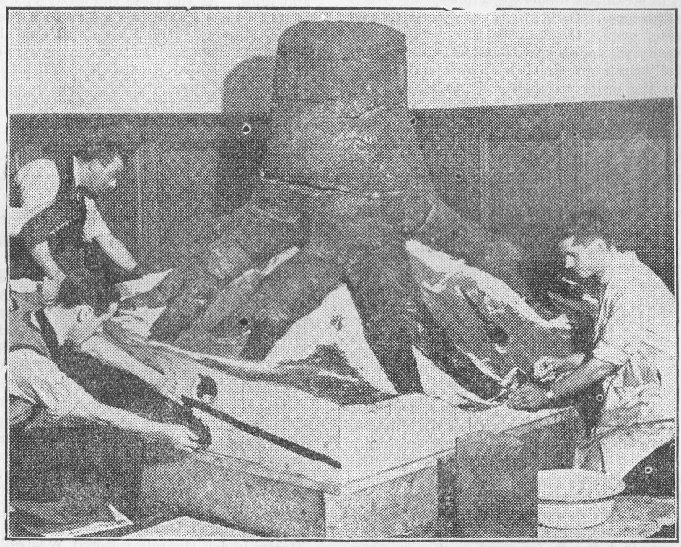
In the photograph herewith members of the staff at Liverpool Museum are shown repairing the fossil tree, weighing over a ton and composed of solid rock, which was found about forty years ago in a Wigan coal mine, rooted into a coal seam where it had lived. The tree has just been moved into another part of the galleries, and the stand beneath the tree is being modified, a section of the coal seam and shale in which it was found being built up. Parts of the roots showing signs of disintegration have been successfully treated and restored. The tree stump and roots, which are extraordinarily complete, were discovered in the roof of the Six Foot coal seam at the Ince Hall Collieries, Wigan, at a depth of 458 yards. They reached the Liverpool Museum in 1897, through the good offices of Sir J. S. Harmood-Banner.
The tree itself is a giant relative of the diminutive present-day Horsetail, a plant that grows commonly on waste ground. In Carboniferous times giant Horsetails were numerous, and they grew all over England, then covered by tropical swamps.
Mr. David E. Owen, Keeper of the Department of Geology at the Museum, told the "Wigan Observer" that these trees and their smaller contemporaries lived in great profusion, and it was to them that we owed the great mineral wealth of Britain. "As they died their remains settled to form peat which has since become transformed to coal," Mr. Owen pointed out. "In a few cases the trees became waterlogged and their decaying centres filled with sand. It is to such an occurrence that we owe our fossil tree."
 |
 |
| Names mentioned in this article | |
 |
 |
| Name | Age | Occupation | Notes |
|---|---|---|---|
| Harmood-Banner, J. S., Sir | |||
| Owen, David E. |




 Contains public sector information licensed under the

