


| Newspaper Articles |

|
Newspaper Articles |
 |
 |
23rd September 1938, Page: 542, Column: 1
Mines Inspection In 1937
The Northern Division
The following is extracted from the report of Mr. W. J. Charlton, under the Coal Mines Act, 1911.
The increasing demand for coal, coke, and ironstone, due to the general improvement of trade throughout the country, resulted in greater activity at the collieries. New seams were opened, and collieries which had been closed during the slump years were re-opened. In some cases difficulty was experienced in recruiting the number of men and boys required.
The number of mines at work during the year was 390 and, with the exception of one small mine, every mine was inspected at least once. Frequent inspections were made at the larger collieries. The inspectors appointed under the Coal Mines Act (apart from the inspectors of horses) made 2,446 underground and 881 surface inspections. The number of fatal and non-fatal accidents reported was 814, the number of dangerous occurrences was 21, and 47 complaints were received. Thirteen of the latter related to overtime. A number of non-fatal accidents which, because of their consequences or because of their mode of occurrence, should have been reported forthwith, were not reported until a scrutiny of the returns made at the end of the year of all accidents on which compensation had been paid revealed the omission, and a report was asked for. For the most part the omissions related to simple fractures discovered by X-ray examination some considerable time after the accident. Nevertheless, so soon as the information was available a report should have been sent to Mr. Charlton and managers are asked to note this.
The proportion of persons under 16 years of age to the total number of persons is high in the Northern division, 9.5 per cent. of surface workers against 6.9 per cent. for Great Britain, and 2.7 per cent. of underground workers against 2.5 per cent. for Great Britain. It is desirable that new boy entrants into the industry should commence work on the surface, and after a period of experience there, pass on to underground work.
Persons Employed. — The average number of persons employed was 171,936 compared with 162,397 in 1936. Of these 134,493 were employed below ground against 126,717.
Output of Minerals. — The total output of minerals amounted to 51,606,888 tons, valued at £35,804,271 (49,302,459 tons, valued at £30,980,270 in 1936). The total comprised 49,076,876 tons of coal, 373,089 tons of fireclay, 2,036,671 tons of ironstone, 112,573 tons of clay, 1,800 tons of sandstone and 5,879 tons of witherite. The coal produced in the various counties was as follows :— Cumberland, 1,343,093 tons; Durham, 33,485,652 tons; Northumberland 14,248,120 tons and Yorks, N.R., 11 tons.
The output of coal per shift per person employed below and above ground at coal mines was 21.96 cwt.
The output of machine-cut coal was 27,158,797 tons, an increase of 1,332,065 tons on the year 1936. Of the total output of coal in the division, 55.3 per cent. was machine-cut, as compared with 55.0 per cent. in 1936.
Coal cutting machines were in use at 168 mines (158 in 1936) to the number of 2,054 (1,996), of these 1,478 were electrically driven (1,392) and 576 operated by compressed air (604).
Mechanisation has taken place to a much greater degree in Northumberland than Durham, the percentage of the output of coal cut by machines having been 90.9 per cent. in the former county, and 39.8 per cent. in the latter during 1937.
Pneumatic picks are being used to a greater extent year by year. In 1937 the number in use was :— 3,890 for coal getting; 496 for ripping, etc. The number of drills in use for boring shotholes was 2,191.
Conveyors were in use at 115 mines (107), there being 747 along the coal face (687), 351 elsewhere (312) and 84 loaders (76). The tonnage of coal conveyed direct into tubs was 12,519,697 tons (11,511,914 tons) and 2,123,237 tons with loaders (1,835,498 tons).
Of the total output of coal in the division 29.8 per cent. was conveyed as compared with 28.4 per cent. in 1936. In Northumberland the proportion of coal conveyed in 1937 was 48.8 per cent. and in Durham 21.8 per cent.
Accidents. — The following is a summary of fatal and reportable non-fatal accidents, classified according to place and cause :—
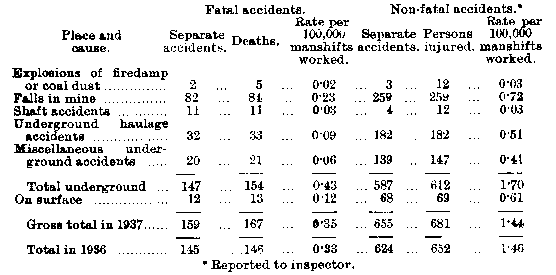
It would appear that 59 per cent. of the accidents underground and 78 per cent. of accidents on the surface might have been avoided by more care on the part of the injured person or of somebody else.
At Murton Colliery, Durham, at 2.35 a.m. on December 21, an explosion of firedamp caused the deaths of four persons (a deputy, McKillup, two hewers, Spry and Simmonds, and a shifter, Monarch), in the first south-west district of the Five Quarter seam, where pillars were being extracted at a distance of 1¾ miles from the shaft. The seam is 7 ft. thick and no shots were fired in it, the coal being got by means of compressed air driven scalloping machines. Fig. 1 shows the lay-out of the district and the place in which the men were at the time of the accident. After the area of the Main Coal seam, shown on the plan, had been worked out, a trial or proving drift had been driven up from the Five Quarter seam at an inclination of 1 in 3 through faulty ground and in line with the Old Back Drift. While this drift was being driven, it was ventilated by air pipes through the brickwork stopping in the Old Back Drift. This trial drift had been abandoned some time before the explosion, and was no longer ventilated. It can safely be assumed that soon after it was abandoned it would fill up with firedamp, and it is likely that, with a falling barometer, firedamp would issue from it. The explosion occurred in a lift (shown on plan) turned off from the "Far Right" place and skirting the Old Back Drift which was the return airway for the district. The lift was in line with the old stopping at the time of the explosion. Prior to December 9, the lift was adequately ventilated by air which came round to the Old Back Drift via the road designated "Air Crossing Stenton." On this date the lift became fouled with firedamp and remained so for two days, after which it was cleared by bratticing from the inbye end of the "Far Right" road, the brattice drop sheet previously maintained in this road being removed to give the air free access. In all probability, the firedamp on this occasion came from the abandoned trial drift.
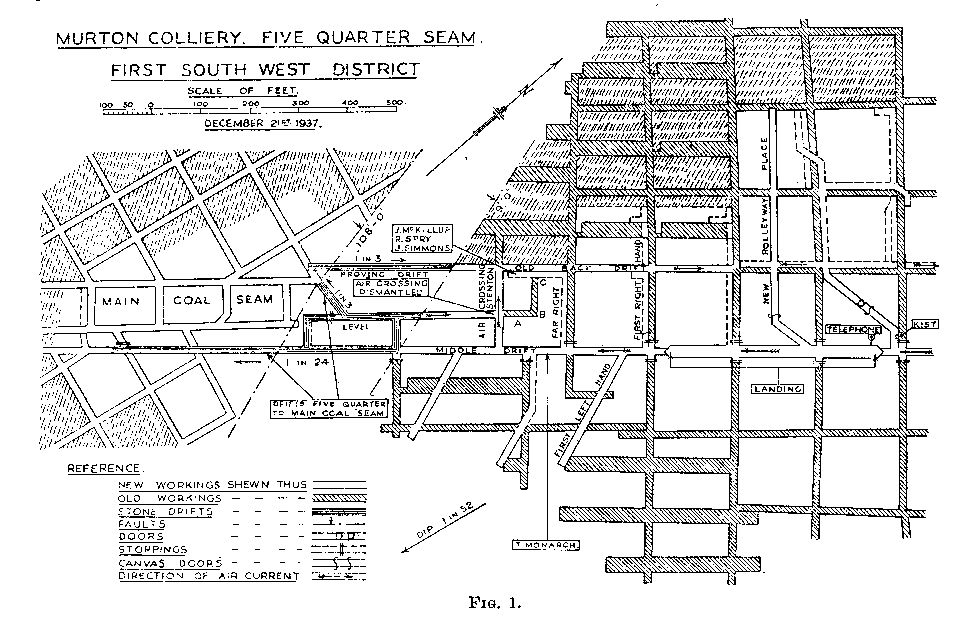
After December 11, and until the day of the explosion (December 21), there was no report of firedamp anywhere in the district. At the time of the explosion, the deputy for the district was at the face of the lift with two hewers and, so far as is known, he was pursuing his normal duties there. The effects of the explosion were confined to a comparatively small area. Some indications of force were felt in the intake shown on the plan as "Middle Drift," and much dust, rendering visibility bad for a time, was raised there. Afterdamp in considerable quantity was also forced out into the inbye end of this roadway and caused the death of the shifter, Monarch, who after recovery from the initial shock of the explosion, appears inadvertently to have gone inbye into the harmful atmosphere. Immediately following the occurrence there was much confusion; this can perhaps be accounted for in part, at least, to the absence of anyone with authority, the deputy, of course, being lost. A putter telephoned to the pit bottom, and from there a message was relayed to the manager, but it was indefinite and to the effect that there had been a fall and that the night overman (Watkin) and others had gone inbye to the district. On arrival in the district, Watkin found all the men assembled at the deputy's kist, except the four deceased and two hewers, Parker and Cook. Proceeding into the "New Rolley-way Place," Watkin found the two hewers at work completely ignorant of any untoward occurrence. Having brought these men out to the main road, he then proceeded with others to look for the four still missing. At the entrance to the "Far Right" place, a test showed that no firedamp was present. To clear the air of the dust and afterdamp, however, the compressed air was turned on, but a few minutes later a further test showed the presence of 4 per cent. of firedamp. Visibility was still poor, but proceeding cautiously along the roadway the lift was reached by the search party. At about 12 yd. up the lift they found an overturned tub, and beyond it could discern a man's body. It was not till this moment that Watkin fully realised there had been an explosion. He at once sent someone so to inform the manager. Soon afterwards he and others with him began to feel the effects of the afterdamp, so they withdrew. Upon the receipt of this further message, at about 4 a.m. the manager took steps to warn the local lodge secretary, the central rescue station and the senior inspector of mines, Mr. W. B. Brown. A rescue brigade further explored the far right lift and removed the bodies of McKillup, Spry and Simmons. Returning to the Middle Drift and proceeding inbye, the rescue brigade found the body of Monarch about 12 yd. beyond the Far Right Hand roadway. Apparently, being dazed after the first shock of the explosion, Monarch wandered inbye instead of outbye and was overcome by afterdamp. After the ventilation had been restored and a careful examination could be made of the Far Right lift, an electric safety lamp was found near the body of Simmons, both the outer glass and bulb of which were broken; and near the lamp there lay a piece of brick which Mr. Brown found could be inserted between the pillars of the damaged lamp so as to reach and break the bulb, without, however, reaching the filament. The other lamps were intact; one of them, a high candle-power flame safety lamp, normally carried by the deputy, was at the face close to Spry's body, and the other, an electric lamp, was found, still alight, near to McKillup's body. It was evident that for the time being McKillup and Spry had exchanged lamps, but for what purpose is unknown. These lamps were examined and tested with others at the Testing Station at Sheffield and found to be safe. In the absence of any other probable cause, it would appear that the gas was ignited by the exposed filament of the damaged electric lamp, either when a "bowk," or weighting of the roof, in the Black Drift caused part of the brick wall to be discharged and fall against it, or, possibly, by an accidental blow from Simmons' pick.
The other explosion of firedamp with fatal consequences occurred at Hamsterley Colliery, Durham,, on October 19, 1937, at 11.15 a.m. Two men operating an electrically-driven coalcutting machine on a longwall face in the Victoria seam were badly burned, one of them dying from his injuries six days later. An extinguished flame safety lamp was found, in an upright position on the floor, just in front of the machine, and another flame safety lamp was found on the floor of the gate road, close up to the bottom canch. The lead locking rivet of this latter lamp had been removed and the oil vessel was adrift from the bonnet. After the coils of trailing cable had been removed a spent match was found on the floor. Apparently an accumulation of firedamp had been ignited when an extinguished safety lamp had been opened and a match had been struck to light it. This lamp was issued to the man who died from his injuries. There is a thin seam of coal, a few inches thick, about 5 ft. below the Victoria seam, so that the floor of any gateway is only about 1 ft. 6 in. above it. It was known that gas did at times come up through cracks in the floor, and there seems little doubt that after the deputy had inspected and failed to find firedamp, the floor broke and gas escaped into the ventilating current. Whether this gas extinguished the lamp of the man on the return side of the point of issue, or whether he accidently knocked his lamp over, will never be known. Apparently he got down into the gateway, to get out of the current of air passing along the face, removed the lamp bottom, and then struck a match close to the point of issue of the gas. The manager had prosecuted two men for being found in the possession of cigarettes and matches just a year before the explosion, and only a few weeks after the explosion took place, a man was prosecuted for having a match in his possession when searched.
At Backworth "Eccles" and "Maude" Colliery, Northumberland, a brusher was using an electrically-driven drill to bore a shothole at a face ripping when firedamp was ignited and he sustained very slight burns about the chest, face and neck. He had earlier in the shift bored four shotholes in the stone and the deputy had charged and fired each of them. On the drill being examined, it was found that the earthing screw was missing and the tapped hole for this screw was stripped. The absence of the screw left a hole, ½ in. diameter, between the terminal chamber and the outside atmosphere and was a possible cause of ignition. For other reasons besides the possibility of igniting firedamp the machine ought not to have been used with the earthing screw missing.
Inspectors collected 1,139 samples of air during the year.
Inspectors collected 1,186 samples of dust from the roadways of coal mines, and 28 samples of dust in connection with shotfiring operations.
The dust made when coalcutting machines are at work, and also where pneumatic picks are being used, is very unpleasant. Some experiments were made during the year at Ashington Colliery with a device designed to lessen the formation of dust by the operation of a longwall coalcutting machine. Normally, a large proportion of the kirvings is carried back by the chain into the cut and is ground to fine dust. The device in question conveys the kirvings away from the entrance to the cut, as they are discharged by the picks. Such efforts to attack the dust problem at the source are most commendable. Apparatus to collect dust at conveyor loading points is marketed by various firms, and managers should make use of such appliances.
The number of accidents from falls of ground in 1937 was 341 against 326 in 1936. In 1937 there were 84 deaths against 83 in 1936. Seven of the fatal accidents, each causing one death, occurred in ironstone mines in Cleveland, 66 of the deaths occurred at the working face, eight on roads while repairing or enlarging and eight on roads while otherwise working or passing. 37 per cent. of the investigated accidents were considered to be preventable, having regard to the conditions prevailing. The avenue by which the number of accidents can be reduced lies, in Mr. Charlton's opinion, in the better training of deputies and other officials, in frequent inspections by them, strict discipline, and the use of suitable tools and protective equipment.
Seventy six per cent. of the accidents from falls of ground occurred at the working face. Fifteen of the fatal accidents occurred at roadheads, a circumstance calling for the serious attention of managers and other officials. A coalcutter machineman follows a dangerous occupation for he has often to withdraw props to allow the machine to pass. The use of steel straps instead of wooden ones would reduce the risk of falls of roof, but unfortunately the introduction of steel supports at the working face is often looked on with disfavour by the workmen. In a Durham colliery a machineman removed props from under the face ends of wooden bars which were against the coal in front of the machine and to each of which three props were set. A large stone broke down three bars at the middle props and the machineman was killed. The manager's subsequent attempt to introduce steel bars was stoutly resisted by the branch of the Durham Miners' Association. In two other cases machinemen were killed under similar circumstances except that they were killed behind the machines. Machinemen must make careful examination of coal or overlying ramble and get down any which seems insecure. The practice of ragging coal off the face instead of breaking into the back of the cut and taking a jud is a bad one. On such a face, a filler set a middle prop to a steel bar but no end prop. When a weight came on, the prop was discharged, and he was killed.
An accident causing the death of two deputies resulted from a fall at a junction caused by the discharge of a crossing girder carrying 10 light girders. A set of four full tubs was being drawn out of a mothergate at right angles to an endless haulage road, by means of a clip on the endless rope, when one of the tubs became derailed. There was some contradictory evidence at the inquest as to whether or not the tub struck the two props under one end of the crossing-girder. It is certain that in some way they were displaced, and it is also certain that a much more substantial form of support for a crossing-girder in such a situation ought to have been provided. This is a matter to which Mr. Charlton appeals to colliery managers to give attention. Crossing-girders, or baulks, in settled ground are usually supported by brick walls. It is very necessary that a crossing-baulk carrying a number of transverse members in any situation, should rest on some support which cannot readily be discharged if struck by tubs, or through ordinary weighting of the roof.
Underground haulage accidents comprised 25.4 per cent. of all reportable casualties and 19.7 per cent. of the deaths. The number of deaths was one fewer than last year, but the non-fatal accidents were 22 more. No less than 84 per cent. of the fatal and 80 per cent. of the non-fatal accidents were, in the opinion of the inspectors who investigated them, preventable, a state of affairs which is deplorable. Nine persons were killed, against five in 1936, and 48 persons were injured against 60 in 1936 in connection with horse haulage. This class of accident is one to which boys are especially liable and of the nine persons killed six were aged 16 or under.
Accidents by explosives comprised 8.6 per cent. of all reportable casualties, and 2.4 per cent. of the deaths. Few accidents from, the use of explosives would occur if the provisions of the Explosives in Coal Mines Order of January 1, 1934, were strictly carried out.
At Deaf Hill Colliery an overman, G. Bedford, and a pumpman, S. D. Myers, were suffocated in a return airway in the Hutton seam, 120 yd. from the upcast shaft when making an exploration to discover the seat of a fire. At 8.45 p.m. Myers had telephoned to the surface fan-attendant to say that when descending in the cage in the upcast shaft from the Hutton seam inset to the Harvey seam a short time previously he had observed smoke at the Hutton seam, and to ask him to inform Bedford who lived close to the pit. On arrival at the pit at about 9.25 p.m. Bedford descended at once to the Harvey seam, and shortly afterwards the cage was signalled up to the Hutton inset and then rapped "clear." That was the last that was heard of Bedford and Myers. At 10 p.m. a deputy, J. H. Walker, coming on duty with several other men, descended the upcast to the Harvey seam, but returned almost at once, having encountered smoke in the air in the shaft down to the Hutton seam inset. Being then informed of Bedford's descent, he sent a messenger to fetch the foreoverman, S. Jackson, who reached the pit at 10.45 p.m. The latter at once sent Walker and another deputy, W. Langlands, to explore by way of the intake in the Harvey seam. At a point in the Harvey seam, 250 yd. from the downcast shaft and at the bottom of a drift leading up to the Hutton seam, they found a raging fire. Walker took steps to deal with the fire, whilst Langlands reported by telephone to the surface and asked for the fire brigade to be summoned. A length of hose was run out from a pump at the pit bottom, but being too short it was ineffective. Matters were becoming desperate when the under-manager, J. Leavy, in the absence of the manager on holiday, was summoned and reached the pit at about 11.30 p.m. As the only Post Office telephone on the premises was in the colliery office, and this was locked, the rescue station was not warned until 11.45 p.m. The rescue brigade being further delayed in fog, did not arrive at the pit until 12.15 a.m. on Sunday. At 12.50 a.m. the brigade found the bodies of Bedford and Myers in the Hutton seam return at 120 yd. from the upcast shaft. They had evidently been overcome in attempting to locate the fire from the return side. Although there were definite indications of the presence of the gaseous products of fire in the upcast shaft, it continued to be used for ascent and descent until after midnight. The fire was finally subdued and extinguished by means of copious supplies of water at 5 a.m. Investigation later revealed that the fire had originated in the heated bearing of a return wheel which was used in connection with an endless rope haulage at the bottom of the Hutton seam drift. The frame of the return wheel was made of wood and this was ignited by burning coal dust. Heating had been observed at this bearing during work in the early hours of the Saturday morning. Water was applied and the wheel pit kept under observation until the haulage ceased at 10 a.m. Bedford, the deceased overman, was informed and he arranged for the wheel hole to be cleaned out on the Sunday night. Apparently the wheel hole had been neglected, for it was said the cleaning operation would have taken two hours. This affair reflects little credit on any of those responsible for dealing with it. To start with, it was foolhardy to attempt to approach the fire from the return side. The foreoverman ought to have summoned the rescue brigade as soon as he knew there was a fire in the workings and even after the under-manager arrived there was delay in doing so. The under-manager and foreoverman showed lack of foresight in allowing the upcast shaft to be used when the air in it was known to be fouled by the fire. It is fortunate that this did not result in further disaster. Further, and finally, the arrangements for telephonic communication between the colliery and the higher officials and the rescue station during the night were anything but satisfactory.
 |
 |
| Names mentioned in this article | |
 |
 |
| Name | Age | Occupation | Notes |
|---|---|---|---|
| Bedford, George | 53 | Overman | Deceased, Individual Page |
| Brown, William Bertram | H.M. Senior Inspector of Mines | Whos Who Page | |
| Charlton, William John | H.M. Divisional Inspector of Mines | Whos Who Page | |
| Cook, — | Hewer | ||
| Jackson, S. | Foreoverman | ||
| Langlands, W. | Deputy | ||
| Leavy, John | Under Manager | Whos Who Page | |
| McKillup, John | 35 | Deputy | Deceased, Individual Page |
| Monarch, Thomas | 34 | Shifter | Deceased, Individual Page |
| Myers, Samuel David | 40 | Pumpman | Deceased, Individual Page |
| Parker, — | Hewer | ||
| Simmons, John | 36 | Hewer | Deceased, Individual Page |
| Spry, Richard | 51 | Hewer | Deceased, Individual Page |
| Walker, J. H. | Deputy | ||
| Watkin, — | Night Overman |
 |
 |
| Related Articles | |
|
|
| Pub. Date | Article (Newspaper) |
|---|---|
| 23 Sep 1938 | Mines Inspection In 1937, The Northern Division (The Colliery Guardian) |
| 30 Sep 1938 | Mines Inspection In 1937, The Northern Division (The Colliery Guardian) |



 Contains public sector information licensed under the

