


| Newspaper Articles |

|
Newspaper Articles |
 |
 |
16th July 1938, Page: 6, Column: 1
Colliery Surveyors Visit Lead Mines
On Saturday, 2nd July, the members of the Lancashire, Cheshire, and North Wales Branch of the Institute of Mine Surveyors visited the lead mines of the Halkyn District United Mines, Ltd., and were welcomed by Mr. J. B. Richardson, general manager of the mines, on behalf of the Company, and his staff. After changing and being provided with hand acetylene lamps of high illuminating power the members descended the Olwyn Goch shaft to the drainage tunnel level in which the "Lead Mines Special" was drawn up in readiness to convey them to a lode about two miles from the shaft.
The journey inbye, if not a new experience of underground transport, was quite thrilling, because a ditch cut on one side of the tunnel was conveying a very great volume of water from the mine to the River Dee, where the entrance to the tunnel was not more than 6 feet above high-water mark. The tunnel, which is at present about 7 miles long, is 10 feet by 8 feet, and has been driven on a rising grade of 1 in 1,000 from inlet to the face, so that at the face of the tunnel the floor level is about 45 feet above high-water mark.
The Ore Body.
The ore being mined consists of galena and blende in a gangue of calcite, hence the finished products of the mine are lead and zinc ores of exceptionally high grade. The valuable minerals occur in fault-fissures which are steeply inclined and run north and-south, and east-and-west, in the Carboniferous Limestone measures extending from the Dee Estuary to the Great Bala Fault. A distinguishing feature which much impressed the colliery surveyors present was the obviously meagre and fluctuating thickness of the lode as compared with the much greater and more constant thickness of the coal seams with which they were more familiar. Sometimes the lode widens out to many feet and contains large pockets of high-grade which can be filled out by hand free from gangue. In such a fortunate circumstance the ore requires little treatment of any kind except that necessary to enable it to be sorted out into lumps of such a size as is found to be in demand and for which a specially favourable price is obtainable, As a rule, however, the width of the lode is but a few inches, and should it be loss than two inches it is necessary that the market value of lead should be above the average to enable the ore to be extracted at a profit. At the present time the price is unfavourable to the exploitation of very narrow veins.
Caverns Deep.
Although those who have no experience of mining have long been familiar with the occurrence of huge caves in the limestone rocks of various parts of the country, the thought comes as an astounding one to experienced miners that they should be standing at a depth of six, or seven, hundred yards below the surface, on the edge of an unfathomable cavity. There in the very heart of the Halkyn mine is an underground Lake which has never been bottomed, and into which for years now the debris of the mine has been deposited. Mr. Richardson called attention to the sides of the cavern in explaining that there was little doubt about the likelihood of the cavity having been formed by the solvent powers of underground streams flowing towards the Dee. Traversing one of these caverns the visitors saw the tramway laid on the floor from which the silt of some ancient stream had been removed to admit of the haulage of the ore from the stopes farther along the strike of the vein.
Mode of Working.
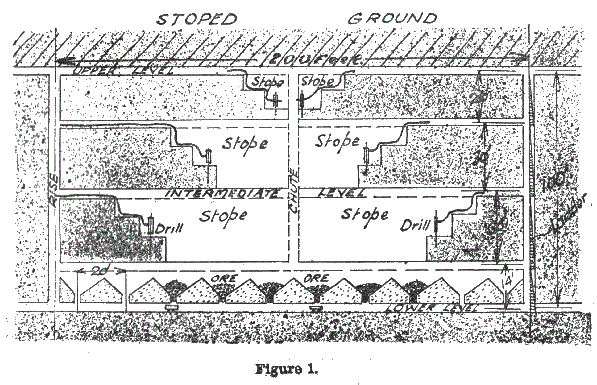
As the main drainage tunnel bears southwards and the main lodes strike east-and-west the latter are cut almost at right angles by the former. To form convenient passages for the transport of the ore from the stopes to the main shaft Levels are driven at vertical intervals of 100 feet along the strike of the lode, and these are connected by winzes and rises at intervals of 200 feet. These rises and Winzes must be driven in the lode, and be made large enough to accommodate a ladderway and a means of bringing supports, machinery, air pipes, and drills, into the stopes. When the lower level has been driven passes for the ore from the stopes above are driven upwards about 4' x 4' for a few feet, and then they are opened out wider (along the vein) as they are raised upwards to reach the floor of another level that has been driven 14 feet above the first. This procedure provides a number of points at 20-feet intervals at which tubs may he filled with the ore descending from the stopes above. Intermediate levels are also driven at intervals of 30 feet, thus dividing the ground between two main levels into four strips of 14, 30, 30, and 26 feet. FIGURE 1 shows the general arrangement of the stopes, and it is seen that a central rise is driven in the vein to form a chute for the ore removed in the stopes, in which the working of the ore commences at the central rise and recedes towards the end rises, the stopes at the lower levels leading the extraction of the ore at the higher levels. The ore is extracted from the vein by a series of steps of about 6 to 8 feet in depth. Work is commenced in the lowest section first, and when the stope face has receded sufficiently from the central chute to ensure the safety of the miners from ore falling the stope above the next higher stope is commenced. Holes are drilled in the ore by pneumatic drills, and when blasting takes place the ore falls down into the pockets above the lower level on which tubs are filled. In ordinary circumstances no supports are placed between the hanging wall and the foot wall (the roof and the floor), but should the ground require support then supports are provided, and should a patch of very low-grade ground be struck, the poor ore may be left in situ. It is thus seen that the stopes are not packed as the workings in collieries are packed, except when the lode is wide and no packing material is available. Square-set timbering is adopted in that case. The only danger attending the working of the stopes arises from small pieces of rock falling on the heads of miners, and in order to prevent injury from that cause safety helmets are worn.
Underground Transport.
The ore broken out in the stopes falls into the chutes in the roof of the main level, and the cars which are filled there, or in any of the branches from it, are taken by hand to the main siding. There they are made up in sets which are taken to the main tunnel by electric locomotives. Traction on the main drainage tunnel is by means of Diesel locomotives, and these haul the cars out to the shaft in sets of 50.
Drainage. — The mine is drained by the great tunnel driven from the side of the Dee, near Bagillt, and passing down through the field in a southerly direction and intersecting the veins of lead on the way. Workings below the level of the tunnel are drained by means of pumps which discharge water into the Bagillt tunnel to flow down a gradient of 1 in 1,000 to the estuary of the Dee. Pumps are electrically driven and they discharge into the main drainage tunnel about 20,000,000 gallons of water per day. Coal miners are unfamiliar with the need for pumping such an enormous amount of water, even in the wettest of mines.
Hoisting. — The ore is taken from the stopes along the levels to the vertical shaft by which it is raised to the surface. At present the ore-winding shaft at Penybray is situated near the village of Halkyn. Penybray shaft is sunk to a depth of fully 800 feet from the surface level of about 600 feet above sea level, and the ore is wound in tubs on cages by means of an A.C. electric winder. All the ore being milled is raised at this shaft and the output is about 400 tons per shift. The mine is also reached by the Olwyn Goch shaft from which much of the mine debris is raised to be dumped on the surface.
Recovery of the Lead Ore.
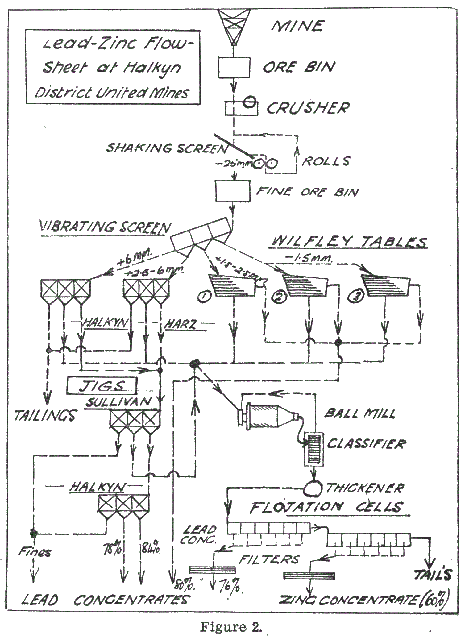
The ore as it comes from the mine consists of a mixture of galena (lead sulphide), zinc blende (lead sulphide), and gangue (dirt and limestone). As the valuable portion of the ore consists of galena and zinc blonde, for each of which there is a good foreign market, the galena and blende must be cleaned and separated from each other. The process by which this is accomplished is distinctly interesting and complicated. As will be seen on referring to FIGURE 2, the ore from the mine is dumped into a bin from which it passes to a Blake crusher in which it is reduced to pass through a 25 mm. screen. The fraction which passes over the screen is passed through a rolls crusher and returned to the screen until it does pass through. All -25 mm. ore passes to the fine ore bin, and from there it passes to a vibrating screen in which it is sorted into four grades, viz. +6 mm., -6+2.5 mm., -2.5+1.5 mm., and -1.5 mm. The coarser qualities pass to a Halkyn jig and a Harz jig, in each of which galena and zinc are concentrated and worthless stuff rejected as tailings. The finer portion of the ground ore passes to shaking tables which also produce concentrates, tailings, and an intermediate product, similar to that also coming from the jigs, consisting of a small proportion of valuable material with a large proportion of worthless stuff. The concentrates from the jigs are further concentrated in other jigs, and those from the tables are at once sufficiently concentrated for the market they contain 80 per cent. of galena. The middlings from the Halkyn and Harz jigs and from the Wilfrey tables pass to a rotating ball mill in which they are ground to pass through a screen with 40 meshes to the inch, and from there the ground material passes to a Dorr classifier which separates the slime (fine material) from the sand (coarse material).
The coarse ore is returned to the ball mill and the fine stuff passes to a settling tank, or thickener, as it is called. The clear water passes off from the top of the thickening tank, and the mineral sludge containing lead and zinc is pumped to the flotation cells in which the galena is separated from the zinc, and both of the metalliferous ores from the accompanying dirt. The cells into which the pulp is first pumped are treated with frothing agents capable of raising the galena and depressing the zinc, and the lead ore is skimmed off from the top of the cells whilst the remainder of the mineral and water passes on to the next set of cells. The water in the next set of cells is treated now in such a way as to activate the zinc blende and bring it up into the froth which is skimmed off and filtered, just as the lead froth is filtered for the recovery of the valuable constituents. As will be seen in FIGURE 2, five grades of lead ore, and one grade of zinc ore, are obtained, and it may be said without reserve that nowhere in the world is a better concentrate of lead ore obtained than that obtained at Halkyn.
Romans Smelted Lead.
In the course of the visit Mr. Richardson gave an interesting and informative resume of the lead-mining industry, in the course of which he pointed out that evidence is available to show that the Romans smelted lead during their occupation of the country, and it seemed to him likely that lead mining had taken place in even earlier times. Since those early days the hills of Flint and Denbigh have been traversed in search of veins of lead. It is now well known that these hills abound in lead, zinc, and silver, although at the present time silver is not recovered from the lead with which it is generally associated. The lead-mining industry in North Wales was begun centuries ago, and having flourished it fell upon less prosperous times. Once again it gives promise of more prosperous times for the miners of North Wales, because the Halkyn District United Mines, Limited, with commendable energy, enterprise, and special knowledge of the problems involved, are making considerable progress with the development and exploitation of the lead veins in their property. Though the veins of lead and zinc have long been known to traverse the hills, in former years their exploitation had been limited in depth by the flooding of the mines below the natural drainage level of the district, but with the construction of the tunnel from just above high-water mark at Bagillt to run in a southerly direction to intersect the lead veins the problem of mine drainage has been simplified. The driving of the tunnel has made the exploitation of the lead veins not only possible but profitable.
The visit was voted an unqualified success and the thanks of the visitors were extended to Mr. Richardson and his staff for pleasant and profitable experience.
 |
 |
| Names mentioned in this article | |
 |
 |
| Name | Age | Occupation | Notes |
|---|---|---|---|
| Richardson, J. B. | General Manager |




 Contains public sector information licensed under the

