


| Newspaper Articles |

|
Newspaper Articles |
 |
 |
2nd July 1938, Page: 409, Column: 1
Pneumatic Picks In Coal Mining
By H. E. Morgan.
From paper on "The Use of Pneumatic Picks as an Aid to Coal-getting," presented for discussion at the meeting on 18th June of the North of England Institute of Mining and Mechanical Engineers.
Each mine and seam has conditions peculiar to itself, and the question of machine-mining should be considered with full regard to the prevailing conditions and circumstances of each case.
The seam under consideration has an average thickness of 3½ feet and lies at a depth of 1,600 feet from the surface. The roof consists of up to 7 inches of mudstone (blue metal containing carbonaceous matter), with a strong sandstone above, and the floor of from 10 to 15 inches of poor quality fireclay with coal partings, underlain by strong "white" seggar. Cleavage-planes are well defined and close together. The top section (2½ feet) of the seam is of medium hardness and the bottom section (1 foot), of a slightly harder nature. The normal gradient of the seam is 1½ to 2 inches per yard, but in the area in which the change-over was made the coal is badly cut-up by faults, the seam being displaced by as much as 45 feet in some instances. Floor movement was extensive and occurred close up to the face.
The proportion of coal obtained by the various methods of working was — Longwall gateways, 40 per cent.; Bord and pillar (whole workings), 20 per cent.; Bord and pillar (broken workings), 40 per cent.
Pony-putting and main-and-tail haulage were the methods of transport used, and the pressure of the compressed air available was from 50 to 60 lb. per square inch at the coal face.
Previously, during lengthy periods, the coal had been worked by percussive heading coal-cutting machines, stubbing (or scalloping) machines of a somewhat similar type, and by hand-hewing. The stubbing machines were eventually replaced by pneumatic picks. The change-over picks did not reduce the number of workmen required but each coal-getter obtained a greater output per shift, and therefore higher wages, with less arduous labour, while the increased output from the same number of coal-getters resulted in a reduced labour cost at the face and elsewhere. Coal-getters normally worked in sets of two men per shift, whether using cutting machines, stubbing machines or pneumatic picks, one operating the machine and the other filling the coal into tubs, or, when not so occupied, getting coal by means of an ordinary hand-pick.
Comparing the aggregate results for the seam, for approximately 18,000 man-shifts worked at the face in each case, the output obtained with pneumatic picks was 32 per cent. higher than that obtained with stubbing machines. The cost of labour underground decreased by 13.7 per cent.
Since the change-over to pneumatic picks it has been necessary to revert to hand-hewing for short periods on several occasions, and the consequent reduction in output has amounted to 60 per cent.
Comparative Advantages.
Other advantages incidental to the use of pneumatic picks are summarised below
1. The initial cost of a pneumatic pick is only about one-sixth of that of a stubbing machine, and the cost of repairs and renewal of machine parts is correspondingly lower.
2. The consumption of compressed air for a pneumatic pick is only about a quarter of that for a stubbing or cutting machine.
3. One man can handle a pneumatic pick, but two men are necessary to move or set a stubbing or cutting machine (in order to avoid excessive loss of time).
4. The coal-getter is able to commence coal-getting immediately after completing examination of the working place when using a pneumatic pick, whereas, when cutting or stubbing machines are used a considerable amount of time is lost in setting the machine or moving it about the face (especially in longwall gateways), and in arranging face supports.
5. When using pneumatic picks, if one man is idle the output of the other man is usually equal to more than half of that of the two men, but when stubbing machines are used the output of one man is usually less than half of that of two men working together.
6. Flitting from place to place with a pneumatic pick is accomplished in a much shorter time, and with less inconvenience or danger, than with a stubbing machine or with a cutting machine.
7. No special difficulty arises from the use of pneumatic picks when encountering broken roof, or changes in thickness of a seam, but much difficulty may arise when stubbing or cutting machines are used in setting the machine firmly and in adjusting it to suit any change in the thickness of the seam.
8. Maintenance cost is lower when using pneumatic picks. During the first six months, with reasonable care, maintenance cost is practically nil for any type of machine. After this period the cost has amounted to 0.25d. per ton of coal produced when pneumatic picks were used, and 1.25d. per ton produced when stubbing or cutting machines were used. These figures include the cost of material and labour involved in repair work and in periodic examinations of machines.
The use of pneumatic picks has a further advantage in the convenience with which defective machines can be replaced in the pit. A few spare machines are kept in the pit and are used to replace any which may become defective or which may be due for routine examination; these are sent to the surface fitting shops for overhaul and repair. On the other hand, When cutting or stubbing machines are used it is necessary to keep a considerable quantity of spare parts in the pit in order that the machines can be repaired underground, because they are very cumbersome to transport.
9. The use of pneumatic picks entails the provision of less pit-room for a given number of coal-getters than is required when cutting machines are used, and they eliminate the loss of time and of output which often occurs when the cutting-machine rods are held fast in the cut owing to lifting of the floor.
10. The increased use of pneumatic picks has resulted in a progressive reduction in the number of shots fired, and the quantity of explosive used, for a given output.
The advantages of using methods of getting other than by pneumatic picks are —
(1) The cutting machine or stubbing machine may be more effective than the pneumatic pick when the cleavage-planes are not well defined or when the coal is of a very hard nature.
(2) Hand-hewing does not create the amount of noise of a pneumatic pick in action, and, from that point of view, may be less dangerous.
Particulars of Machines.
The following particulars are of interest :—
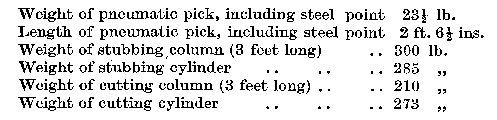
Stubbing machines are similar to the cutting machines of the percussive heading type ("Hardiax" or "Siskol"), but are fitted with a vertical quadrant and worm feeding gear in addition to the horizontal fitting. With a stubbing machine the coal can be cut in the vertical and horizontal planes, and the machine can be used as a punching machine to break, or "stub," down the coal after undercutting and nicking. The use of the stubbing machine dispenses with the need for shot-firing in the coal seam.
Sometimes to the foot of the stubbing column a plate was attached. The presence of this plate added 80 lb. to the weight of the machine.
The useful life of the pneumatic pick has been found to be approximately three years; this period will, of course, vary according to the conditions underground and to its treatment by the workmen.
The coal-getting life of a pneumatic pick tool (steel) used during eleven shifts per fortnight has averaged about six months. After this period of use the tools become too short for efficient use in coal-getting and are used for other purposes.
With regard to maintenance costs, it is of interest to note that at one colliery where 97 pneumatic picks are in use, 23 handles (containing control valves, etc.) have been replaced during a period of four years — a replacement-rate of 23.7 per cent. The surface pressure of compressed air is 70 lb. per square inch. At another colliery, where the surface pressure is 80 lb. per square inch, and 169 pneumatic picks are in use, 180 handles have been replaced during the same period, a replacement-rate of 1065 per cent. The pressure at the face of the compressed-air supply for pneumatic picks has a direct bearing on the efficiency with which they work; if it is too low then a less output will be obtained, and if too high the cost of repair will be excessive.
 |
 |
| Names mentioned in this article | |
 |
 |
| Name | Age | Occupation | Notes |
|---|---|---|---|
| Morgan, Harold Eustace | Whos Who Page |




 Contains public sector information licensed under the

