


| Newspaper Articles |

|
Newspaper Articles |
 |
 |
4th June 1938, Page: 376, Column: 2
General Mining Notes. — I.
These notes are based on the Mines Inspectors' Reports for 1936. The price of each Report is 1s. net. Copies are obtainable through H.M. Stationery Office.
Hand v. Cap-lamps.
In the Scotland report it is noted that, compared with 1935 there were at 30th June, 1936, 925 more flame safety-lamps and 2,447 more electric safety-lamps in use, an indication mostly of the increase in mines of personnel rather than a change over from naked lights. Electric cap-lamps outnumbered electric hand-lamps in the proportion of 11 to 1, proving clearly the preference for a lamp which leaves both hands free and concentrates its light upon the object of vision. In the other Divisions the proportion was 14 to 1 in favour of hand-lamps. In this respect, Mr. E. H. Frazer remarks, "the Scottish miner is more enlightened than his English brother, in more senses than one." 54 per cent. of the electric cap-lamps in the Kingdom are in use in Scotland.
Auxiliary Ventilation.
In the majority of Scottish mines inflammable gas is not a serious source of anxiety, so the meagre quantities of air supplied are adequate to remove it safely. There are few really gassy mines, and, of these, all but three seem to be well ventilated. Mr. Frazer observes that far too much reliance is placed upon auxiliary underground fans for ventilating odd corners and small districts. In the Scotland Division, 6,203 h.p. of motors are used for auxiliary ventilation, compared with 4,104 h.p. in all the seven Divisions of England and Wales. The provisions of Section 31 of the Coal Mines Act forbid the placing below ground of any mechanical fan unless the main fan on the surface is capable of producing such amount of ventilation as, in an emergency, would be sufficient for the safety of the persons underground. The Inspector says the emergency contemplated is, of course, the stoppage of the underground fan, either by breakdown or by cessation of the electric current. In effect, then, the Act requires that the fan on the surface shall be sufficient, without the aid of an auxiliary fan, to prevent a dangerous accumulation of firedamp occurring in any working place or working road.
Fireman's Duties.
Mr. Frazer comments on a tendency to load the fireman with non-statutory duties and so occupy time that would be better spent in looking after the safety of men and mines. He then states that a fireman's statutory duties are laid down in Section 14 (1) of the Coal Mines Act, 1911, and in General Regulations 49 to 62 inclusive. They are restricted to examinations, reporting and checking the number of persons under his charge. He is required to devote his whole time to these duties, except that he may fire shots and measure the work done by persons in his district, so long as these extraneous duties do not interfere with the performance of his statutory work. It is difficult to understand, he adds, how managers can reconcile placing upon firemen such work as starting, oiling and looking after pumps: laying pump pipes: moving fans: coupling up conveyors, etc., with the provisions of the Act; usually they do not attempt to do so but lay the blame upon oversmen and other subordinate officials. In the Inspector's opinion, however, minor officials would not undertake the responsibility unless they knew it would be approved by their superiors or, at least, not definitely disapproved.
A most vexing matter, Mr. Frazer proceeds to say, is the use of naked lights by firemen who are compelled by Section 64 (2) of the Coal Mines Act to use safety-lamps during inspections. The excuse invariably offered when H.M. Inspectors find them with open lights is that they are not making inspections. Neither checking the number of workmen nor measuring work seem to the Inspector to be valid excuses for allowing firemen to carry naked lights seven days a week. Since a fireman has to carry a safety-lamp giving sufficient light to enable him to perform his duties, there is no necessity for anything more. When firemen are allowed to use naked lights there is always the possibility that they may be remiss or forgetful and make a statutory examination for firedamp with an open light. It is no wonder that so many ignitions of gas by officials are recorded year by year, is the comment made by Mr. Frazer, and he adds that when a fireman is given a safety-lamp to make inspections he should be forbidden to have any other light at any time underground. It would impress upon him the importance of his examinations for the presence of firedamp and would probably result in fewer ignitions occurring.
Officials and Workmen's Common Aim.
There were fewer inspections made by representatives of the workmen on their behalf. In 1936 the number was 131 and all the inspections took place in the day shift. Mr. Frazer mentions that the reports were more moderate in tone and less querulous; they usually stated defects in a plain way without comments antagonising to managers. Consequently they commanded more useful attention and led to many improvements. The reports did not stop at pointing out defects from a statutory point of view but sometimes made useful suggestions for safety, such as indicating places where electric light could be supplied with advantage. In this matter mine officials have a common aim with the workmen. Practically all the reports which showed anything to be out of order, except the most trifling matters, were followed up during visits by H.M. Inspectors, until all defects were found to have been rectified. Sometimes a visit was unnecessary because the colliery manager, in forwarding reports by workmen's examiners, sent a covering letter explaining in detail what he had done and was doing to remedy everything stated to be wrong. Rarely during the year did a mine official dispute the accuracy of any statement in the reports-another testimony to their fairness.
Falls in Broken Workings.
In his remarks on support of roof and sides in the Northern Division Mr. T. Greenland Davies refers to the work done by the Committee of the North of England Institute of Mining and Mechanical Engineers. With reference to the investigations of the causes of falls in broken workings, observations showed that shale roofs were generally fractured above the coal pillars. These fractures, known as "holing breakers," were parallel with the old herds and walls and were found to occur at distances from 1 to 19 feet from the sides of the old roadways. Mr. A. Walker is the Senior Investigator, and from the summary of the work done furnished to him by the Investigator, Mr. Davies quotes the following :—
"The size of the pillars has an important bearing upon the development of these fractures ; in a particular seam it was found that fracturing had occurred in the shale roof above the pillars at a distance of ten feet from the old roadways where the pillars were 40 yards square, but that the roof was unfractured above pillars 84 by 62 yards. It may not always be a practical proposition to form pillars of larger size in order to reduce the extent of this fracturing, but improved conditions may be attained by conserving the strength of the pillars during extraction.
"A common method of extraction is to split the pillar into two or in some cases four, by means of narrow roadways driven through the middle of the pillars; the smaller pillars are then removed by lifts.
"It has been noted that in some seams pillars could be satisfactorily worked in this way, while in other seams pillars of equal size could not be so worked. It appears from a consideration of the effects of the abutment pressures that this is due to a difference in the strengths of the coal and the containing strata, relative to the depth, in the two cases.
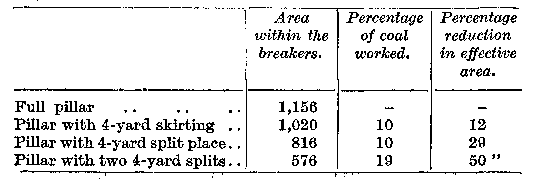
"The effective area of a pillar is the area within the breakers and the support afforded by a pillar is decreased to a greater extent by a place splitting the pillar than by a place skirting it, owing to the fractures over the solid at the sides of these places.
"An example of these differences in the case of a seam where the pillars are 40 yards square with breakers nine feet over the solid is given below :—
Lighting and Accidents.
In his reference to the Coal Mines General Regulations (Lighting), 1934, Mr. J. Macleod Carey, the Cardiff and Forest of Dean Divisional Inspector, considered it too early to estimate with any degree of confidence the effect of the increased illumination but held it to he not unreasonable to cherish the hope that occurrence of accidents to face workers, and especially from falls of ground, will he lessened appreciably. The workmen themselves are fully conscious of the superiority of the new lamps to the old ones. During the months in which these lamps have been gradually introduced there has been lively competition for the privilege of carrying them. In Mr. Carey's Division the system of lighting in the face is universally by portable lamps. Defective distribution of the light is inseparable from this system with its resulting alternation of regions of glare and darkness along the face. It will not be possible, by the very nature of the system, to eliminate this defect except by introducing systems of mains lighting or installations of pneumatic electric lamps. He would welcome such installations of pneumatic electric lamps along conveyor faces where the conditions are suitable. The use of compressed air for power purposes in the face is almost universal, so that its extension to lighting would be a natural step.
The Regulations only require that the new lamps he supplied to those working in and about the face. The Inspector says it is greatly to be desired that their use be extended to repairers. The kind of risk to which these men are exposed would be diminished if they were provided with high candle-power electric lamps.
In and about the coal face itself, the tension ends and driving heads of belt conveyors are proving a fruitful source of a distressing kind of accident. Mr. Carey strongly urges that these points should be specially illuminated by stationary lights, such as pneumatic electric lights.
Conditions Behind Working Faces.
Whilst the ventilation of the working faces in the steam coal pits remains in general satisfactory, the Inspector is concerned, however, with the conditions behind the working faces where open spaces are allowed to form in which accumulations of firedamp are ever-present although impossible to approach because of the dangerous condition of the broken roof in such spaces. The notoriously fiery nature of the seams in the steam coal area of the South Wales coalfield precludes their safe working if open spaces are permitted anywhere. When support of the roof at the face depends upon the partial stowing of the waste behind, that is, by packs and wastes, such open spaces are an inevitable result. The existence of such conditions is a constant and ever-present anxiety to Mr. Carey. Such open spaces cannot be ventilated, and as the face of work advances, these spaces partially closed are reservoirs out of which the firedamp exudes whenever there is a drop in the barometer. For example :—
In a steam coal colliery in Monmouthshire where strip-packing was adopted, the return air of the district was fouled several yards backbye of the working face by firedamp. Close to the roadside packs chemical analysis of the air showed that there was seven-and-a-half per cent. of firedamp, whilst in the main body of the return air there was proved again by analysis to be three-and-a-half per cent. of firedamp present. The air-current at the working face was absolutely free of firedamp. That such conditions are capable of being produced below ground is a very strong condemnation of such methods of working. Should a heavy fall occur in any of the wastes, forcing out into the working faces a large explosive mixture of firedamp and air that became ignited by any means whatever, Mr. Carey says a disaster must inevitably follow.
 |
 |
| Names mentioned in this article | |
 |
 |
| Name | Age | Occupation | Notes |
|---|---|---|---|
| Carey, Joseph Macleod | H.M. Divisional Inspector of Mines | Whos Who Page | |
| Davies, Thomas Greenland | H.M. Divisional Inspector of Mines | Whos Who Page | |
| Frazer, Edgar Hamilton | H.M. Divisional Inspector of Mines | Whos Who Page | |
| Walker, Arthur | Safety Inspector | Whos Who Page |
 |
 |
| Related Articles | |
|
|
| Pub. Date | Article (Newspaper) |
|---|---|
| 04 Jun 1938 | General Mining Notes. — I. (The Science and Art of Mining) |



 Contains public sector information licensed under the

